Articles & BlogBy Trapper W. Brown10 min read
For anyone who has wondered how a controller in one city can see and talk to an airplane hundreds of miles away. By the end you will know what the FAA's telecommunications network carries, how it is bought, and what is planned to replace it.
An air traffic controller almost never looks at an airplane. The controller looks at a screen and talks into a headset. The radar that feeds the screen and the radio that carries the voice are often many miles away, on a hilltop or at the edge of an airfield, with nobody there. Everything the controller knows arrives over a wire or a strand of glass.
That set of wires and glass is the Federal Aviation Administration's telecommunications network. It is easy to overlook, and the rest of the system leans on it. This article explains it from documents published by the FAA, the Government Accountability Office (GAO, the audit arm of Congress) and the Department of Transportation's Inspector General (the department's internal auditor). The figures are theirs, with the date each was reported. I read all of them on 15 November 2026.
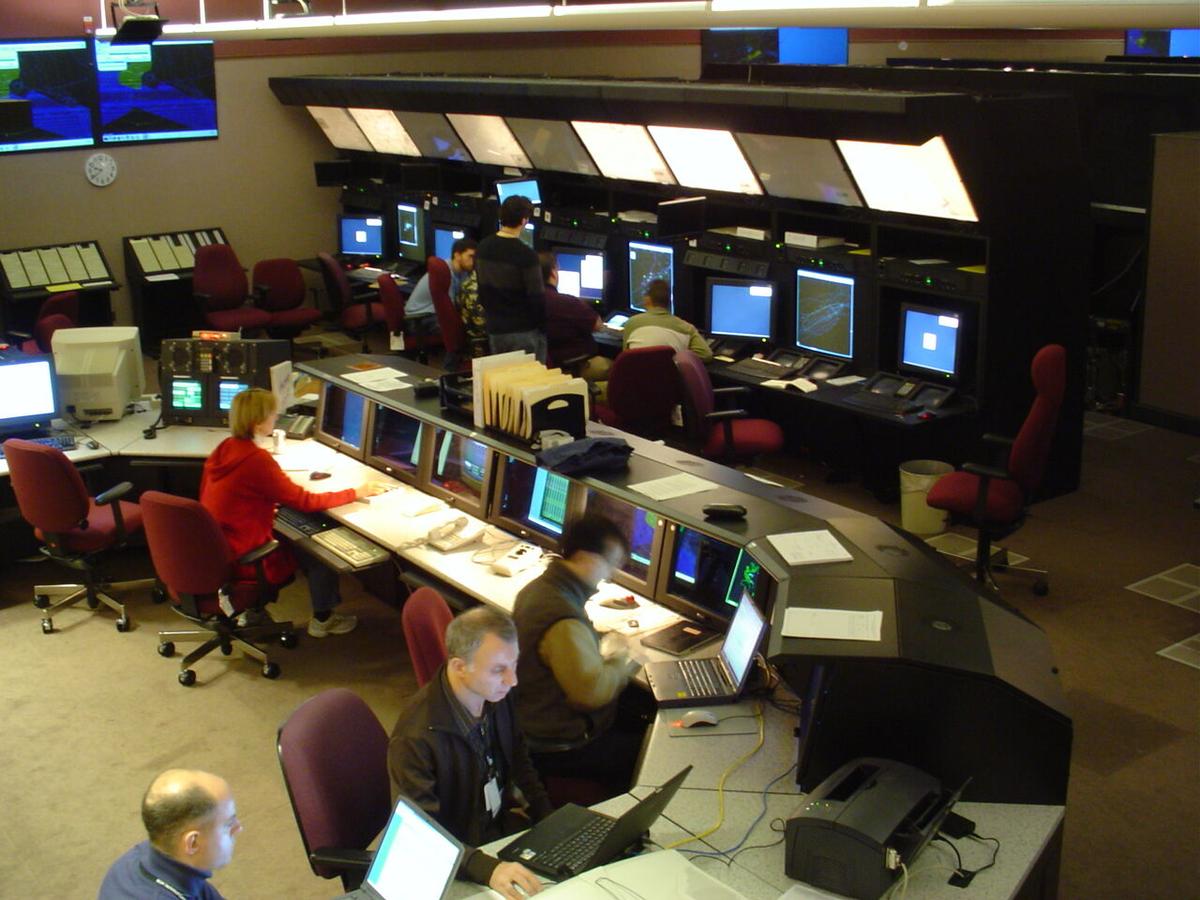 The FAA's Anchorage Air Route Traffic Control Center in March 2006. Nothing on these screens is made in this room: it all arrives over the network. Photo by the Federal Aviation Administration, public domain, via Wikimedia Commons.
Who needs to talk to whom?
The FAA calls the whole arrangement of airspace, airports, equipment and rules the National Airspace System. GAO's September 2026 report says controllers "manage up to 45,000 flights per day" in it, and counts the buildings they work in:
| Facility | How many | What it handles, in the FAA glossary's terms |
|---|---|---|
| Airport towers | 409 | Aircraft "in the vicinity of an airport" and on its runways and taxiways |
| Terminal Radar Approach Control (TRACON) | 25 standalone, plus 119 combined with a tower | Aircraft "arriving, departing, or transiting" the airspace around busy airports |
| Air Route Traffic Control Centers | 21 | Aircraft "principally during the en route phase of flight," the long cruise between airports |
Above those sits one Command Center, which the glossary says is responsible for "monitoring and managing the flow of air traffic" across the country.
A single flight is handed from tower to approach control to one center after another, then back down again. Each handoff is a message between two buildings. Each controller along the way also needs two things from outside the building.
The first is surveillance, which means knowing where the aircraft are. Radar sites send out radio pulses and listen for replies, and the result is sent on "for processing and display at an air traffic control facility," in the glossary's words.
The second is voice. A controller's radio is usually not in the room either. The glossary describes a remote communications outlet as "an unmanned communications facility remotely controlled by air traffic personnel." GAO says the FAA "relies on 42,000 radios" and uses 450 voice switches, the machines that connect a controller's headset to the right radio or telephone line.
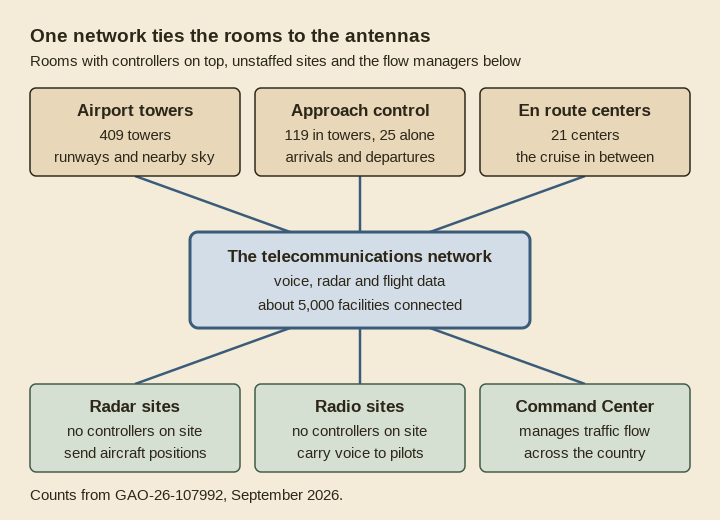 The rooms where controllers sit, the unstaffed sites that feed them, and the one network in the middle.
What is the network, and who owns it?
The network has a plain name: the FAA Telecommunications Infrastructure, or FTI. GAO describes telecommunications as "the communications backbone" of the system, "connecting approximately 5,000 FAA facilities, radars, voice systems, and flight data communications," and says the FAA gets most of those services through FTI.
FTI was itself a replacement. A 2008 Inspector General report says it was "intended to replace seven FAA-owned and -leased telecommunications networks with a single network to reduce operating costs," and calls it mission-critical because it carries "voice, radar, and flight data communications" for air traffic control.
The FAA does not own it. The same report says that "in July 2002, FAA awarded a contract to Harris Corporation" to bring FTI into service and to manage and support the network. A 2010 Inspector General letter put it this way: "FAA does not own the network," and the contract "is essentially a 15-year lease" covering the cost of "acquiring, operating, and maintaining" it. I did not find an official page that describes the contract's terms after that period, so I leave them out.
That is the first thing worth knowing. For example, a family does not own the cable that brings internet service to the house, and a hospital system does not own the fiber between its campuses. The FAA is in the same position at national scale: it buys connections as a service and depends on the networks of commercial carriers underneath.
Why does it matter what kind of line it is?
There are two broad ways to carry a signal between two buildings.
The older way is a dedicated circuit: a fixed path between two points that is reserved whether or not anything is being sent. The Inspector General's 2010 letter describes FTI services that used a technology called time division multiplexing, which requires "a circuit connection between two end points." It called those services critical because they carried the FAA's "voice and radar data information." In December 2009, by the letter's count, 19,174 of FTI's 20,982 services (91.4 percent) worked that way.
The newer way is Internet Protocol, or IP: data is cut into packets, and each packet finds its way across a shared network. The article "IP Addresses, Ports and Your Home Router" explains the idea at home scale. One point is easy to get wrong, and the Inspector General spelled it out: these services "do not use the actual Internet; they just follow similar procedures." The FAA's IP network is private.
Many of those older circuits run on copper. GAO's 2026 report lists the concerns in three short lines: "Copper cables are from the 1960s." The "technology is no longer supported by the communications providers." And incidents that stem from unsupported technology "have the most direct impact" on air traffic control. The replacement is glass. The article "Fiber Optic Internet: Light in Glass, Explained" covers how that works.
What happens when a link fails?
GAO's report describes two recent cases.
In late April 2025, a failure of "antiquated telecommunication lines and systems" at the Philadelphia TRACON, which handles the airspace around Newark, left controllers without "radar and radio contact with all inbound and outbound aircraft" at Newark Liberty International Airport "for about 90 seconds." A second outage followed in May. GAO reports that the FAA attributed the incidents to "aging infrastructure, specifically old copper wiring," and to moving Newark's airspace control to Philadelphia "without adequately testing the reliability of the commercial telecommunications lines used for critical data."
In September 2025, "a telecommunications issue led to a loss of radar, frequencies, and automation equipment" at the Dallas TRACON. GAO counts "over 1,800 flight delays and cancellations as controllers reverted to manual methods."
The defense against a single failure is a second path. The Inspector General's term for it is diversity: "adequate separation of primary and alternate services." Two lines that leave a building by different routes are diverse. Two lines that pass through the same switching center are not, whatever the paperwork says. In 2008 the Inspector General found three New York facilities whose FTI services "were all routed through a single switching center operated by a single telephone company."
What is planned to replace it?
The replacement program is called FAA Enterprise Network Services, or FENS. GAO's September 2024 report says it was started in April 2018 to provide "modern ethernet/internet protocol telecommunications infrastructure." As of May 2024 the FAA's preliminary estimate was about $2.0 billion with completion in 2038.
The schedule then changed. In May 2025 the Secretary of Transportation announced a plan the FAA calls the Brand New Air Traffic Control System. In July 2025 Congress appropriated $12.5 billion for it, including $4,750 million under the heading of telecommunications. GAO's 2026 report describes the telecommunications job as replacing "5,170 copper lines with fiber optic cable" and moving "nearly 30,000 services" to IP. The earlier target was 30 September 2030. The new one is 31 December 2028, which GAO notes is 21 months earlier.
| Replaced | 2,560 lines |
|---|---|
| Still to replace | 2,610 lines |
Source: GAO-26-107992, September 2026
Three contract facts come from official documents:
- In December 2025 the FAA awarded a prime systems integrator contract to Peraton, with a ceiling of $1.5 billion, to coordinate the 13 programs in the plan's first phase (GAO).
- In a notice posted on 12 August 2026, the FAA said it had "made a direct award" of a contract for FENS to AT&T, with a first task order of $74.3 million for "early start-up planning and development activities." The notice says the FAA "anticipates a multi-billion dollar" contract lasting "up to 15 years."
- The same notice gives the FAA's reason for not holding a competition: the current network "can no longer adequately support" operations, and a competitive procurement "would require a minimum of 22 months, making the December 2028 deadline impossible to meet."
What have the auditors said?
Both auditors have a long record on this subject. GAO's 2026 report opens its history with the words "For over four decades we have reported on challenges facing FAA's modernization" of its air traffic control systems.
The Inspector General's 2008 report records that FTI's first target date was September 2005, that it was moved to December 2007, and then to December 2008.
GAO's 2026 report supports the speed and questions the planning. It found that the FAA "has not developed a comprehensive and well-documented lifecycle cost estimate" and "has not developed an integrated master schedule." There are "11,389 individual project schedules that are not integrated," so separate crews are booked into the same sites at different times. For the three communications programs together (telecommunications, voice switches and radios), the FAA's own June 2026 estimate was $5,910 million against the $4,750 million appropriated. GAO made two recommendations, and the Department of Transportation "partially concurred" with both.
Tip
When a news story says an airport lost "radar" or "radios," check whether the equipment broke or the line to it did. In the cases GAO describes above, the trouble was in the telecommunications.
What about 13 November 2026?
On 13 November 2026 the FAA stopped departures nationwide for several hours. The site's article "FAA Nationwide Ground Stop on November 13, 2026: What We Know" records what the FAA and other officials have said about it, and it is the place to look for updates. Every document cited here was published before that day. This article does not explain that event and gives no cause for it.
What to remember
- Controllers work from screens and headsets. The radars and radios are usually somewhere else, and a telecommunications network joins them.
- That network is called FTI. GAO says it connects about 5,000 facilities. The FAA leases it as a service and does not own it.
- Much of it still runs on copper lines from the 1960s. The plan is to replace 5,170 of them with fiber and move nearly 30,000 services to IP by the end of 2028.
- As of May 2026, GAO reported 2,560 lines replaced.
- The planned successor is called FENS. The FAA announced a direct award for it in August 2026.
- GAO's standing concern is planning: no reliable cost estimate and no single integrated schedule.
To follow the work, read the next GAO report on it and the FAA's own budget documents when they come out. Each one states its figures with a date, which makes it easy to see what has changed since the last.
Sources (10)
- GAO, "Air Traffic Control Systems: Ambitious New Modernization Effort Needs to Improve Cost and Schedule Planning", GAO-26-107992, 14 September 2026
- GAO, "Air Traffic Control: FAA Actions Are Urgently Needed to Modernize Aging Systems", GAO-24-107001, September 2024 (Internet Archive copy of GAO's file)
- DOT Office of Inspector General, "FAA's Progress and Challenges in Meeting FTI Transition Goals", AV-2008-089, 30 September 2008 (Internet Archive copy)
- DOT Office of Inspector General, letter on the 19 November 2009 FTI outage, CC-2010-012, 17 June 2010 (Internet Archive copy)
- FAA, award notice "FAA Enterprise Network Services (FENS)", contract 693KA8-26-D-00016, posted 12 August 2026
- FAA, "Communications, Information, and Network Programs (CINP)", last updated 17 September 2025
- FAA, "Pilot/Controller Glossary: A" (Air Route Traffic Control Center, Command Center)
- FAA, "Pilot/Controller Glossary: R" (radar, radar approach control facility, remote communications outlet)
- FAA, "Pilot/Controller Glossary: T" (tower)
- FAA, "Air Traffic Control Facilities", last updated 13 January 2026