Articles & BlogBy Trapper W. Brown10 min readCurrent to 12 November 2026
For anyone who has seen the name Hermes next to the words "open model" or "agent" and wondered what it is. By the end you will know what it is, who makes it, how people run it, and what to think about first.
Hermes is a family of artificial intelligence (AI) language models made by a company called Nous Research, along with an agent program that carries the same name. This article is about those two things. It is not about the Greek messenger god or the JavaScript engine that shares the name.
Why should you care? Because Hermes is one of the clearer examples of a different way to use AI. Most people meet AI as a website run by a large company. A Hermes model is a file. You can download it, keep it, and run it on a computer you own, with nobody on the other end.
 An open model can run on a computer you own, with nobody on the other end of the line. Photo by Simon Hattinga Verschure, CC0, via Wikimedia Commons.
What is Hermes, and who makes it?
Nous Research describes itself on its website as "a pioneer in open AI training and research." Its releases page lists work going back to July 2023, when it published a model called Nous-Hermes-Llama2-13b. The Hermes name has been on its main line of models ever since: Hermes 2 from late 2023, Hermes 3 in August 2024, Hermes 4 on 26 August 2025, and Hermes 4.3 on 3 December 2025.
Two terms need a plain definition before going further.
A language model is a very large table of numbers that has been adjusted, by reading huge amounts of text, until it is good at predicting what words come next. Those numbers are called weights or parameters. When a model is described as "36B", it has about 36 billion of them.
An agent is a program wrapped around a model that lets it act: run commands, read files, send messages, and keep going through many steps without a person approving each one.
Nous Research makes both. The models are the Hermes family. The agent is called Hermes Agent, and it gets its own section below.
How is an open model different from a hosted assistant?
A hosted assistant lives on the maker's computers. You type, your words travel to the company, the model runs there, and the answer travels back. You never hold the model. The company can change it, limit it or withdraw it, and your conversation passes through its hands. The article AI Assistants at Work: What Not to Paste In covers what that means for private information.
An open-weight model is published as a download. Once you have the file, it runs wherever you put it. If that is your own computer, your prompts never leave the room.
Hermes models are also fine-tunes. Training a large model from nothing costs more than almost anyone can pay, so Nous Research does not start from nothing. It takes a base model that a bigger lab has already published and trains it further on its own data. The model cards on Hugging Face, the site where most open models are shared, name the base each time. Hermes 4 70B is built on Meta's Llama 3.1. Hermes 4 14B is built on Alibaba's Qwen 3. Hermes 4.3 36B is built on a 36 billion weight base model from ByteDance, published under the name Seed.
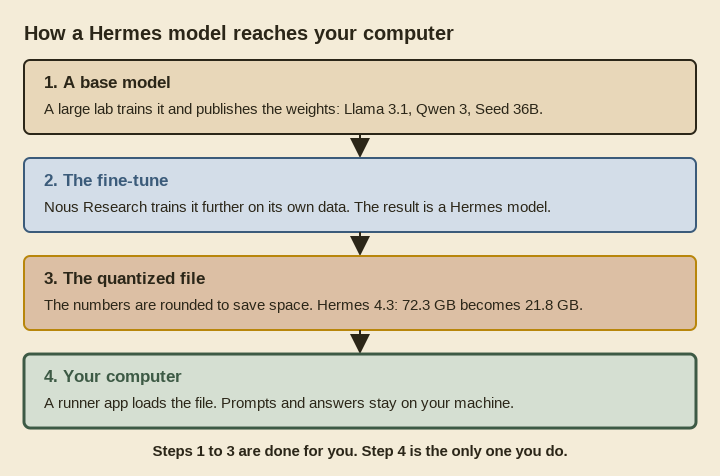 A Hermes model is someone else's base model, trained further, shrunk, and handed to you as a file.
What does the extra training change? According to the maker, mostly how the model behaves. The Hermes 4 cards describe the models as aligned to the user and claim large gains in "steerability," which means the model follows the instructions and persona you give it and refuses fewer requests. They are also "hybrid reasoning" models: they can write out their working between <think> tags before giving a final answer, or skip that step for speed.
What are the current releases?
As of 12 November 2026, the newest Hermes model on the company's releases page is still Hermes 4.3, from December 2025. The 2026 entries on that page are a coding model and the agent.
| Model | Released | Built on | License |
|---|---|---|---|
| Hermes 4 14B | 26 August 2025 | Qwen 3 14B | Apache 2.0 |
| Hermes 4 70B | 26 August 2025 | Llama 3.1 70B | Llama 3 license |
| Hermes 4 405B | 26 August 2025 | Llama 3.1 405B | Llama 3 license |
| Hermes 4.3 36B | 3 December 2025 | Seed 36B | Apache 2.0 |
The releases page says Hermes 4.3 performs near the 70B model at about half the size. That is the maker's own comparison.
How does a person actually run one?
At a high level there are three steps: get a runner app, download a model file, and type.
A runner is a free program that loads a model file and gives you a chat window. The Hermes cards name llama.cpp, Ollama and LM Studio as apps that work with the smaller files. Those are the common ones, and that list is not a ranking.
The hard part is size. Here is the arithmetic for Hermes 4.3. It has 36 billion weights. Stored at full precision, each takes 2 bytes, so the file should be about 72 gigabytes (GB). The maker's full file is 72.3 GB. Very few home computers can hold that in memory.
The fix is quantization: rounding each weight to fewer digits so the file shrinks. Quality drops a little with each step down. Nous Research publishes ready-made quantized files, and their sizes show the trade.
| Full precision | 72.3 GB |
|---|---|
| Q8 | 38.4 GB |
| Q6 | 29.7 GB |
| Q5 | 25.6 GB |
| Q4 | 21.8 GB |
| Q3 | 17.6 GB |
Source: Nous Research, Hermes-4.3-36B-GGUF file list on Hugging Face, read 12 November 2026
As a rule of thumb, the file has to fit in your computer's memory with a few gigabytes left over for the conversation. The Q4 file is 21.8 GB, so a laptop with 16 GB of memory cannot load it at all. A machine with 32 GB can, slowly. A graphics card with enough memory of its own makes it fast.
Take two examples. A family with one gaming PC wants a homework helper that keeps chats off the internet. The 36B model is out of reach. The 14B model has about 40 percent as many weights, so by the same arithmetic its Q4 file should come to roughly 8 or 9 GB, which a mid-range machine can manage. A ten-person firm wants to summarize contracts without sending them anywhere. It buys one workstation with a large graphics card, loads the 36B model, and shares it over the office network. Same family of models, very different hardware bills.
If you would sooner not run anything, the 70B card lists hosted options, including the company's own Nous Portal and Nous Chat. That is convenient, and it is also a hosted assistant again, with everything that implies.
What is Hermes Agent?
Hermes Agent is a separate product. Its page on GitHub calls it "the self-improving AI agent built by Nous Research," and the releases page dates its launch to 25 February 2026. The latest version on 12 November 2026 was 0.23.1, with release notes dated 9 November 2026.
The agent runs on your own machine or a rented server. The project's README says it keeps a memory across sessions, writes reusable "skills" for itself after finishing complex tasks, and can be reached through Telegram, Discord, Slack, WhatsApp, Signal or a command line.
One point surprises people: the agent does not need a Hermes model. The README lists Nous Portal, OpenRouter, OpenAI and custom endpoints as model sources. The agent is the hands. You choose the brain.
An agent that can run commands on your computer is a bigger step than a chat window, and the article We Are Handing AI Agents the Keys Before We Have Locks explains why. The project's own security documentation is candid about it. It describes approval prompts for dangerous commands, an option to run everything inside a container (a sealed box, explained in Virtual Machines and Containers), and a default that rejects messages from anyone you have not approved. It also says its command filters "are not a complete shell interpreter or an OS capability sandbox." In plain words: the guardrails catch accidents, and the container is the real wall.
What is it good for?
Judging from the model cards, Nous Research aims Hermes at four kinds of work.
- Private chat and writing help on your own hardware, where nothing leaves the building.
- Role-play and creative writing, where a model that holds a persona and refuses less is the point.
- Tool use. The cards describe built-in formats for calling functions and producing structured output, which is what programmers need to wire a model into software.
- Research and tinkering. Because the weights are public, anyone can study the model, test it or train it further.
What it is not: a search engine or a source of record. An open model makes things up as readily as a hosted one.
What do the licenses allow?
"Open" does not mean one thing. Each Hermes model inherits the terms of its base.
Hermes 4 14B and Hermes 4.3 36B carry the Apache 2.0 license, a standard open source license that allows commercial use. Hermes 4 70B and 405B carry Meta's Llama 3 license, which is Meta's own document with its own conditions. Hermes Agent, the program, is under the MIT license, one of the shortest and most permissive there is.
For home use the difference rarely matters. For the ten-person firm it does. My rule: before a model goes into anything you sell, read the license file that ships with it, not a summary of it.
What should you know about a less restricted model?
This is the part to read twice.
It will answer more. Hosted assistants decline some requests. Hermes is built to decline fewer. Nous Research publishes its own test, RefusalBench, and reports that Hermes 4.3 answered 74.60 percent of the test's questions in its plain mode. That is the maker's number on the maker's test, but the direction is clear. Nobody is watching the conversation, and no filter sits behind the model. Judgment about what to ask, and what to do with the answer, is yours alone.
It is still wrong sometimes, and now with nothing to stop it. A model that will discuss medication doses or legal strategy without hesitation is not a model that gets them right. Treat it as a well-read stranger, not a professional.
Think before handing one to a child. A family that sets up a local model has removed the content rules a hosted service applies. That may be fine for a teenager writing fiction. It deserves a conversation first.
Local is private only if it stays local. Prompts stay on your machine when the model runs on your machine. The moment you use a hosted Hermes, or connect the agent to a chat app, your words travel again.
Download from the source. Model files are large and tempting to grab from wherever is fastest. Take them from the NousResearch page on Hugging Face, where the cards and licenses live.
An agent reads things you did not write. A web page or email can carry hidden instructions meant for the model. Prompt Injection: The New Phishing, Aimed at the Machine covers that attack.
Watch out
The law does not change because the model is on your own computer. A less restricted model will help write things a hosted one would refuse. What you do with the output is still on you.
What to remember
- Hermes is a family of open-weight language models, plus a separate agent program, from Nous Research.
- Each Hermes model is a fine-tune: another lab's published base model, trained further to follow the user and refuse less.
- The newest model on 12 November 2026 is Hermes 4.3 36B, released 3 December 2025. Its files run from 17.6 GB to 72.3 GB.
- Licenses differ by model: Apache 2.0 for the 14B and 36B, Meta's Llama 3 license for the 70B and 405B, MIT for the agent.
- Running a model locally keeps your prompts at home. Running an agent gives software the power to act, so box it in.
- Fewer refusals means more of the judgment is yours.
If you are curious, a small model in a runner app on a spare evening is a low-risk way to see what "your own AI" feels like. Start with chat only, and leave the agent until you have read its security page.