Articles & BlogBy Trapper W. Brown6 min read
 Illustration generated for Warhawk Division.
The Centers for Disease Control and Prevention (CDC) says this year's flu season is off to an early start. Its weekly report for the week ending 31 October 2026, published 6 November, says activity "is higher than typically observed at this time of year." The CDC estimates "at least 1,700,000 illnesses, 25,000 hospitalizations, and 1,400 deaths from flu so far this season." The same report confirmed two human infections with H5 avian influenza, or bird flu, in Washington dairy workers, including one death. The CDC adds that "human-to-human transmission of avian influenza A(H5) virus (H5 bird flu) has not been identified in the United States." I am not giving medical advice here. Talk to your doctor before changing any medication.
What does the CDC's report say?
The CDC publishes a weekly report called FluView. It pulls together lab tests, doctor visits, hospital admissions and deaths. The report I am working from covers Week 43 of 2026, which ended 31 October. All of its data are, in the CDC's words, "preliminary and may change as more reports are received."
Its top line reads: "Seasonal flu activity continues to increase in many parts of the country and is higher than typically observed at this time of year."
The next sentence matters just as much, and it is the one most likely to get left out of a headline. The CDC says "an earlier increase in activity does not necessarily lead to a higher seasonal peak or greater overall severity."
On severity, the CDC's preliminary assessment rated the season so far as "low across all ages," and added that it "may change as flu activity is currently increasing."
How much flu is out there?
Here are some of the week's figures, all from the CDC's report:
- Lab tests: Clinical labs tested 51,351 specimens, and 9.1% were positive for flu.
- Hospital admissions: Hospitals reported 8,396 laboratory-confirmed flu admissions for the week, a rate of 2.5 per 100,000 people. The CDC says that was an increase from the week before.
- Doctor visits: 2.8% of outpatient visits were for flu-like illness, up from the week before but "below the national baseline of 2.9%."
- Forecast: The CDC's FluSight forecasts "predict a likely increase nationally" in flu hospital admissions and emergency visits for the week ending 21 November.
The FluSurv-NET hospital network covers parts of 14 states, about 10% of the population. Its numbers show who is landing in the hospital, and the oldest adults are far ahead.
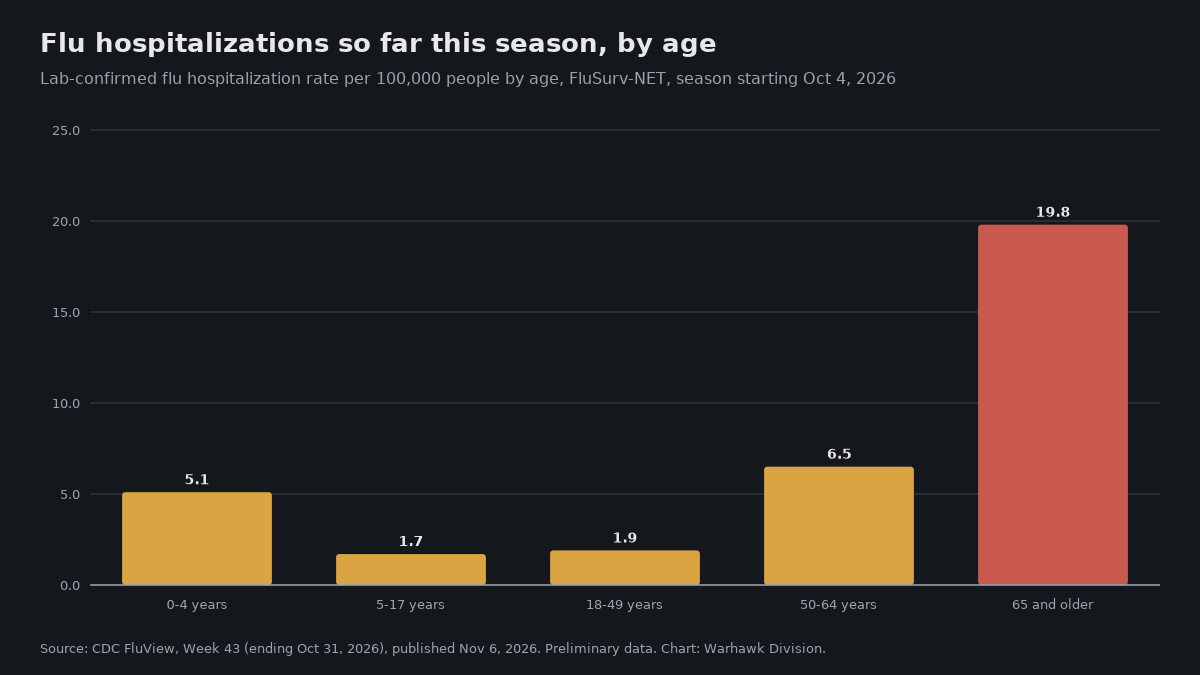 Flu hospitalization rates by age, season to date. Data: CDC FluView, Week 43 (ending 31 October 2026), published 6 November 2026. Chart by Warhawk Division.
The CDC also reported two flu-associated deaths in children for the 2026-27 season that week, bringing the season's total to three. It notes these counts "may increase" because case investigations take time.
Which flu is going around?
Nearly all of it is influenza A, and nearly all of that is one strain. Public health labs subtyped 388 influenza A viruses that week. 379 of them (97.7%) were A(H1N1)pdm09, the H1N1 strain that emerged in 2009 and has circulated every season since.
The CDC flags something new about it: "We are seeing more genetic diversity among co-circulating A(H1N1)pdm09 viruses than we have before." It also says "it is too early to know what viruses may predominate or to say whether there might be implications on flu vaccine effectiveness this season."
There is some reassuring lab data as well. The CDC tested how well antibodies against this season's vaccine strains recognize the viruses that are circulating. For H1N1, 140 of 147 viruses (95.2%) were "well-recognized." All 35 H3N2 viruses and all 33 B/Victoria viruses tested were well-recognized too. That is a lab test, not a measure of how well the vaccine works in people, and the CDC does not claim otherwise.
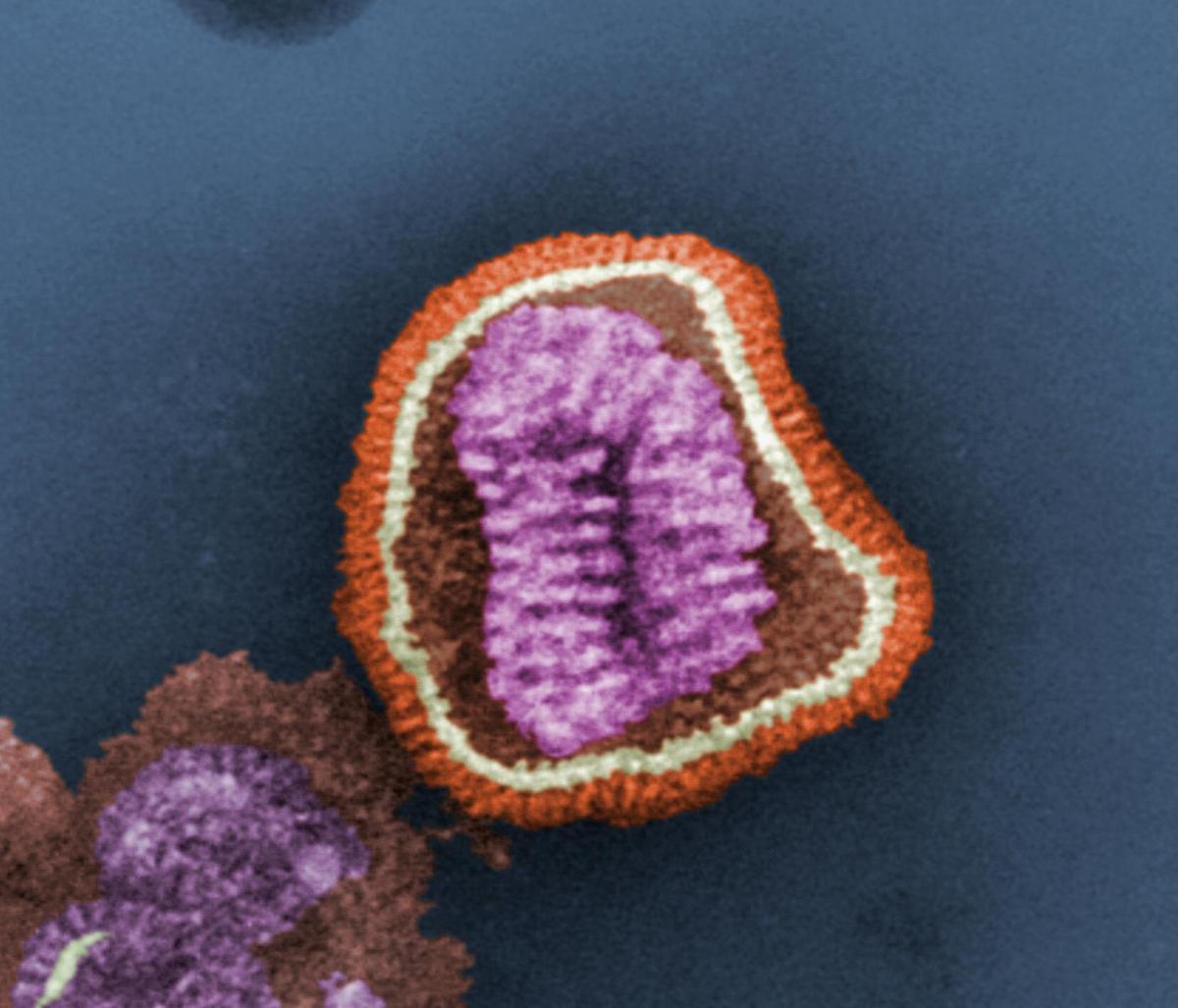 An influenza virus particle under a transmission electron microscope, colorized. Photo by Cynthia Goldsmith, CDC (content providers Dr. Erskine L. Palmer and Dr. M. L. Martin), public domain, via Wikimedia Commons.
What happened in Washington?
The same CDC report describes two confirmed human infections with avian influenza A(H5), reported by the Washington State Department of Health. According to the CDC, both were adults who worked at commercial dairy cattle farms "where highly pathogenic avian influenza (HPAI) A(H5N1) virus has been detected in cows."
The CDC gives these details:
- The first person developed respiratory symptoms during the week ending 24 October 2026, went to an emergency department the next week, was hospitalized "and has died." Testing confirmed influenza A(H5), and further testing identified it as A(H5N1).
- The second person developed conjunctivitis, an eye infection, and sought care. The state public health laboratory confirmed influenza A(H5), and the specimen was shipped to the CDC for more testing.
The CDC says there have been "a total of three influenza A(H5) cases in dairy workers in Washington." The report does not name the farms, the counties or the people, and neither will I.
Should the public be worried about bird flu?
On the evidence in the report, the key fact is the one the CDC repeats twice: human-to-human transmission of H5 "has not been identified in the United States." Both cases were in people who worked around infected cattle.
The CDC's bird flu situation page, updated 5 November 2026, says "the current public health risk is low," and that the CDC "is watching the situation carefully and working with states to monitor people with animal exposures." As of that update, it counted 74 reported human H5 cases in the United States since February 2024.
That does not make it nothing. A death is serious, and the CDC is testing further. But the official record describes a workplace exposure, not spread in the community, and I will not describe it as anything else.
What to do
These steps restate what the CDC says. They are not personal medical advice.
- Vaccination: The CDC says annual flu vaccination is recommended for people 6 months and older, and that those who have not been vaccinated "are encouraged to be vaccinated now." Ask your doctor or pharmacist what is right for you.
- Antivirals: The CDC notes there are prescription flu antivirals that "should be started as early as possible," and that they are "especially important for patients at higher risk for influenza complications." If you get sick, call your doctor early. Talk to your doctor before changing any medication.
- Older adults and young children: The hospitalization numbers above show who is most at risk. If that is you or someone you care for, plan ahead.
- Farm and dairy workers: The CDC publishes interim recommendations for people exposed to H5 at its bird flu pages, listed below.
- Stay current: FluView updates weekly. Do not rely on a number that is a month old, including the ones in this article.
Where I land
- Flu is running ahead of the usual calendar. The CDC is explicit that early does not necessarily mean worse.
- The season's severity is rated "low" so far, and adults 65 and older are being hospitalized at the highest rate.
- Two H5 cases in Washington dairy workers, one fatal, are serious. The CDC says it has found no person-to-person spread.
- The strain picture is still forming, and the CDC says it is too early to judge vaccine effectiveness.
The best thing I can do with a report like this is quote it accurately and refuse to inflate it. The flu is early. Bird flu is being watched closely. Neither is a reason for panic, and both are a reason to pay attention.
Sources (4)
- CDC, "Weekly US Influenza Surveillance Report: Key Updates for Week 43, ending October 31, 2026," published 6 November 2026: https://www.cdc.gov/fluview/surveillance/2026-week-43.html
- CDC, H5 Bird Flu: Current Situation: https://www.cdc.gov/bird-flu/situation-summary/index.html
- CDC, Avian Influenza (Bird Flu): https://www.cdc.gov/bird-flu/
- CDC, Influenza (Flu): https://www.cdc.gov/flu/