Articles & BlogBy Trapper W. Brown10 min readBoth sides
Dimming the sun is a nickname for solar geoengineering: cooling the planet on purpose by bouncing a small share of incoming sunlight back into space. Nobody would touch the sun. The idea is to make the Earth slightly more reflective, most often by spraying tiny particles high in the atmosphere. Scientists also call it solar radiation modification, or SRM.
Why should you care? Because it is one of the few ideas that could lower global temperatures within years, because it would affect everyone on Earth whether or not they agreed to it, and because governments are now funding research on it, banning it, or both. The World Meteorological Organization (WMO) puts 2024 at about 1.55°C above the 1850 to 1900 average and 2025 at about 1.43°C. Whether a sunshade belongs in the answer is a live argument. This guide lays out both sides and does not pick one.
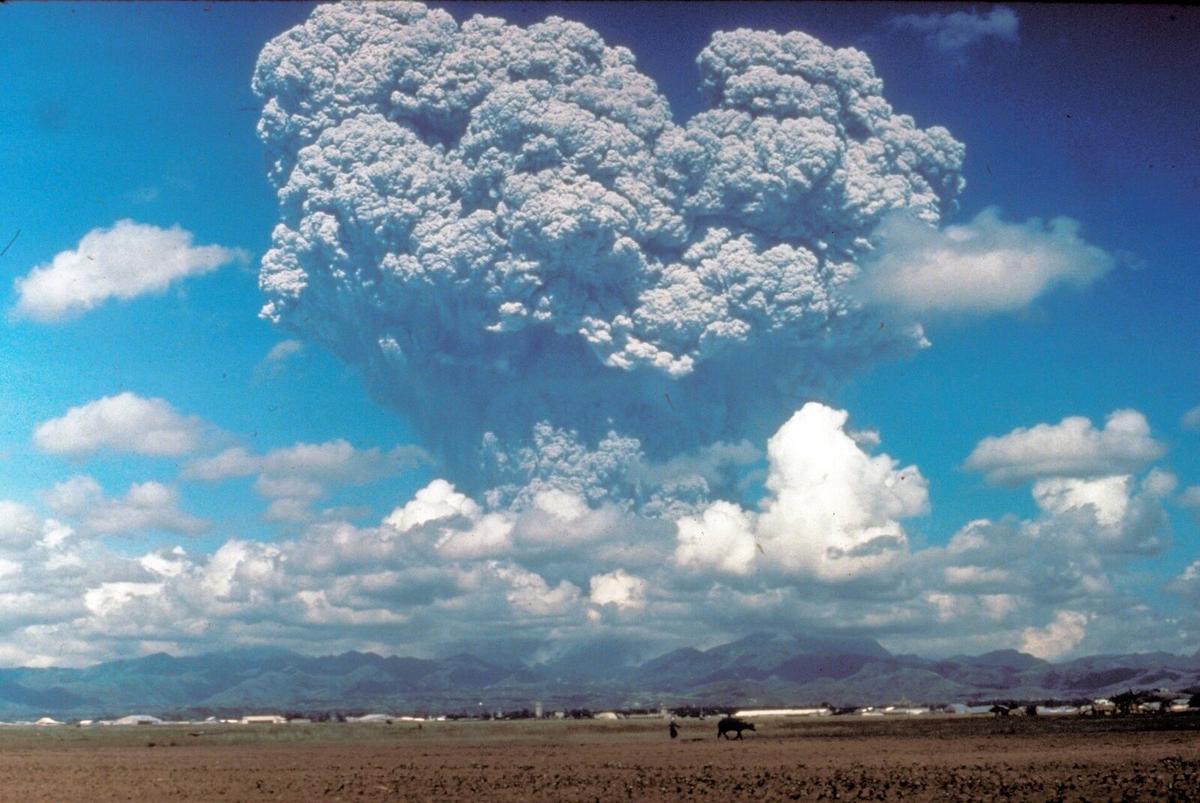 The eruption column of Mount Pinatubo in the Philippines on 12 June 1991, the natural event that showed particles in the upper air can cool the planet. Photo by Dave Harlow, U.S. Geological Survey, public domain, via Wikimedia Commons.
How would you dim the sun?
A March 2026 summary from the U.S. Government Accountability Office (GAO), the research arm of Congress, describes the two methods that get the most attention.
Stratospheric aerosol injection. Aircraft would release small particles or gases, such as sulfur dioxide, into the stratosphere, the calm layer of air above the weather. There the gas forms a thin haze of droplets that reflects some sunlight before it reaches the ground.
Marine cloud brightening. Ships would spray fine sea salt into low clouds over the ocean. More particles make more and smaller cloud droplets, and a cloud of small droplets is whiter and reflects more light.
Neither method removes any carbon dioxide (CO2), the main gas warming the planet. They treat the temperature and leave the cause in place.
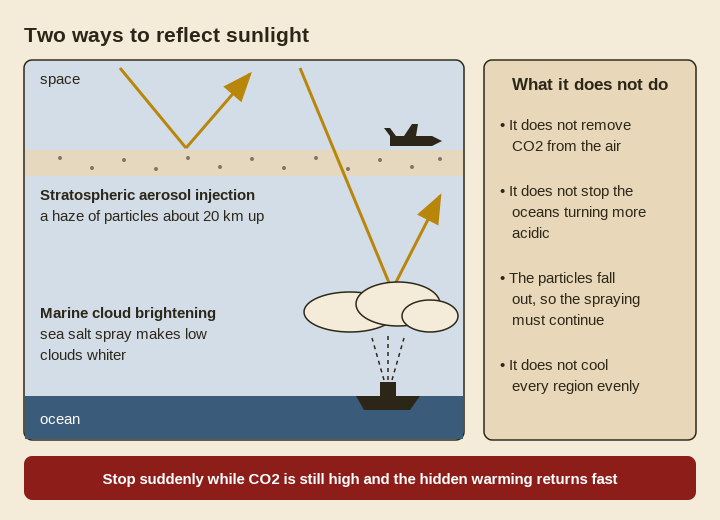 Both methods reflect a little sunlight before it warms the surface, and neither touches the carbon dioxide that causes the warming.
What did a volcano already show?
Nature has run the experiment. In June 1991 Mount Pinatubo in the Philippines erupted. The U.S. Geological Survey (USGS) says the eruptions put nearly 20 million tons of sulfur dioxide into the stratosphere, and that as the gas cloud spread around the world, global temperatures dropped by about 0.5°C (about 1°F) from 1991 through 1993.
Two lessons come out of that. The first is that the physics works: sulfur in the stratosphere cools the planet, and fast. The second is that it does not last. The haze fell out and the cooling faded: the USGS dates it to 1991 through 1993. A deliberate program would have to keep spraying, year after year, for as long as the cooling was wanted. GAO puts it this way: deployment "would therefore require a long-term commitment."
What would it cost, and how big is anything done so far?
The best-known cost study is a 2018 peer-reviewed paper in Environmental Research Letters by Wake Smith and Gernot Wagner. It modeled a program that would offset half of the growth in human-caused warming, and found:
- No existing aircraft can carry the load to about 20 kilometers, so a new high-altitude tanker would have to be built. Development: roughly $2 billion for the airframe and $350 million for engines.
- About 4,000 flights in the first year, rising by about 4,000 a year. By year 15 that is 60,000 flights a year, and 480,000 flights in total.
- An average cost of about $2.25 billion a year over the first 15 years, or roughly $34 billion in all.
For a sense of scale, compare one company and one volcano. The U.S. Environmental Protection Agency (EPA) says a startup that launches balloons filled with sulfur dioxide reported releasing about 0.1 tons into the stratosphere as of May 2025. Pinatubo released nearly 20 million tons. The volcano's dose was about 200 million times larger. What has been done on purpose so far is, in climate terms, nothing.
The low price is used by both sides. To supporters, $2.25 billion a year is small next to the cost of climate damage. To opponents, it is small enough that one country, or one very rich person, could afford to try. The paper's authors add a point that bears on that fear: a program needing thousands of flights a year would be hard to keep secret.
What is the strongest case for studying it, and perhaps using it?
It is the only known lever that works fast. Cutting emissions is slow work. The Intergovernmental Panel on Climate Change (IPCC), the United Nations body that assesses climate science, wrote in its 2023 synthesis report that SRM "has the potential to offset warming within one or two decades and ameliorate some climate hazards." Supporters argue that heat waves, storms and crop losses fall hardest on poor countries that did little to cause them, and that refusing even to study a tool that could blunt those harms is itself a choice with victims.
Ignorance is the worst position to decide from. A 2021 report from the U.S. National Academies of Sciences, Engineering, and Medicine recommended a federal research program of $100 million to $200 million over five years, while stressing that solar geoengineering "is not a substitute for reducing greenhouse gas emissions." A 2023 White House science office report to Congress, quoted on EPA's site, concluded that research would help the country judge the risks and benefits and prepare for possible deployment by others. An open letter from climate scientists dated 27 February 2023 said current knowledge "is not sufficient to detect, attribute or project" the consequences. The argument: someone may try this in a crisis, and the world should know what it does before that day.
Research is not deployment. Britain's Advanced Research and Invention Agency is running a £56.8 million program whose stated aim is to find out whether such approaches "could ever be feasible, scalable, safe, and governable." Supporters say that small, supervised experiments with public results are how a risky idea is tested, or ruled out.
We already do it by accident. The same scientists' letter notes that air pollution particles cool the planet, and that cleaning up that pollution for health reasons is removing some of that cooling. On this view the question is whether to manage an effect humans already have.
What is the strongest case against?
It treats the fever and leaves the infection. The IPCC is blunt: SRM "would not stop atmospheric CO2 concentrations from increasing nor reduce resulting ocean acidification." The seas would keep turning more acidic, and the underlying problem would grow behind the shade.
Stopping could be worse than never starting. If the spraying halted, through war, a pandemic, a budget fight or a change of government, the masked warming would return quickly. The IPCC says "a sudden and sustained termination of SRM in a high CO2 emissions scenario would cause rapid climate change," and attaches high confidence to that. Critics call it a commitment that binds people centuries from now.
The cooling would not be even. The IPCC expects "substantial residual or overcompensating climate change" at regional and seasonal scales. GAO lists changes in rain and snowfall patterns and damage to the ozone layer among the possible harms, and says they are "poorly understood." A change that helps one region could hurt another's rainfall, and nobody could prove afterward which drought was natural.
Nobody is in charge of the thermostat. GAO says there is "no international consensus on how to regulate use of or coordinate research on solar geoengineering," and that its effects "are almost certain to cross state or international boundaries." The IPCC warns that deployment by a few states "could create international tensions." An open letter from academics calling for an International Non-Use Agreement argues that deployment "cannot be governed globally in a fair, inclusive, and effective manner," and asks governments to refuse public funding and ban outdoor experiments.
It could weaken the will to cut emissions. If leaders believe a cheap fix is waiting, the hard work of cutting CO2 may slow. The United Nations Environment Programme said in a May 2026 working paper that current science "does not support SRM as a viable response to climate change," and urged that the topic not divert attention from cutting emissions and adapting.
Who is doing what in 2026?
| Who | What they have done | When |
|---|---|---|
| Convention on Biological Diversity | Parties agreed that no geoengineering that may affect biodiversity should take place, except small-scale research in a controlled setting | 2010 |
| U.S. Congress | Has passed no law solely about solar geoengineering, EPA says. A 1972 law requires a report to the weather agency NOAA 10 days before any weather modification | EPA page dated April 2026 |
| NOAA | The only federal agency funded to study it, since fiscal year 2020. GAO found 4 of 1,084 filed reports described solar geoengineering, on a form little changed since 1974 | February 2026 |
| Tennessee | Prohibited releasing chemicals into the air to affect temperature, weather or the intensity of sunlight | In effect 1 July 2024 |
| Florida | Prohibited acts intended to affect temperature, weather or the intensity of sunlight | In effect 1 July 2025 |
| Other U.S. states | 3 had banned weather modification and 29 more had proposed some form of ban, GAO found | July 2025 |
| United Kingdom | Funding a £56.8 million research program that includes a small number of controlled outdoor experiments | Under way |
| Private companies | GAO says one company received $75 million to develop and test aircraft-based aerosol technology | 2025 |
The same idea is being funded in one country and outlawed in parts of another, with no treaty that settles who may do what.
What is known, what is disputed, and what can facts not settle?
Known. Sulfur particles in the stratosphere cool the planet; Pinatubo measured it. The effect fades in a year or two without resupply. SRM does nothing about CO2 or ocean acidity. The direct cost is small by the standards of governments.
Disputed. How rainfall, monsoons and the ozone layer would respond to a deliberate, sustained program, since a single eruption is a short test. Whether small outdoor experiments can answer those questions or only large ones can. Whether the prospect of a sunshade would in practice slow emissions cuts. Whether a ban stops reckless actors or only careful ones.
Value judgments. Who has the right to set the planet's temperature, and who answers for a failed harvest. Whether a known harm from warming outweighs an uncertain harm from intervening. Whether it is fair to hand future generations a system they must keep running. Whether studying a thing makes using it more likely, and whether that is a reason not to study it.
What to remember
- Both sides agree that the physics is real: a volcano cooled the Earth by about 0.5°C for about two years.
- Both sides agree that it would not remove CO2, would not stop ocean acidification, and is no substitute for cutting emissions.
- Both sides agree that stopping suddenly would be dangerous and that no international rules exist.
- They divide on research: one side says knowledge is the safeguard, the other says research builds the road to use.
- They divide on risk: whether the dangers of a hotter planet are worse than the dangers of managing sunlight.
- They divide on governance: whether fair worldwide control is possible at all.
The next round of this argument will come from the research programs now running, the state laws now in force, and whatever the United Nations bodies do with their own reports. The site's guide "Why Nuclear Power Is the Best Choice, and What the Real Risks Are" covers one of the ways to cut the emissions that every party to this debate says must fall.
Sources (16)
- World Meteorological Organization, "WMO confirms 2024 as warmest year on record at about 1.55°C above pre-industrial level", 10 January 2025
- World Meteorological Organization, State of the Global Climate 2025 release, March 2026
- GAO-26-108837, "Science & Tech Spotlight: Solar Geoengineering", 24 March 2026
- U.S. Geological Survey, Fact Sheet 113-97, "The Cataclysmic 1991 Eruption of Mount Pinatubo, Philippines"
- Smith and Wagner, Environmental Research Letters, 23 November 2018
- EPA, "Government Action" page on geoengineering, 3 April 2026
- IPCC, "AR6 Synthesis Report, Longer Report", 2023
- National Academies, news release on solar geoengineering research, 25 March 2021
- "Letter of support for research on atmospheric aerosols and their potential to increase the reflection of sunlight", open letter, 27 February 2023
- ARIA (UK), "Exploring Climate Cooling"
- Solar Geoengineering Non-Use Agreement, open letter
- UN Environment Programme, "Solar Radiation Modification: Scientific evidence does not support SRM as a viable climate solution", May 2026
- Convention on Biological Diversity, COP 10 decision X/33, 2010
- GAO-26-108013, "Weather Modification: NOAA Should Strengthen Oversight", 23 February 2026
- Tennessee Public Chapter 709, 2024
- Florida CS/CS/SB 56 (2025), Chapter 2025-157