Articles & BlogBy Trapper W. Brown12 min readBoth sides
In June 2013 a contractor working for the National Security Agency (NSA), the American agency that collects foreign electronic communications, gave reporters a large set of classified files. His name is Edward Snowden. Some people call him a whistleblower, meaning a person who exposes wrongdoing from the inside. Others call him a leaker, meaning a person who hands out secrets with no right to do so. The two words lead to very different legal results, and the argument over which one fits has run for thirteen years.
Why should you care? Because the question is bigger than one man. Every government keeps secrets, and every government sometimes breaks its own rules in secret. A country has to decide who may reveal that, to whom, and what happens to the person afterward. This piece lays out what the law says, what the official reviews and the courts found, and the strongest case on each side. It does not pick one.
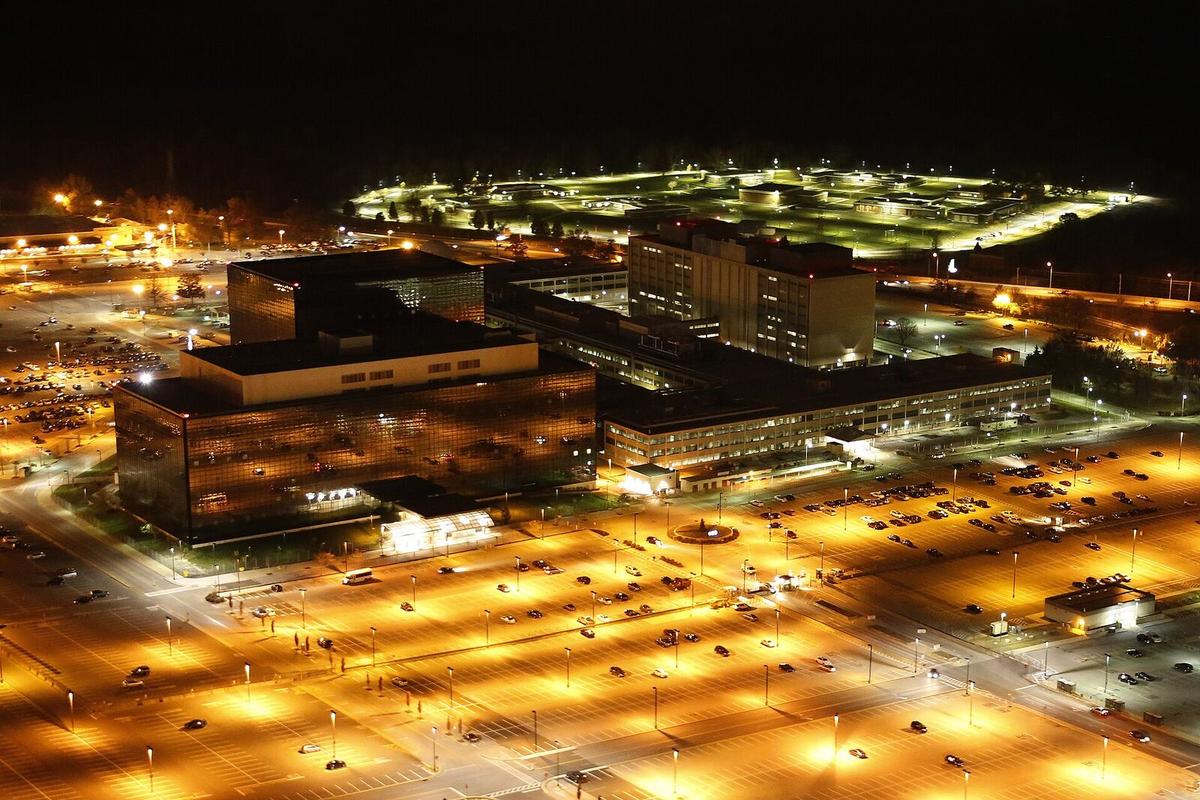 The National Security Agency, photographed from the air in 2013, the year its files reached the press. Photo by Trevor Paglen, CC0, via Wikimedia Commons.
What happened, according to the record?
Start with the documents nobody disputes.
A federal appeals court summarized the event in 2020. In United States v. Moalin, the Ninth Circuit wrote that in June 2013 Snowden "made public the existence of NSA data collection programs." One of them gathered telephone records in bulk from phone companies. The records were metadata: who called whom, when and for how long. They did not include what was said.
A one-page criminal complaint, dated 14 June 2013 and filed in the federal court for the Eastern District of Virginia, lists three charges: theft of government property, unauthorized communication of national defense information, and willful communication of classified communications intelligence to an unauthorized person. The last two come from the Espionage Act of 1917 and a companion law, and each carries up to ten years in prison. A complaint is an accusation. No court has tried it. In October 2020 the Justice Department still referred to "the criminal charges brought against Snowden for his alleged disclosures." A 2016 review by the House Intelligence Committee places him in Moscow.
There was also a civil case. In September 2020 the same Virginia court entered a judgment of more than $5.2 million against him, because he published a memoir and gave speeches without the review his secrecy agreements required. The government did not try to stop the book. It took the proceeds, relying on a 1980 Supreme Court case, Snepp v. United States.
What does the law call a whistleblower?
Federal law draws its line by route. What matters is who you told. Whether you were right comes second.
| Route | Who hears it | What the law says |
|---|---|---|
| Inside channel | A supervisor in the chain of command, the agency head, an inspector general, the Director of National Intelligence | 50 U.S.C. 3234 bars reprisal for a lawful disclosure the person reasonably believes shows a violation of law, mismanagement, a gross waste of funds, an abuse of authority or a substantial danger to public safety |
| Congress | The intelligence committees, reached through the inspector general | 50 U.S.C. 3033 lets a person with an "urgent concern" report it to the Intelligence Community Inspector General on the way to Congress |
| Press or public, unclassified facts | Anyone | 5 U.S.C. 2302 protects federal workers outside the intelligence agencies, but only if the disclosure is not barred by law and the information is not ordered kept secret |
| Press or public, classified facts | Anyone | No protection. 18 U.S.C. 793(d) makes it a crime to willfully communicate national defense information "to any person not entitled to receive it" |
Read the last row again. The text of section 793 asks whether the act was willful. It contains no exception for a good motive or for information the public arguably needed.
So in the law's vocabulary, a whistleblower is a person who takes a reasonable belief about wrongdoing to an authorized listener. A person who takes the same belief to a newspaper is not one, however accurate the belief turns out to be.
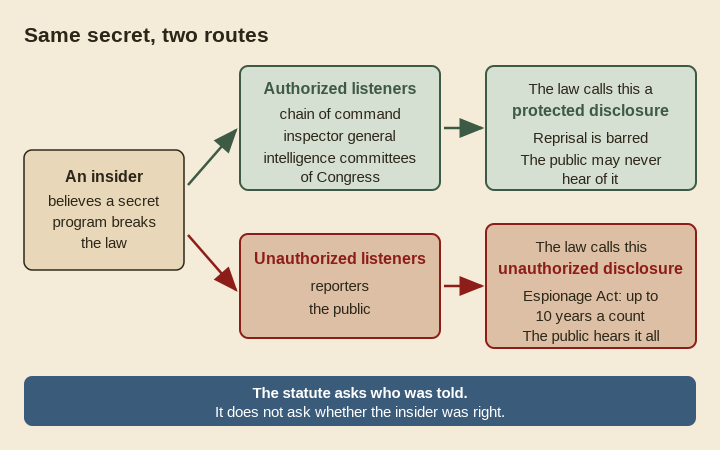 The legal line follows the route a disclosure takes, not what it reveals.
A paired example helps. In July 2023 a former intelligence officer named David Grusch told a House subcommittee that he had become a whistleblower "through a PPD-19 Urgent Concern filing with the Intelligence Community Inspector General." He then testified in public about claims he said he could detail only in a closed room. That is the inside route. Another piece in this set, "UAP Hearings: What Was Said Under Oath, and What Was Not," covers what he said. Snowden took the other route.
Did Snowden have a protected route?
Here the two sides read the same record differently.
His account comes from written testimony he gave the European Parliament in March 2014. He wrote that he "had reported these clearly problematic programs to more than ten distinct officials," that as a contractor "I was not protected by US whistleblower laws," and that people in his position "were left with no proper channels."
The House Intelligence Committee's 2016 review says the opposite. It "found no evidence that Snowden attempted to communicate concerns about the legality or morality of intelligence activities to any officials." It records one contact with an internal oversight office, about "his personal difficulty understanding the safeguards." Its legal conclusion is that he "did not use whistleblower procedures under either law or regulation" and so "is not considered a whistleblower under current law."
The statute books give each side something. The reprisal protection in 50 U.S.C. 3234 was created by a law signed in July 2014, a year after the disclosures, and the words "contractor employee" were added in January 2018. The presidential directive on the subject that existed in 2013, known as PPD-19, speaks of employees. On the other hand, the urgent concern procedure, as it reads today, names "an employee of a contractor to the intelligence community" among the people who may use it, and the committee's position is that procedures existed and went unused.
A panel appointed by the President, reporting in December 2013, managed to say both things in one paragraph. An employee or contractor "should not take it upon himself to decide on his own to 'leak' classified information." And the channels for raising concerns exist but "can certainly be strengthened and made more accessible."
What did the reviews and courts say about the program?
Four official findings deal with the phone records program.
- The privacy board. In January 2014 the Privacy and Civil Liberties Oversight Board, an independent federal agency, reported that the program "lacks a viable legal foundation." It added that "we have not identified a single instance involving a threat to the United States in which the program made a concrete difference in the outcome of a counterterrorism investigation." Two members wrote separately. One, Rachel Brand, dissented from the call to shut the program down "without establishing an adequate alternative."
- The President's panel. It found the phone data "was not essential to preventing attacks" and could have been obtained in time with ordinary court orders.
- The Second Circuit. In ACLU v. Clapper, decided in May 2015, the appeals court held that the program "exceeds the scope of what Congress has authorized." It did not reach the constitutional question.
- The Ninth Circuit. In Moalin, the court held that the collection violated the surveillance statute and "may have violated the Fourth Amendment." It upheld the convictions anyway, because the phone data did not taint the trial evidence.
In June 2015 Congress passed the USA FREEDOM Act, which in the Ninth Circuit's words "effectively ended" bulk collection of phone records.
None of these rulings is about Snowden. They judged the program. No court has ruled on whether exposing it was justified.
What did the reviews say about the harm?
The House committee's review is the main public source, and it is blunt. It says "the vast majority of documents Snowden removed were unrelated to electronic surveillance or any issues associated with privacy and civil liberties," and that they dealt with military, defense and intelligence programs. It cites a Defense Department review that had, by June 2016, identified 13 high-risk issues, and warns that if the Russian or Chinese governments have the material, "American troops will be at greater risk in any future conflict."
There is a limit that cuts both ways. The damage assessments are classified. A reader cannot check the committee's summary against them, and cannot check a denial against them either.
What is the best case for each word?
The case for whistleblower. The program he exposed was unlawful. That is the holding of two federal appeals courts and the view of the government's own privacy board, and none of them reached that conclusion until the files were public. The privacy board records that a secret court first approved the program in May 2006, so the authorized listeners already knew and had allowed it. Telling them again would have changed nothing.
The law that now shields intelligence contractors from reprisal did not name contractors until 2018. The official reviews found the program had made no concrete difference in any terrorism case. Congress then rewrote the statute. On this view the test of a whistleblower is what the disclosure revealed and what it changed, and by that test the record is strong.
The case for leaker. The law defines the word, and he does not meet the definition. The privacy board itself wrote that the program had been run "in good faith" under a court's oversight, which is not the cover-up the word whistleblower suggests. The House committee found no evidence that he raised a concern with anyone, and a procedure for reaching Congress existed. He removed far more than the files about the phone program, and the committee says most of what he took concerned military and intelligence work with no link to privacy.
A secrecy system cannot run on each cleared person's private judgment about what the public should see, and the President's panel said so. He has not put his justification before a jury. On this view the test is the route and the scale, and by that test the record is just as strong.
How have other cases ended?
Motive varies a great deal from case to case. The statute is the same for all of them.
| Person | What the Justice Department said happened | Result |
|---|---|---|
| Reality Winner | A contractor printed one top secret report and mailed it to a news outlet | Guilty plea. 63 months in prison, August 2018 |
| Jack Teixeira | An Air National Guard member posted hundreds of pages of classified documents on a social media platform | Guilty plea to six counts. 15 years in prison, November 2024 |
| Edward Snowden | Charged by complaint in June 2013 | Not tried |
One older case marks the edge of the question. In 1971, in New York Times Co. v. United States, the Supreme Court refused to stop newspapers from printing a leaked classified history of the Vietnam War, citing the "heavy presumption" against government orders that block publication in advance. That ruling protected the publishers. It did not decide what the law could do to the person who gave them the papers.
Where is the line?
People draw it in three places.
By route. A whistleblower uses the channels. This is the law's line. It is clear and it can be applied before anyone knows who was right. Its weakness shows when the channels themselves approved the conduct.
By content. A whistleblower reveals real wrongdoing and no more than is needed to show it. This is the line many people use in ordinary speech. It fits the phone records program. It fits less well with a large set of files on other subjects.
By conduct afterward. A whistleblower accepts the legal process. For example, Winner pleaded guilty and was sentenced. Others answer that a trial under section 793 does not weigh motive, so it offers no forum for the defense a whistleblower would want to make.
What facts can settle: what the statutes say, what the courts held, what the reviews found. What stays disputed: whether he raised concerns inside, and how much damage the other documents did. What facts cannot settle: whether breaking a secrecy law is ever right when the secret is itself unlawful, and who gets to decide that.
What to remember
- Both sides accept that he gave classified files to reporters, that he is charged under the Espionage Act, and that no court has tried the charges.
- Both sides accept that two appeals courts later found the phone records program unlawful and that Congress ended bulk collection in 2015.
- They disagree on a fact: whether he tried inside channels first. He says he told more than ten officials. The House committee says it found no evidence of that.
- They disagree on scale: whether the files beyond the phone program were needed to make the point, and what harm they did. The assessments are classified.
- They disagree on a value: whether a whistleblower is defined by the route taken or by what was revealed.
- The statute uses the route. Ordinary speech often uses the content. Much of the argument is two groups using one word for two different tests.
The next time the word comes up, about this case or a newer one, a useful first question is which of the three lines the speaker is using. The statutes, rulings and reviews named above are all public, and each one can be read in full.
Sources (19)
- United States v. Moalin, 9th Cir., 2 September 2020
- United States v. Edward J. Snowden, E.D. Va., criminal complaint, 14 June 2013
- 18 U.S.C. 793
- 18 U.S.C. 798
- U.S. Department of Justice, "United States Obtains Final Judgment and Permanent Injunction Against Edward Snowden", 1 October 2020
- House Permanent Select Committee on Intelligence, "Review of Edward Snowden Disclosures", highlights
- Supreme Court of the United States, Snepp v. United States, 444 U.S. 507 (1980)
- 50 U.S.C. 3234
- 50 U.S.C. 3033
- 5 U.S.C. 2302
- David Grusch, written statement to the House Oversight Committee, 26 July 2023
- Edward Snowden, written testimony to the European Parliament LIBE committee, March 2014
- The White House, Presidential Policy Directive 19, "Protecting Whistleblowers with Access to Classified Information", 10 October 2012
- Privacy and Civil Liberties Oversight Board, "Report on the Telephone Records Program Conducted under Section 215", 23 January 2014
- President's Review Group on Intelligence and Communications Technologies, "Liberty and Security in a Changing World", 12 December 2013
- ACLU v. Clapper, 2d Cir., 7 May 2015
- U.S. Department of Justice, "Federal Government Contractor Sentenced for Removing and Transmitting Classified Materials to a News Outlet", 23 August 2018
- U.S. Department of Justice, "Former Air National Guardsman Sentenced to 15 Years in Prison for Unlawfully Disclosing Classified", 12 November 2024
- Supreme Court of the United States, New York Times Co. v. United States, 403 U.S. 713 (1971)