Articles & BlogBy Trapper W. Brown10 min readCurrent to 12 November 2026
When a hurricane or a flood makes the news, the letters FEMA follow within the hour. Many people picture a federal rescue force that rolls into town and takes over. That picture is wrong in ways that matter to your household.
FEMA is the Federal Emergency Management Agency. Its own page gives the mission as "helping people before, during and after disasters." In practice it mostly coordinates federal help and pays for part of it. It does not run your town's fire trucks, it does not replace your insurance, and it arrives only after a formal request. This guide explains how the system is layered, what a household can really receive, how to apply and appeal, and how to spot people pretending to be FEMA. It reports the agency's status as official pages and the Congressional Research Service (CRS, the research office of Congress) describe it as of 12 November 2026.
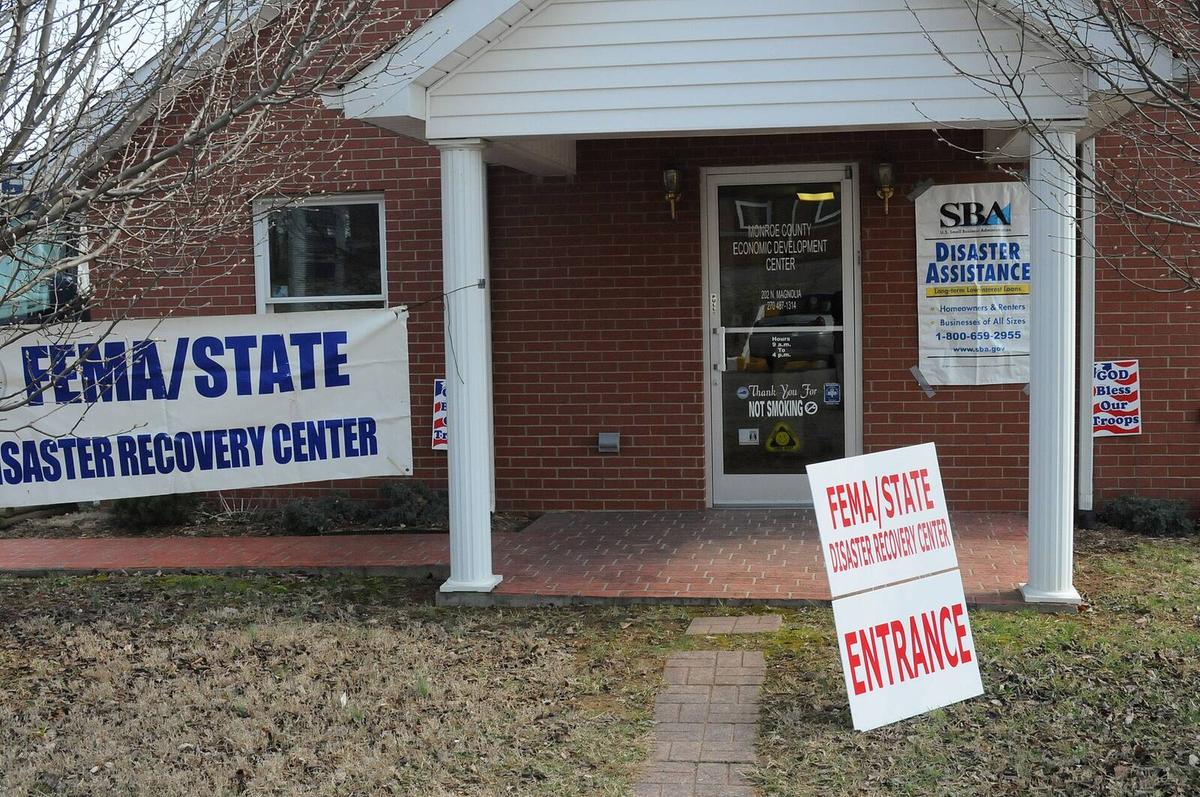 A Disaster Recovery Center in Tompkinsville, Kentucky, in March 2008, where FEMA, the state and the Small Business Administration shared one front door. Photo by George Armstrong, FEMA, public domain, via Wikimedia Commons.
Who shows up first?
Your own town does. CRS describes American emergency management as a "bottom-up" approach. The first people on scene are local: firefighters, police, paramedics and public works crews.
When a town or county runs out of people or equipment, it turns to the state. The governor can declare a state emergency, send state crews and the National Guard, and ask other states for help.
The federal layer comes in only when the damage is beyond what the state and its local governments can handle. FEMA's page on how a disaster gets declared (last updated 29 July 2025) gives the order. State and FEMA staff do a joint Preliminary Damage Assessment, which is a count of what was lost. The governor, or the chief executive of a federally recognized tribe, then sends a request to the President through the FEMA regional office. The page is blunt about who decides: declarations "are made solely at the discretion of the President." If the answer is no, the governor has 30 days to appeal.
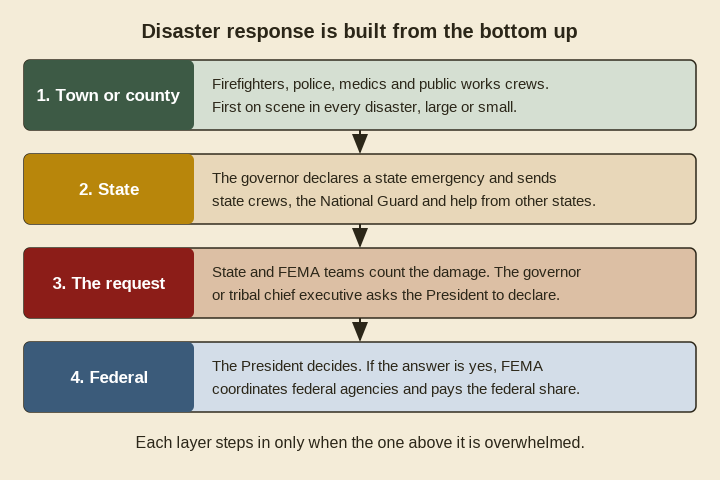 Federal help is the fourth step, not the first.
What does a declaration unlock?
The law behind all of this is the Robert T. Stafford Disaster Relief and Emergency Assistance Act, known as the Stafford Act. It allows two kinds of presidential declaration, and they open very different doors.
| Emergency declaration | Major disaster declaration | |
|---|---|---|
| What it is for | Adding federal help to protect lives and property. It can come before a storm lands. | Damage beyond what the state and local governments can handle. |
| Money limit | $5 million for a single emergency, unless the President reports to Congress | No fixed cap |
| Help for households | Limited: crisis counseling and, rarely, household grants | Individual Assistance can be turned on |
| Help for governments | Debris removal and emergency protective measures only | All Public Assistance categories, including rebuilding, plus hazard mitigation |
Two details catch people out. FEMA's page says "Not all programs are activated for every disaster." And declarations name specific counties, so check your own address at DisasterAssistance.gov.
What FEMA does, and what it does not
It coordinates federal agencies under one plan, and it pays grants. The largest stream goes to governments, not to people. Public Assistance pays state, tribal, territorial and local governments, and certain private nonprofits, for debris removal, emergency protective measures and rebuilding public facilities such as roads and water plants. The federal share is generally 75 percent. The state or town covers the rest.
Here is what it does not do:
- It is not the first responder. Rescue is local.
- It does not replace insurance. FEMA's page on household aid says the program "is not a substitute for insurance and cannot compensate for all losses caused by a disaster."
- It cannot pay twice. If insurance or another source already covered a loss, FEMA will not cover it again.
What can a household actually receive?
Help for people is called Individual Assistance. Its main piece is the Individuals and Households Program. FEMA's page (last updated 28 July 2026) lists what it may pay for: temporary housing such as rent or hotel costs, repair or replacement of a home you own and live in, a temporary housing unit when there is nothing to rent, and other uninsured expenses and serious needs.
The amounts have a ceiling, set each year. A notice in the Federal Register on 6 November 2026 puts the maximum at $46,400 for housing assistance and $46,400 for other needs, for disasters declared on or after 1 October 2026. A second notice the same day sets Serious Needs Assistance, a flat award inside the same program, at $820.
Those are ceilings, not typical payments. FEMA's rumor page says each application is reviewed on its own and that claims of a fixed amount for everyone, such as $750, are misleading.
For example, take two households in a county declared for Individual Assistance after a flood.
A renter loses about $9,000 of furniture and clothes and has no insurance. FEMA might pay the $820 for serious needs, some rent for a temporary place, and something toward essential belongings. It will not refurnish the apartment.
A family owns a house with $90,000 of flood damage. Their homeowners policy excludes flood, and they have no flood policy. The most the housing grant can be is $46,400. That leaves at least $43,600 for the family to find.
Two other programs fill that gap, and neither is a gift.
Flood insurance. The National Flood Insurance Program (NFIP) is managed by FEMA and sold through more than 47 insurance companies. A homeowner's policy covers up to $250,000 for the building and up to $100,000 for contents, and renters can buy contents coverage. There is typically a 30-day wait before a new policy takes effect, so it cannot be bought as the storm approaches. CRS reports that the program's authority runs to 11 December 2026. If it lapsed, CRS says, no new policies could be written, while existing ones would run to the end of their term. Our guide How Insurance Works explains deductibles and exclusions.
Disaster loans. The Small Business Administration (SBA), despite its name, lends to homeowners and renters after a declared disaster: up to $500,000 to repair a primary residence and up to $100,000 for personal property. For borrowers who cannot get credit elsewhere, SBA says the fixed rate will not exceed 4 percent. Terms run up to 30 years, and the first payment is deferred for 12 months. It is a loan.
How do you apply, and what if the answer is no?
There are three doors.
- Online at DisasterAssistance.gov.
- By phone on the FEMA Helpline, 1-800-621-3362. FEMA's fraud page lists the hours as 7 a.m. to 11 p.m. Eastern time, daily.
- In person at a Disaster Recovery Center. The free FEMA App lists the centers.
Have ready a Social Security number, your insurance details, a description of the damage, your household income and your contact details. File your insurance claim as well. FEMA cannot act on an insured loss until it sees the settlement or the denial.
Then expect a letter. A FEMA release explaining these letters says: "If your letter says you are not currently eligible for assistance, this is not a denial." Often a document is missing. The usual gaps are:
- No insurance settlement or denial letter on file.
- Identity not confirmed against a valid Social Security number.
- No proof that you lived there or, for repair money, that you owned the home.
- No proof the damaged home was your primary residence.
You can appeal within 60 days of the date on the letter. Send the missing papers with your FEMA application number and the disaster number on every page. Upload them at DisasterAssistance.gov, mail or fax them, or hand them in at a recovery center. FEMA says decisions usually come within 30 days and can take up to 90.
How do you spot a fake FEMA?
FEMA's disaster fraud page (last updated 26 June 2026) warns that scam artists and identity thieves follow disasters. Its rules are simple enough to memorize.
- No fees, ever. FEMA "never charges a fee for an inspection," and federal agencies never charge for disaster assistance. Anyone asking for money to apply or to inspect is not FEMA.
- A real inspector wears an official government badge and already has your application number. An inspector does not ask for bank details.
- No vouchers, and nobody takes your land. FEMA's rumor page says it does not hand out vouchers and that applying gives the government no claim on your property.
- A letter you did not expect is a warning sign. If FEMA writes to you, or an inspector visits, and you never applied, someone may have used your identity. Call the Helpline.
For repairs, the fraud page says not to pay a contractor more than half up front. For the texts and calls that follow any disaster, see our guides Text and Phone Scams: The Fake Bank, the Fake Delivery, the Fake Grandchild and Phishing: How to Read an Email Before You Click.
Where does FEMA stand in November 2026?
FEMA has been under formal review since 2025. This section reports what official sources and CRS say, with dates, and takes no side.
- Structure. FEMA's About page, as of 29 September 2026, shows the agency inside the Department of Homeland Security, where it has been since 1 March 2003, with more than 20,000 employees and 10 regional offices.
- The review. An executive order in January 2025 created the FEMA Review Council. CRS reports that the council approved its final report on 7 May 2026. Among its recommendations: raising the damage thresholds used to judge requests for a major disaster declaration, turning Public Assistance into an up-front formula grant to states, and merging household aid into a single direct payment for survivors whose homes cannot be lived in. CRS notes that some of this could be done by executive action and that much of it would need legislation.
- Congress. CRS reports that H.R. 4669, a bill to restructure FEMA, was ordered reported by a House committee in September 2025. As of the CRS summary dated 15 May 2026, no companion bill had been introduced in the Senate.
- Operations. The Stafford Act programs described above remain in law and in use. A CRS summary dated 13 October 2026 describes emergency declarations issued on 9 October for Hurricane Isaias in Florida, Alabama and Georgia, and roughly $8.3 billion in the Disaster Relief Fund at the end of fiscal year 2026. It adds that questions in Congress may center on whether FEMA has enough staff and whether states can take on more.
If you are reading this later, the figures and the rules may have changed. Check FEMA.gov.
Why are the first 72 hours on you?
Look back at the diagram. Local crews are stretched across a whole town. State help takes time to move. Federal help waits on a damage count, a request and a decision. That is how the system is built, and it leaves a gap at the start that only a household can fill.
That is where the old advice comes from. A FEMA release from June 2020 told people to have food, water and supplies "to last for at least 72 hours." Ready.gov, the government's preparedness site, now says you may need to get by on your own for "several days," and the American Red Cross suggests a three-day supply if you have to leave and two weeks' worth at home. The other guides in this series cover each piece: a go bag for leaving, a stocked home for staying, stored water and food, and first aid when help is delayed.
What to remember
- Response is layered: local first, then state, then federal, normally on a request from the governor or tribal leader. The President decides.
- FEMA coordinates and funds. It is not a rescue service and not a substitute for insurance.
- For disasters declared on or after 1 October 2026, household grants top out at $46,400 for housing and $46,400 for other needs. Those are ceilings, not promises.
- Apply at DisasterAssistance.gov, on 1-800-621-3362 or at a Disaster Recovery Center. A "not eligible" letter can be appealed for 60 days.
- FEMA never charges a fee. A real inspector carries a government badge and does not ask for bank details.
- Flood damage needs flood insurance, and a new policy typically takes 30 days to start.
Two things are worth doing this week, while nothing is wrong: find out whether your address sits in a flood zone, and read the exclusions page of your homeowners or renters policy.