Articles & BlogBy Trapper W. Brown10 min readCurrent to 12 November 2026
A drone is an aircraft with nobody on board. The formal name is unmanned aircraft system, or UAS, which covers the aircraft, the controller in the pilot's hands and the radio link between them. Not long ago the word meant a toy with a camera. Today it also means a machine that sprays a field, inspects a power line, or lowers a bag of groceries into a yard.
You should care for two reasons. First, the rules are being rewritten so that drones can fly over neighborhoods on errands, with no pilot standing nearby. Second, if you own one, or a teenager in your house does, there are federal rules that apply from the first flight, and they are easy to miss.
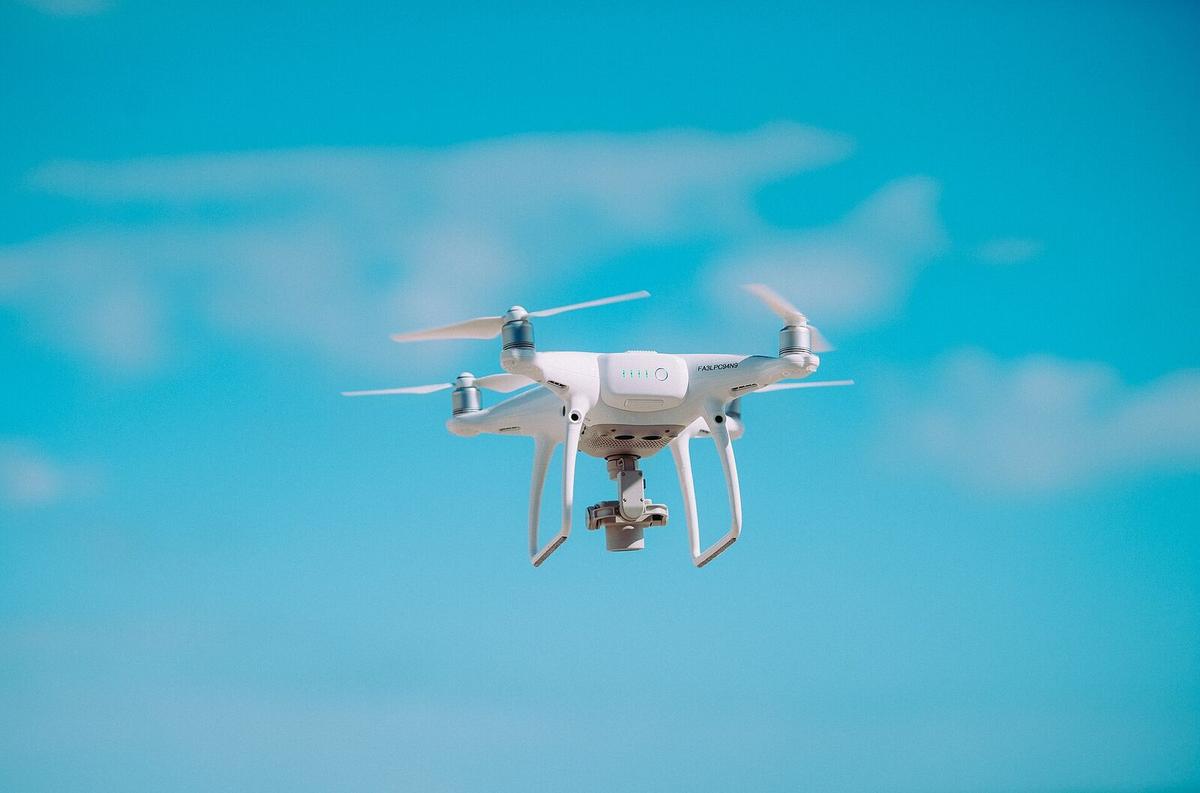 The code printed on the side of this drone is a registration number, the first thing the rules ask of most owners. Photo by Annie Spratt, CC0, via Wikimedia Commons.
What is the big change coming?
One phrase explains most of it: beyond visual line of sight, shortened to BVLOS.
Under today's main rules, a drone pilot must be able to see the aircraft with their own eyes for the whole flight. That one requirement caps what a drone can do. You cannot deliver a package three miles away, or inspect 50 miles of pipeline, if you have to keep the aircraft in view.
Flying beyond sight removes the cap. It also removes the safety system that the old rule relied on, which was a human looking at the sky. Something has to replace those eyes.
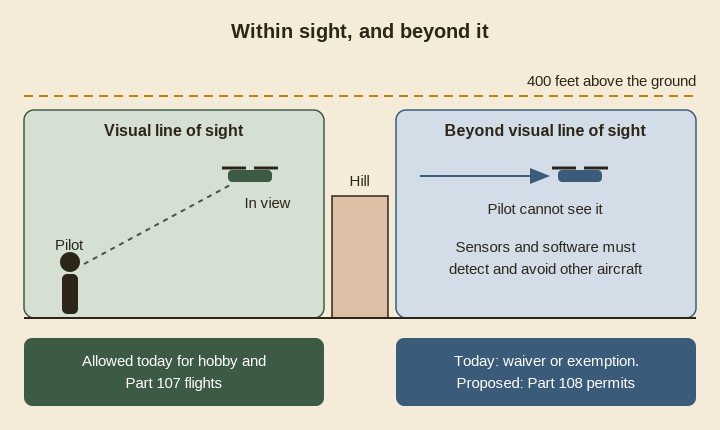 The line between the two kinds of flight is whether the pilot can see the aircraft.
Where does the FAA's rule stand?
The Federal Aviation Administration (FAA) regulates everything that flies in US airspace. Its rules are grouped into numbered "parts." Part 107 is the existing rule for small drones under 55 pounds flown for work. The proposed rule for flights beyond sight is Part 108.
Here is the status as of 12 November 2026, from the government's own pages.
| Date | What happened | Source |
|---|---|---|
| 6 June 2025 | Executive Order 14307 told the FAA to propose a BVLOS rule within 30 days and publish a final rule within 240 days | Federal Register |
| 7 August 2025 | The FAA and the Transportation Security Administration published the proposal | Federal Register, 90 FR 38212 |
| 6 October 2025 | Public comments closed | Federal Register |
| 28 January 2026 | Comments reopened until 11 February on two topics: electronic conspicuity and right of way | Federal Register |
| 10 July 2026 | The final rule arrived at the White House regulatory review office | reginfo.gov |
| 12 November 2026 | Still listed there as "Pending Review" | reginfo.gov |
So the rule is not in force. No final Part 108 has been published in the Federal Register as of this writing. The 240 days in the executive order ran out at the start of February 2026. Until a final rule is published and its effective date arrives, flights beyond sight need what they have always needed: an individual waiver or exemption from the FAA.
What did the proposal say? In the FAA's words it is meant to replace one-off permissions with a "repeatable, scalable regulatory framework." The main points of the August 2025 text:
- It would cover aircraft weighing up to 1,320 pounds, cargo included. That is far beyond a hobby quadcopter.
- Operators would hold one of two kinds of approval, a permit or a certificate, with weight limits that depend on the kind of work.
- The responsibility would sit with the company. The proposal would not require individual pilot certificates. It would require an operations supervisor and trained flight coordinators.
- It sets requirements for detecting and avoiding other aircraft, and would require that equipment in Class B and Class C airspace, the zones around the busiest airports.
- Flights over open-air crowds would stay prohibited.
The reopened comment period matters. "Electronic conspicuity" means an aircraft announcing its position by radio so that other aircraft can see it on a screen. "Right of way" means who must move when a drone and a crewed aircraft meet. Those are the two topics the FAA asked the public about a second time, and the final text may differ from the proposal.
Who is already flying, and for what?
Several uses run today under special permission. They are the best guide to what will become ordinary.
Delivery. Package delivery by drone is certified under Part 135 of the FAA's rules. The FAA says delivery drones fly under 400 feet and that commercial models "have an average wingspan of about 5 feet." Some are multi-rotor, some have fixed wings, and some are hybrids that take off like a helicopter and cruise like a plane. The agency says it has completed more than 20 environmental assessments for delivery proposals, covering sites in eleven states.
Light shows. A drone light show is a large group of small aircraft with colored lamps, flown as one pattern by a single computer. The ordinary rule forbids one pilot flying several drones at once, so shows run under an FAA waiver.
Agriculture. Spraying crops from a drone falls under Part 137, the rule for agricultural aircraft. The FAA says a drone sprayer needs an exemption, a Part 137 certificate, a certificated remote pilot and a registered aircraft. The agency's page currently carries a notice that it has found some operators not following the terms of their exemptions and has begun checking.
Inspection. Bridges, roofs, cell towers, power lines and pipelines. This is the least glamorous use and, I think, the one that will grow fastest once flights beyond sight are routine, because a pipeline is long and nobody lives on most of it.
Take a paired example. A roofer with one drone photographs a house while standing in the driveway. She flies under Part 107, keeps the aircraft in view, and needs nothing new. A utility that wants to fly 200 miles of power line every month cannot post a person every half mile. It is the utility, not the roofer, that is waiting on Part 108.
How does a drone avoid what the pilot cannot see?
Three layers, working together.
Detect and avoid. Sensors on the drone, or on the ground beneath its route, find other aircraft. Software then changes course. The sensors may be cameras, radar, microphones, or a radio receiver listening for the position signals that crewed aircraft broadcast.
Traffic management. The FAA calls this UAS Traffic Management, or UTM. It is not a control tower. The agency describes it as "a cooperative interaction between drone operators and the FAA," in which operators share their planned routes through approved data services and sort out conflicts before takeoff.
Remote ID. The FAA calls it the ability of a drone in flight "to provide identification and location information that can be received by other parties through a broadcast signal." Think of it as a license plate that transmits. It does not prevent a collision. It tells police and regulators whose drone that is and where the controller is standing.
What about batteries, hydrogen and swarms?
Most small drones run on lithium batteries, and the battery is the limit. A battery heavy enough to fly for an hour leaves less lift for cargo, so every design is a trade between time in the air and weight carried. As a rule of thumb, treat any flight time printed on a box as measured in still air with no load, and expect less.
Two ideas aim past that limit. One is a hydrogen fuel cell, which makes electricity on board from stored hydrogen and can hold more energy for its weight than a battery, at the price of a pressurized tank and a harder refueling job. The other is a hybrid, with a small engine turning a generator. Neither is common in consumer drones. Both show up where long routes pay for the trouble, such as inspection and surveying.
A swarm is many drones flown as one system. A light show is the friendly version: each aircraft follows a script and holds its place. The harder version is a group that shares information and divides up a job, such as searching a hillside for a lost hiker, without a person steering each one. The rules lag the engineering here. One pilot for many aircraft still needs a waiver.
What can be done about a drone that should not be there?
Counter-drone work has two halves. Detection means finding the drone and, if possible, its operator, using radar, cameras, microphones, or receivers that pick up its radio link and its Remote ID broadcast. Mitigation means stopping it: jamming its radio link, taking over its controls, catching it in a net, or hitting it with another drone.
Detection is the easy half. Mitigation is hard because a jammed or captured aircraft still has to come down somewhere, and jamming affects other radios nearby.
Executive Order 14305, also signed on 6 June 2025, set up a federal task force on the problem and described prisons, mass gatherings and critical infrastructure as exposed to unauthorized flights. One result is a proposed rule the FAA published on 6 May 2026. It would let the operators of certain fixed sites ask for a flight restriction over them.
The FAA's page for hobby flyers says: "Drones are aircraft." My rule for a private citizen follows from that: do not try to bring one down. Note the time and place, and call local police.
Privacy cuts both ways. A neighbor may worry about the camera overhead, and state and local laws on that vary widely. The pilot has a privacy question too, because a standard Remote ID drone broadcasts where the controller is. A related article in this set, Smart Home Devices: Cameras, Doorbells and What They Leak, covers cameras that stay on the ground.
What do official sources say about military use?
This section is short on purpose and limited to what governments have published.
Executive Order 14305 says that critical infrastructure, "including military bases," has been subject to frequent drone incursions. In a release dated 8 April 2026 about the war with Iran, the White House said US forces had intercepted more than 1,000 attack drones. Another piece in this set, The War in Iran: The Facts as of 12 November 2026, covers that conflict.
The point for a civilian reader is narrow. Everything else in this article is about civilian flying and civilian rules.
What does a hobbyist need to do today?
None of the coming rules change the basics, and the basics are short. The FAA's recreational flyer page, last updated 29 October 2026, lists them.
| Requirement | The detail |
|---|---|
| Take the test | The Recreational UAS Safety Test, called TRUST, is free and online. Carry proof that you passed. |
| Register | Required if the drone weighs 250 grams (0.55 pounds) or more. It costs $5, lasts three years, and covers every drone you own. |
| Mark the drone | Put the registration number on the outside and carry the certificate. |
| Remote ID | Required for any drone that must be registered, unless you fly inside an FAA-recognized identification area. |
| Stay in sight | Keep the drone where you can see it, or use an observer standing next to you. |
| Stay low | At or below 400 feet in uncontrolled airspace. Near airports, only with authorization through LAANC or DroneZone. |
| Give way | Give way to other aircraft and do not interfere with them. |
| Follow a safety code | Fly by the safety guidelines of an FAA-recognized community-based organization. |
You must be 13 or older to register. A younger owner needs someone 13 or older to do it.
Watch out
"Recreational" has a narrow meaning. The FAA says taking photos to help sell a house, or even volunteering your drone for a nonprofit, is not recreational flying. Those flights fall under Part 107, which requires a remote pilot certificate. The agency's own advice: when in doubt, assume Part 107.
What to remember
- The big change is flight beyond the pilot's sight. It is what delivery, long inspections and large farm work depend on.
- The FAA proposed Part 108 on 7 August 2025. As of 12 November 2026 the final rule is under White House review and has not been published.
- Until it takes effect, flights beyond sight need an individual waiver or exemption.
- Detect and avoid, traffic management and Remote ID do the job the pilot's eyes used to do.
- Hobbyists: pass TRUST, register at 250 grams or more, use Remote ID, keep the drone in sight and at or below 400 feet.
- Do not interfere with someone else's drone. Report it.
If you own a drone, the next step takes ten minutes: take TRUST and check your registration on the FAA's DroneZone site. To follow Part 108, search reginfo.gov for the rule number 2120-AL82 and watch for the day its status changes.