Articles & BlogBy Trapper W. Brown11 min readCurrent to 12 November 2026Facts only
This is a factual account of the war involving the United States, Israel and Iran, as of 12 November 2026. It began on 28 February 2026. It has included a ceasefire, a signed memorandum, renewed attacks, a naval blockade, and the restriction of the Strait of Hormuz, which carried about a quarter of the world's seaborne oil trade in 2025.
Every statement below is tied to a named source and a date. Where sources give different dates or numbers, both are shown. The account contains no forecast.
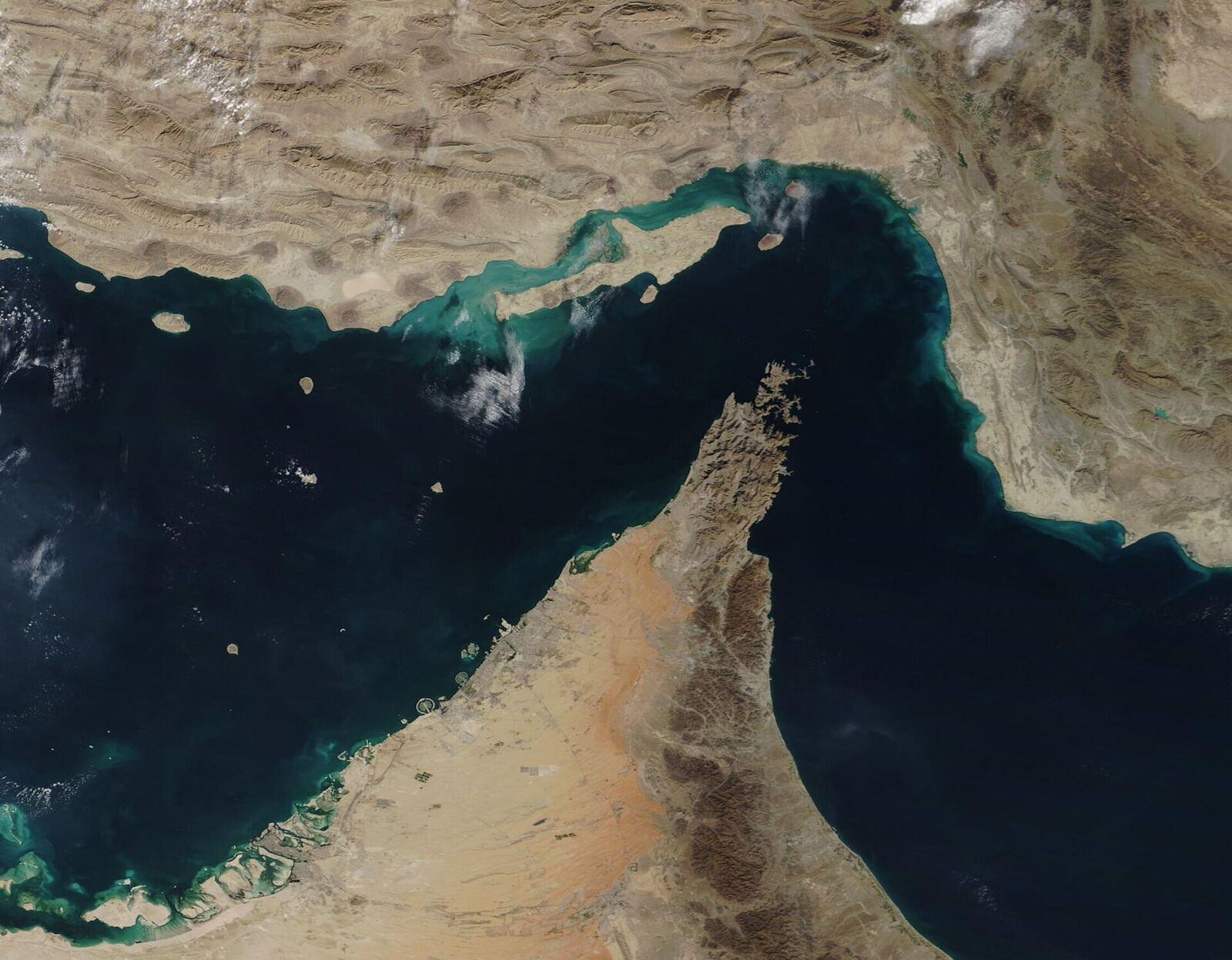
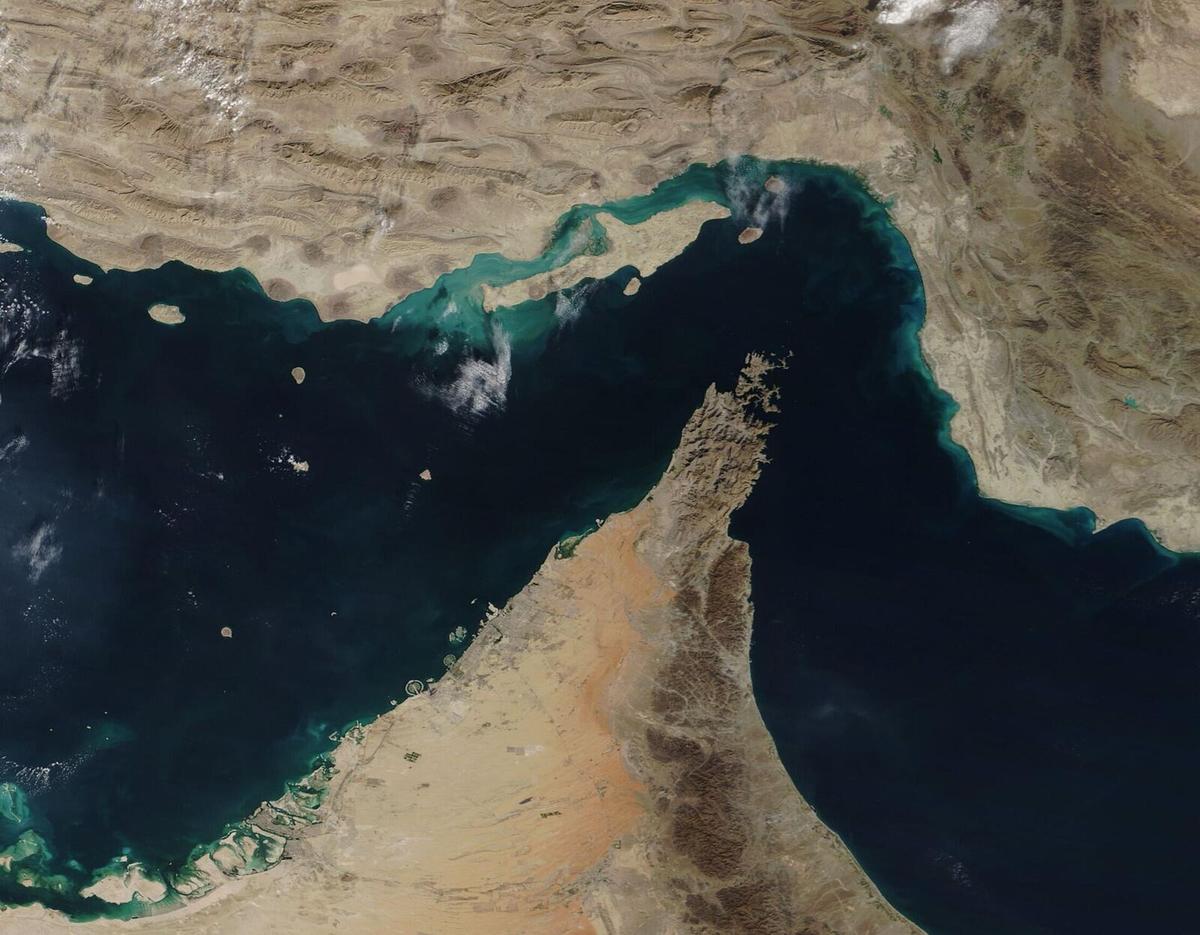 The Strait of Hormuz from orbit in December 2020, with Iran to the north and the Musandam Peninsula to the south. Photo by the MODIS Land Rapid Response Team, NASA GSFC, public domain, via Wikimedia Commons.
How and when did it begin, and who are the parties?
The International Atomic Energy Agency (IAEA), the United Nations body that inspects nuclear programs, records the start in its report GOV/2026/50 of 1 September 2026: "On 28 February 2026, the United States of America and Israel launched further military attacks on Iran, including on the sites of some nuclear facilities." The word "further" refers to June 2025, when, the same report says, Israel and then the United States attacked Iranian nuclear facilities.
The IAEA report also says indirect negotiations between the United States and Iran took place in Geneva on 17 and 26 February 2026, days before the attacks. The Council on Foreign Relations (CFR) conflict tracker, on a page marked updated 23 October 2026, says the attack followed Tehran's refusal of US demands to end all uranium enrichment. It says the first strikes killed Iran's Supreme Leader, Ali Khamenei, and that the Assembly of Experts appointed his son, Mojtaba Khamenei, to succeed him.
The parties, as the CFR tracker and the Congressional Research Service (CRS) describe them:
- The United States and Israel, which began the attacks.
- Iran, which struck back at Israel, at US facilities in the region, and at neighboring states.
- Groups aligned with Iran: Hezbollah in Lebanon, the Houthi movement in Yemen, and militias in Iraq.
- States that were struck: UN Security Council Resolution 2817 names Bahrain, Kuwait, Oman, Qatar, Saudi Arabia, the United Arab Emirates and Jordan.
- Mediators: a UN statement of 14 June 2026 names Pakistan, Qatar, Egypt, Saudi Arabia and Türkiye.
What has each side said it wants?
United States. A White House release on the campaign, which it calls Operation Epic Fury, dated 8 April 2026, quotes General Dan Caine, chairman of the Joint Chiefs of Staff, saying the president ordered three goals on 28 February: destroy Iran's ballistic missile and drone capabilities, destroy its navy, and destroy its defense industrial base. The CFR tracker lists the stated US goals as also including preventing a nuclear weapon and cutting support for allied armed groups, and says President Trump called for a change of government in Iran. Al Jazeera reported on 11 November 2026 that Secretary of State Marco Rubio said "The economic campaign is so devastating that right now there is no need for major combat operations."
Israel. News On AIR, India's public broadcaster, reported on 28 February 2026 that Prime Minister Benjamin Netanyahu said the operation was needed to remove "an existential threat posed by the Iranian regime" and to "create an opening for political change within Iran."
Iran. Foreign Minister Abbas Araghchi told the state news agency IRNA on 10 November, as reported by Al Jazeera: "The conflict with Iran will not be resolved through military means, nor by intensifying sanctions." Al Jazeera reported on 12 November that parliament speaker Mohammad Bagher Ghalibaf listed Iran's conditions for returning to talks: lifting the US naval blockade, sanctions relief, release of frozen Iranian funds, an end to hostilities on all fronts, and a formal declaration that the war is over. Iranian officials refer to seven conditions, and Al Jazeera noted on 11 November that the full list has not been published.
What were the main phases?
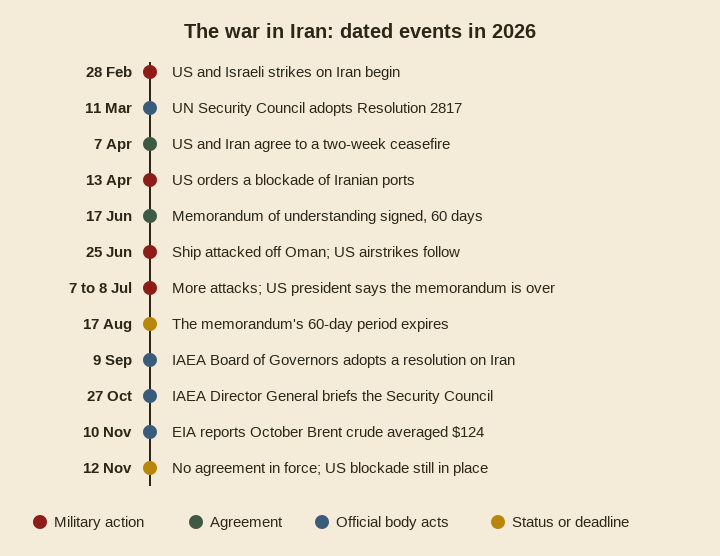 Twelve dated events, from the first strikes to the date of this account.
28 February to 7 April: major combat. The CRS report R45281, dated 7 August 2026, says Iranian forces declared the Strait of Hormuz closed days after the attacks began, and that traffic through it largely halted. The CFR tracker says Iran struck US military facilities in Bahrain, Jordan, Kuwait, Qatar and the United Arab Emirates, and that Hezbollah and Israel resumed fighting in Lebanon. The UN Security Council adopted Resolution 2817 on 11 March, by 13 votes with China and Russia abstaining, the Qatar News Agency reported.
7 April to mid-June: ceasefire and blockade. CRS dates a two-week US-Iran ceasefire to 7 April and says no agreed text was released. The White House release announcing it is dated 8 April. CRS says that after talks in Islamabad, Pakistan, failed, the president ordered a blockade of Iranian ports on 13 April, with an exception for humanitarian aid.
July to mid-August: renewed attacks. CRS says that by mid-July the volume of attacks, by Iran on shipping and regional countries and by the United States on Iran, was higher than at any point since April. CRS says the conflict had abated by early August amid talks between Iran and Oman.
September to 12 November: pressure without full-scale combat. Al Jazeera reported on 11 November that maritime monitoring firms counted at least 37 attacks on ships in and near the strait in October, the highest monthly total of the war. On 12 November it described full-scale fighting as on hold with no formal peace deal. NPR reported on 11 November that President Trump said the war was on hold and that the US naval blockade would continue.
What happened to the ceasefire and the memorandum?
The IAEA report says a memorandum of understanding (MOU), a written statement of what two sides intend to do, "was signed by President Trump and President Pezeshkian on 17 June 2026," with an initial duration of 60 days. The CFR tracker dates the deal to 14 June, which is the date of a UN statement welcoming "the announcement" of an agreement. The UN statement refers to an announcement. The IAEA and CRS refer to the signing.
CRS quotes the MOU as declaring the "removal of [the U.S.] naval blockade" and Iranian arrangements "for the safe passage of commercial vessels with no charge, for 60 days only." The IAEA quotes it as saying Iran would "maintain the current status quo of its nuclear program" until a final deal.
Attacks resumed within days of the signing. The sequence, from CRS and the IAEA:
- 25 June: CRS says Iran attacked a ship in Omani waters and US airstrikes followed. Al Jazeera reported that Iran neither claimed nor denied that attack and that Washington blamed Iran.
- 7 to 8 July: CRS says a second round of attacks on ships led to more US airstrikes, after which President Trump said the MOU was no longer in force. The IAEA dates his remark to 8 July. Al Jazeera dates it to 7 July.
- 19 July: The IAEA says Iran's deputy foreign minister told reporters the United States had suspended its commitments and Iran was taking reciprocal measures.
- 17 August: The 60-day period expired. The IAEA report cites Iran's foreign ministry spokesman saying "gross US violations" had made the deadline "entirely moot."
The CFR tracker says each government has accused the other of violating the memorandum. As of 12 November no ceasefire text or memorandum is in force, and CRS reported in August that the United States had reimposed its blockade.
What have official bodies published?
- White House. The 8 April release lists what the administration presents as results: more than 13,000 targets struck and 150 Iranian warships destroyed. These are the government's own claims.
- UN Secretary-General. A statement of 14 June welcomed the deal. One of 13 July said he was "deeply concerned" by renewed attacks by Iran and by the United States and that "These attacks must all stop."
- IAEA Board of Governors. Resolutions on Iran's safeguards obligations on 10 June and 9 September.
- IAEA Director General. His September report says the agency received no information from Iran about its declared nuclear facilities in the period covered and had no access to them. On 27 October he told the Security Council the one exception was the Bushehr power plant. He said the agency has "not been able to verify that there has been no diversion of nuclear material," including 440 kilograms of highly enriched uranium, and that it has "not identified any activity to repair or reconstruct" the damaged facilities.
- CFR conflict tracker. The page updated 23 October lists the conflict's status as "Worsening."
What are the casualty and cost figures, and who reported them?
The CFR tracker states that complete casualty figures do not exist. These are figures that named sources have published.
| Figure | Reported by | Date |
|---|---|---|
| At least 3,375 killed in Iran, 383 of them aged 18 or under | Head of Iran's Legal Medicine Organization, via the judiciary's Mizan agency | 20 April |
| 1,701 civilian deaths in Iran | HRANA, cited by the CFR tracker from a Time article | 21 April |
| Up to 3.2 million displaced in Iran | UN refugee agency, cited by the CFR tracker | Tracker of 23 October |
| 13 US service members killed | NPR, cited by the CFR tracker | Tracker of 23 October |
| 21 US service members dead, more than 850 wounded | Senator Jack Reed, reported by Stars and Stripes | 28 October |
| At least 3,000 killed in Lebanon since early March | Al Jazeera, source not named in its article | 17 August |
The two US figures differ. They come from different sources on different dates, and no Department of Defense casualty page was read for this account. No official Israeli casualty total was read for this account.
On cost, Stars and Stripes reported on 28 October that the Defense Department told Congress the war had cost $47.1 billion as of 16 October, up from $43.6 billion through 3 September. The estimate excludes damage to US assets from Iranian attacks.
What has happened to shipping and oil?
CRS says about 20 million barrels of oil a day moved through the Strait of Hormuz in 2025, roughly 25% of the world's seaborne oil trade, along with about 19% of its liquefied natural gas. At its narrowest the strait is 22 nautical miles wide.
The US Energy Information Administration (EIA), in its outlook of 10 November 2026, reported:
- Brent crude, the main international oil price, averaged $124 a barrel in October, the highest monthly average since July 2022.
- The spot price fell below $100 on 4 November.
- Middle East production shut in, meaning oil that could be pumped but is not, averaged 2.5 million barrels a day in October, down from a peak of 10.9 million in May.
| 2024 average | $81 |
|---|---|
| 2025 average | $69 |
| October 2026 average | $124 |
Source: US Energy Information Administration, Short-Term Energy Outlook, 10 November 2026
On traffic, two measures are in circulation. Al Jazeera, citing Reuters and the ship-tracking firm Kpler, reported five commodity vessels crossing the strait on 7 November and none on 8 November, against 31 the weekend before. NPR, also citing Kpler, reported on 11 November that the region's exports overall had reached close to 90% of pre-war levels. The first counts ships through the strait. The second counts exports by all routes, including pipelines that bypass it.
Sources also differ on single incidents. For 10 November, Iran's Revolutionary Guard said three tankers caught fire after hitting mines, while the UK Maritime Trade Operations office said it had reports involving two tankers.
What remains unresolved?
- An agreement. None is in force. On 10 November Iran's security chief called reports of ongoing talks "a pure lie," while President Trump spoke of momentum after meeting Qatar's prime minister on 9 November. The two accounts conflict.
- The strait. CRS says Iran created a "Persian Gulf Strait Authority" in May and claims no vessel may pass without its permit. The United States and Gulf Arab states reject that claim.
- The nuclear program. The IAEA cannot verify the location or size of Iran's enriched uranium. The CFR tracker cites Reuters reporting on 11 November that Iran said none of it would leave the country.
What to remember
- The war began on 28 February 2026 with US and Israeli attacks on Iran, as the IAEA records.
- A two-week ceasefire was agreed on 7 April and a 60-day memorandum was signed on 17 June. Attacks resumed, and the memorandum's period expired on 17 August.
- As of 12 November 2026 no agreement is in force, the US naval blockade continues, and Iran restricts passage through the Strait of Hormuz.
- The IAEA says it cannot verify Iran's enriched uranium, including about 440 kilograms enriched up to 60%.
- The Defense Department put US costs at $47.1 billion as of 16 October. Casualty totals vary by source and are incomplete.
This account is current to 12 November 2026. For updates, check the CFR Global Conflict Tracker, the IAEA's statements and Board reports at iaea.org, UN press releases at press.un.org, the EIA's monthly Short-Term Energy Outlook, and the AP and Reuters wires.