Articles & BlogBy Trapper W. Brown7 min read
Security+ SY0-701, Objective 5.6: Put security awareness practices to work in a given scenario
When was the last time a yearly training video changed what you did on a Monday morning? For most people the honest answer is never.
That is a problem, because people are where most attacks land. Verizon's 2026 Data Breach Investigations Report found the human element present in 62 percent of breaches. Security+ covers the response in Domain 5: phishing, spotting behavior that is off, what to teach, how to report and monitor, and how to build the program itself.
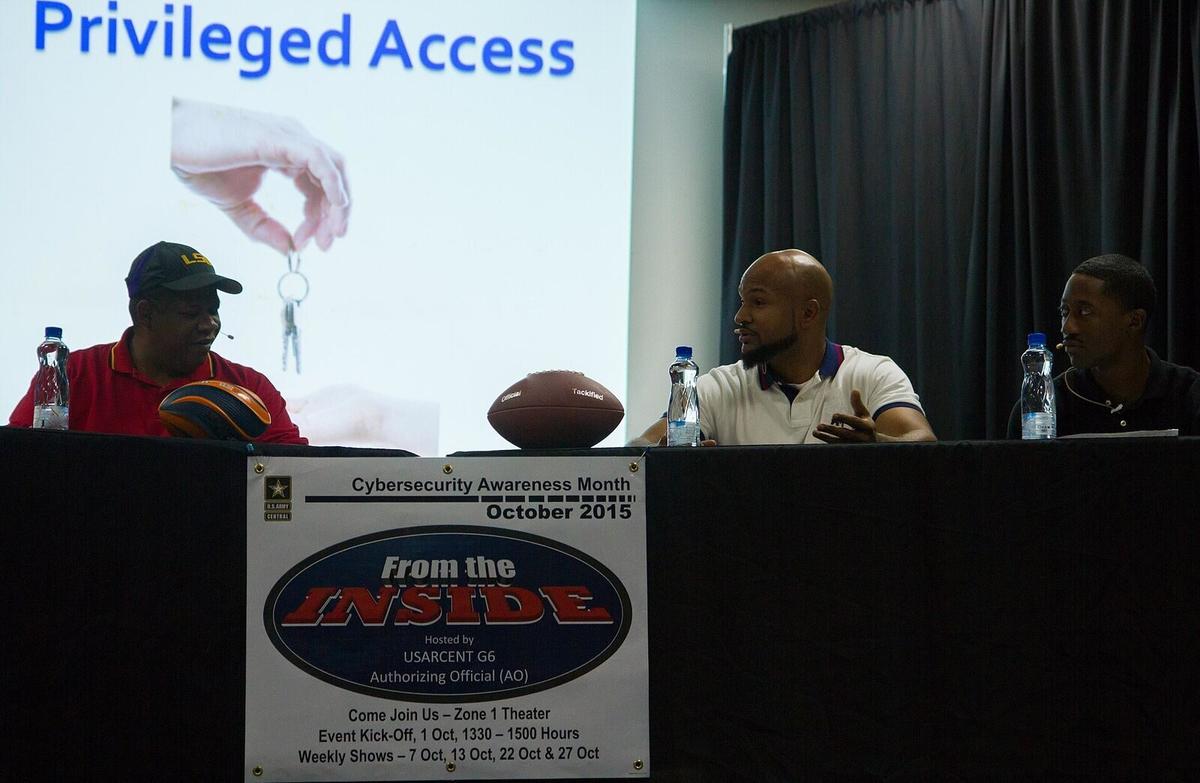 Awareness training staged as a sports talk show for U.S. Army Central staff in Kuwait, 2015. U.S. Army photo by Sgt. Youtoy Martin, public domain, via Wikimedia Commons.
My opinion, up front: awareness training fails when it is built to produce a completion certificate. It works when it is short, frequent, specific to the job and kind to the person who makes a mistake. Everything below follows from that.
Phishing: practice, recognition and response
The exam lists three parts to phishing awareness.
Campaigns are simulated phishing emails that you send to your own staff. The point is practice and measurement. You learn who clicks, and more usefully, who reports.
Recognizing a phishing attempt is a skill, and it can be taught with a short list of signs.
| Sign | What it looks like |
|---|---|
| Urgency or threat | "Your account closes in 24 hours" |
| A sender that is slightly wrong | A display name you know over an address you do not |
| An unexpected attachment or link | An invoice you never asked for, a link that points somewhere other than its text |
| A request for credentials or money | A login page reached from an email, a change of bank details, gift cards |
| A break from routine | The chief executive emailing a clerk directly for a favor |
Responding to reported suspicious messages is the part organizations forget. When someone reports an email, three things should happen. The security team checks it. If it is real, they remove it from every other mailbox and block the sender. And the reporter hears back, even if it is one line saying thanks, that one was real.
Say a clinic with 30 staff runs a simulated campaign every quarter for a year.
| Q1 clicked | 30% |
|---|---|
| Q1 reported | 10% |
| Q2 clicked | 20% |
| Q2 reported | 27% |
| Q3 clicked | 13% |
| Q3 reported | 43% |
| Q4 clicked | 10% |
| Q4 reported | 60% |
Source: Worked example in this article
Clicks fell from 9 people to 3. Reports rose from 3 people to 18. The second number matters more. You will never reach zero clicks, but if 18 people report a real attack in its first few minutes, the three who clicked can be helped before much harm is done.
Watch out
Do not punish people who fail a simulated phish. Shame teaches staff to hide mistakes, and a hidden click on a real attack is far worse than a reported one. Reward the report, coach the click.
Noticing behavior that is off
The objective calls this anomalous behavior recognition, and it sorts the behavior into three kinds.
| Kind | Meaning | Example |
|---|---|---|
| Risky | A person knowingly does something unsafe | Sharing a password with a coworker, propping open the server room door |
| Unexpected | Something happens that does not fit the normal pattern | A login at 3 a.m. from another country, a clerk opening hundreds of patient records |
| Unintentional | An honest mistake with security consequences | Emailing a spreadsheet to the wrong address, leaving a laptop in a taxi |
Staff should be taught to notice all three, in themselves and around them, and to say something. The categories matter because the right response differs. Risky behavior needs a conversation about why the rule exists. Unexpected behavior needs investigating. Unintentional behavior needs a fast, blame-free way to report it.
What to teach
The exam lists eight topics under user guidance and training. Here is each in a line or two.
Policies and handbooks. People cannot follow rules they have never seen. Hand over the acceptable use policy and the employee handbook on the first day, in plain language, and record that each person received them.
Situational awareness. Paying attention to your surroundings: who is behind you at the badge door, who can see your screen, whether that technician is expected today.
Insider threat. Some risks come from people who already have access. Teach the warning signs, such as copying large amounts of data or working around controls, and teach that reporting a concern is not an accusation.
Password management. Long, unique passwords kept in a password manager, never reused or shared, with multi-factor authentication switched on. Microsoft wrote on 20 August 2019 that MFA can block over 99.9 percent of account compromise attacks. The figure is old, but the advice has held up.
Removable media and cables. A USB drive found in the parking lot does not go into a work computer. Neither does a free charging cable from a stranger, since a cable can carry data as well as power.
Social engineering. Phishing is only one form. Attackers also phone, text and walk in, relying on helpfulness, authority and hurry.
Operational security. Small public details add up. A badge in a social media photo, a job posting that lists your exact firewall model, a loud phone call on a train: each one hands an attacker a piece.
Hybrid and remote work environments. Home networks, shared family computers, coffee shop Wi-Fi and screens visible to visitors. Teach the use of the company VPN, locked screens and keeping work on work devices.
Tip
In a scenario question, match the topic to the clue. A found USB drive is removable media. A stranger following someone through a door is situational awareness or social engineering. An employee posting work details online is operational security.
Reporting and monitoring
Training is delivered at two points. Initial training happens at hiring, before the new person has access to anything sensitive. Recurring training repeats on a schedule after that.
I would trade one 60-minute yearly session for a five-minute lesson each month, every time. A new nurse at a hospital hears the phishing lesson once in orientation week, between the parking pass and the fire drill. Without repetition, that lesson is gone by spring.
Monitoring means measuring whether any of it worked. Completion rates tell you who clicked through the slides. Better measures are the ones from the campaign above: click rates, report rates and how long it takes for the first report to arrive. Track real incidents caused by human error too.
The stakes are easy to show. The FBI's Internet Crime Complaint Center recorded $20.877 billion in reported losses for 2025, from 1,008,597 complaints.
| 2020 | $4.2B |
|---|---|
| 2021 | $6.9B |
| 2022 | $10.3B |
| 2023 | $12.5B |
| 2024 | $16.6B |
| 2025 | $20.88B |
Source: FBI Internet Crime Complaint Center (IC3) annual reports, 2020 to 2025
Those are only the losses that someone reported.
Building and running the program
The last items in the objective are development and execution: building the program, then running it.
Development starts with your own risks. A clinic's front desk needs to recognize a caller pretending to be a patient's relative. A hospital's finance team needs to recognize a fake request to change a supplier's bank details. Generic content wastes both groups' time. Decide who needs what, pick the format (short videos, live sessions, posters, simulated phishing) and get leadership to take the same training as everyone else.
Size matters less than people expect. A 12-person clinic can run a useful program with a ten-minute talk at the monthly staff meeting and one agreed way to report a suspicious email.
Execution is the calendar and the follow-through. Schedule the sessions, run the campaigns, publish the results without naming individuals, and change the content when the numbers stall or the attacks change. A program that looks the same in its third year as in its first has stopped being managed.
What to remember
- Phishing awareness has three parts: campaigns, recognition and responding to reports.
- Measure reports as well as clicks, and never punish a report.
- Anomalous behavior is risky, unexpected or unintentional.
- Eight training topics: policies and handbooks, situational awareness, insider threat, password management, removable media and cables, social engineering, operational security, and hybrid and remote work.
- Training is initial at hiring and recurring after that.
- Develop the program around your own risks, then execute it and adjust.
People do not hate learning. They hate having their time wasted and being made to feel stupid. Build the program around short lessons, real examples and a thank-you for every report, and most of them will end up helping you.