Articles & BlogBy Trapper W. Brown10 min read
Most people who get into trouble outdoors did not set out on an expedition. They went for a day hike and took a wrong fork, or rolled an ankle three miles from the car, or slid off a quiet road in the snow. This guide is about the hours after that moment: what to do first, what can wait, and what to carry so that the wait is uncomfortable instead of dangerous.
It is worth knowing because the order of your actions counts for more than any clever trick. People in this spot tend to worry about food and wild animals. The things that actually hurt them are colder, wetter and far more ordinary. Once you know the real order, most of the fear goes away, because you always have a next step.
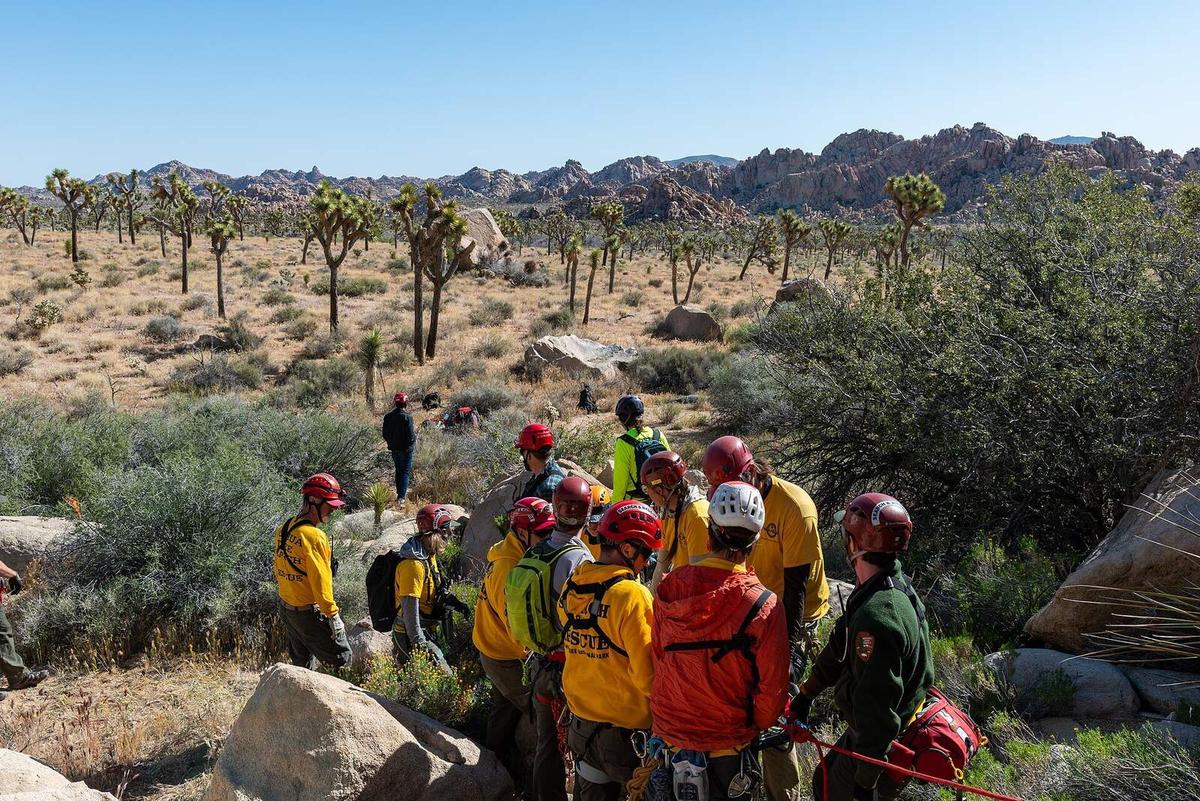 The people who come looking train for it, and they start from where you said you would be. Photo by the National Park Service (Bill Bjornstad), public domain, via Wikimedia Commons.
What actually hurts people outdoors?
The National Park Service (NPS) publishes the deaths reported in its parks. For 2014 through 2019 it counted an average of 358 deaths a year, about 7 a week. Half were unintentional, and among those the top three causes were motor vehicle crashes, drownings and falls, in that order. Half of the medical deaths happened while the person was doing something physical.
For scale, NPS puts its 2019 rate at 0.11 deaths per 100,000 recreational visits. Parks are safe places, and the hazards are ordinary: the road in, moving water, a slip near an edge, and a heart working harder than usual.
Look at what is missing from the top three: bears, snakes and starvation. Cold and heat deserve respect too. NPS names hypothermia and heat among its safety topics, although that page gives no count for them. So the plan has two parts: be careful around cars, water and heights, and be ready for one unplanned night out.
The order of priorities, and the rule of threes
There is an old outdoor saying called the rule of threes. A person can last about three minutes without air, three hours without shelter in harsh weather, three days without water and three weeks without food.
Treat it as a memory aid and nothing more. The numbers are round because round numbers are easy to remember. Cold water or a wet, windy ridge can turn "three hours" into much less, and a hot day shortens the water figure. People also stop thinking clearly long before any of those limits. And the saying leaves out what comes before everything else: immediate danger and serious injury. What it gets right is the order.
| Priority | Rough time scale | First action |
|---|---|---|
| Immediate danger and injury | Minutes | Get out of the water, off the road, away from the edge. Press hard on serious bleeding. Call 911 if you can |
| Shelter and body temperature | Hours | Add layers, get out of wind and rain, get off the bare ground |
| Being found | Hours to a day or two | Stay put, make yourself visible, signal in threes |
| Water | Days | Drink what you carry. Treat any water you find |
| Food | Weeks | Eat your spare snacks. Do not burn energy looking for more |
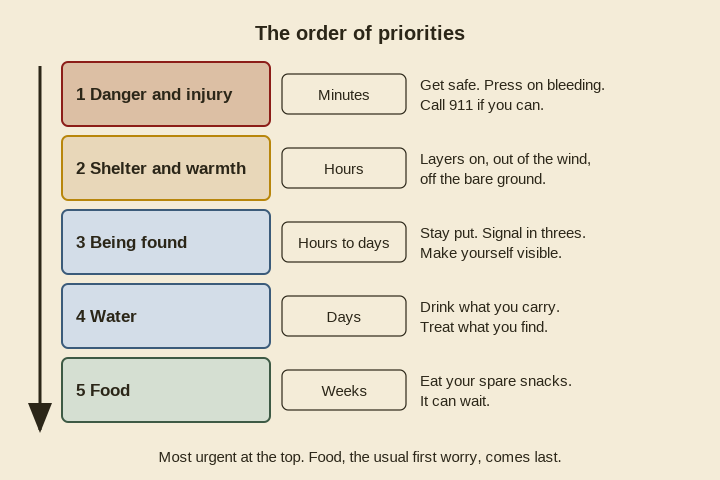 Work from the top down. Food, the thing most people worry about first, comes last.
STOP: what do you do in the first five minutes?
The US Forest Service teaches four letters for the moment you realize you may be lost: STOP.
- Stop. Stay calm and stay where you are. The Forest Service calls panic your greatest enemy.
- Think. Go over how you got here. What was the last place you were sure of? Do not take a step until you have a specific reason to.
- Observe. Get out the map and compass and work out the directions from where you stand. If you are on a trail, stay on it.
- Plan. Come up with possible moves and compare them. The agency's advice is blunt: unless you are very confident of the route, it is better to stay put.
It adds that if night is falling, or you are hurt or near exhaustion, you should stay in place.
Why does staying put usually get you found?
The NPS Outdoor Emergency Plan gives the steps in order. First, retrace your steps if it is safe to do so. If you cannot, call 911. Then stay put. In its words, changing location will make it difficult for authorities to find you, and you should move only if there is an immediate threat to your life.
The reasoning is simple. Searchers start from the last place anyone knew you were. A person who sits still stays inside the search area. A person who keeps walking can leave it.
That only works if somebody knows where to start, which is the job of a trip plan. NPS says to fill one out and leave it with a trusted contact who is not going with you. The Forest Service says to give exact details: where you are going, the trail you plan to follow and when you will return. NPS also suggests a turnaround time, a set hour at which you head back whether or not you reached the goal.
If a call goes through, NPS says to give the dispatcher your GPS coordinates if the phone shows them, the trail or area where you started, your last known location, what you can see around you and the colors of your clothing.
NPS also says not to rely on the phone, because a park may have no coverage. Most phones have an emergency SOS shortcut that calls for help and shares your location, and some recent models can send an emergency text by satellite when there is no cell signal. What yours can do depends on the model and the plan, so find out at home. The series pieces on handheld radios and on a family communications plan cover other ways to reach people.
While you wait, signal. The number to remember is three, and NPS gives these signals:
- Whistle. Blow three times, take a break, and blow three times again. NPS says a whistle helps people find you and saves the energy you would spend yelling.
- Light. Flash SOS with a flashlight: three quick, three slow, three quick. Go easy, since this drains the batteries.
- Mirror. Flash it at planes and helicopters. A mirror has no battery to run down.
- Color and shape. Wear bright clothing. Lay out your shelter or arrange rocks in a shape that can be seen from the air.
Shelter first: staying warm, or staying cool
Hypothermia means an abnormally low body temperature. The Centers for Disease Control and Prevention (CDC) says it can happen even at cool temperatures above 40 degrees Fahrenheit if a person is chilled by rain, sweat or cold water. The warning signs it lists for adults are shivering, confusion, fumbling hands, slurred speech and drowsiness. A body temperature below 95 degrees is an emergency.
So act before you are cold. Put on every layer you have while your hands still work. Get out of the wind and the rain. Then get off the ground, which pulls heat out of you by contact all night long. Sit on your pack, a coil of rope, or a thick pile of dry leaves or branches. A tarp or an emergency blanket keeps rain and wind off.
Heat is the same problem in reverse. The National Weather Service (NWS) describes heat exhaustion as heavy sweating, weakness, cool and clammy skin, a fast weak pulse, and dizziness or nausea. Its advice is to move to a cooler place, loosen clothing, apply cool wet cloths and sip water. Heat stroke is the emergency: confusion, a body temperature above 103 degrees, hot skin and a rapid strong pulse. That one needs 911.
Fire, water and food, in that order
Fire does three jobs. It warms you, it can be seen, and it gives you something to do. It also starts wildfires. NPS says not to build one if fire risk is high or it is wildfire season, since that puts you and others at great risk. Where a fire is allowed, clear the ground down to bare dirt, keep it small and away from overhanging branches, stay with it, and drown it until it is cold before you leave.
Water comes before food. Drink what you carry, and NPS says to drink often and before you feel thirsty. In winter, NWS says to melt snow before drinking it, because eating snow lowers your body temperature. Any water you find needs treating first, and the CDC says a clear mountain stream is generally not safe to drink from as it is. Our guide Emergency Water: Storing It, Finding It and Making It Safe covers the methods.
Food can wait. An emergency booklet from FEMA and the Red Cross says healthy people can get by on half their usual food for an extended period. Eat the spare snacks in your pack and leave the berries alone.
What should a day hiker carry?
NPS calls its packing list the Ten Essentials. In my words:
- A map and a compass or GPS unit, with a paper map as backup
- Sun protection: sunglasses, sunscreen, a hat
- Extra clothing: a jacket, hat, gloves and a rain shell
- A flashlight or headlamp with spare batteries
- A first aid kit, including your regular medicines
- Waterproof matches or a lighter, plus fire starter
- A repair kit: knife or multi-tool and duct tape
- Extra food. NPS says to pack an extra day's supply
- Water, and a way to treat more
- An emergency shelter: a tarp, bivy sack or space blanket
The Outdoor Emergency Plan adds a whistle and a mirror. As a rule of thumb, pack for the night you do not plan to spend.
Two examples: a sprained ankle and a snowbank
The hiker. Dana is three miles up a trail at 4 p.m. when her ankle rolls. She stops and sits. She cannot put weight on the foot, and dark is 90 minutes away. Her phone shows one bar, so she calls 911 with the trail name, her last junction and the color of her jacket. Then she follows the NPS advice for an injury: stay put and keep movement to a minimum. She puts on her extra layers, sits on her pack, and blows three whistle blasts every few minutes. Had the call failed, her trip plan said "back by 6," and her contact would have raised the alarm that evening. For the ankle itself, the Red Cross says to rest it, limit its use and treat any such injury as a possible fracture. Our guide First Aid When Help Is Delayed goes further.
The driver. Marcus slides off a rural road in a snowstorm. The NWS advice starts with three words: stay in the vehicle. The agency warns that people become disoriented quickly in wind-driven snow. He runs the engine about 10 minutes each hour for heat, opens a window a little while it runs, and clears snow from the exhaust pipe so carbon monoxide cannot back up into the cabin. He turns on the dome light at night when the engine is running and ties a bright cloth to the antenna. When the snow stops he raises the hood.
What makes the night bearable is in the trunk. The NWS winter kit includes blankets or sleeping bags, a flashlight with extra batteries, a first aid kit, high-calorie food that keeps, extra clothing, a shovel, a windshield scraper, sand or cat litter for traction, booster cables, a phone charger, and a small can with waterproof matches to melt snow for drinking. NWS also says to keep the gas tank near full and to tell someone your departure time and route.
What to remember
- The common dangers outdoors are vehicles, water, falls and your own heart. Cold and heat come next. Hunger and wildlife are far down the list.
- Priorities run in this order: immediate danger and injury, shelter, being found, water, food.
- STOP: stop, think, observe, plan. If you are not sure of the way, stay put.
- Leave a trip plan with someone who is not going, and set a turnaround time.
- Signal in threes: whistle, light or anything bright.
- Carry the ten essentials on every hike, and a winter kit in the car.
Before your next hike, write the trip plan and hand it to someone. It takes five minutes, and it is the one item on the list that works even if you forget everything else. The series pieces on go bags and on staying home versus leaving cover the same thinking for emergencies closer to home.