Articles & BlogBy Trapper W. Brown11 min read
For anyone who has held a card over a reader and wondered what the beep agreed to. By the end you will know who was asked, what was sent, and why "pending" on your statement is not the same as "paid".
You hold a card or a phone near a small screen, something beeps, and you walk out with a sandwich. Nobody counted anything. Cards are the bulk of the country's noncash payments. The Federal Reserve's payments study counted 236.6 billion noncash payments in the United States in 2024, and 120.6 billion of them were by debit card and 67.1 billion by credit card. Together that is 187.7 billion card payments, or close to 6,000 every second of the year.
Behind the beep are at least four organizations, a radio link about as wide as a thumb, and a code that will never be used again. It helps to know how it works for a practical reason. The safety of a payment depends heavily on which of three ways the card was read, and you often get to choose.
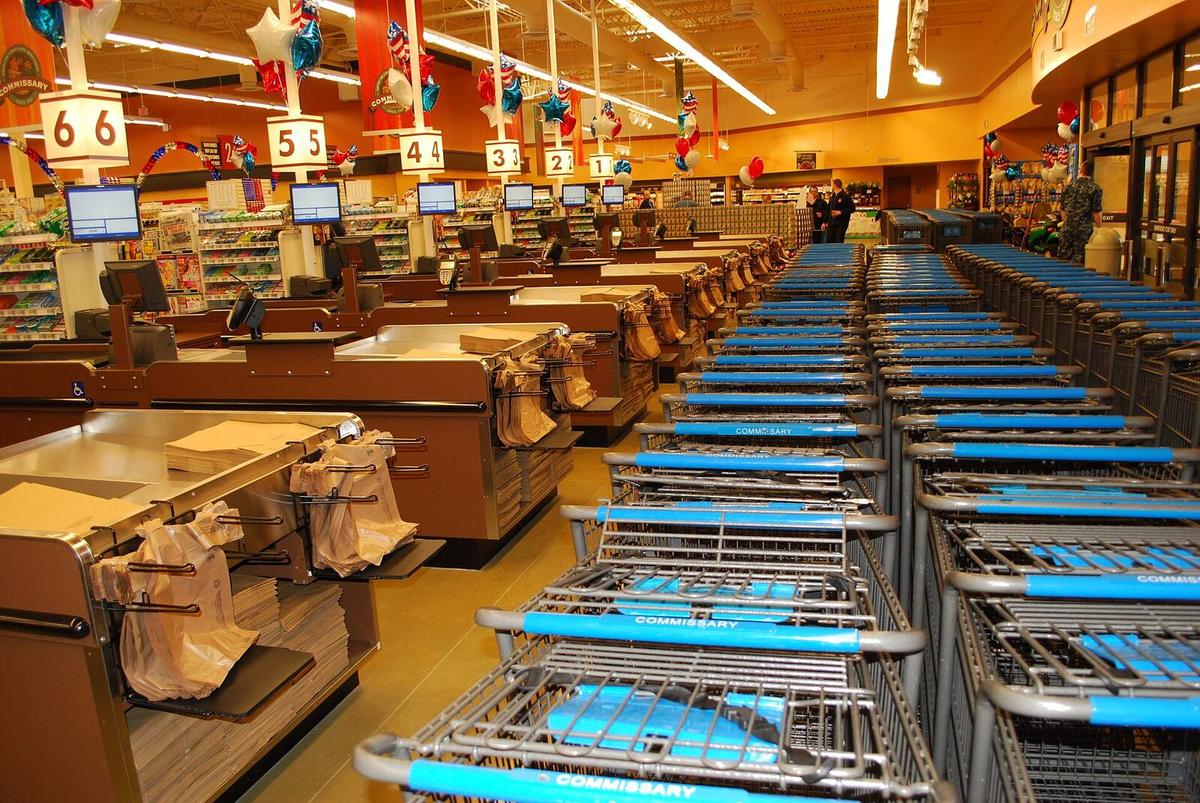 Every lane has a small card terminal, and each one starts the same chain of messages. Photo by Kevin Robinson, Defense Commissary Agency, public domain, via Wikimedia Commons.
Who is involved when you pay?
The Federal Reserve Board described the usual arrangement in its 2011 rule on debit cards and called it the four-party system. The four are:
- the cardholder, which is you
- the issuer, the bank or credit union that gave you the card
- the merchant, the store
- the acquirer, the merchant's bank, which the PCI Security Standards Council's glossary also calls the "merchant bank"
Between the two banks sits the card network, which carries messages from one to the other. A few systems fold the roles together. The Board calls those three-party systems: one company acts as issuer and network, and often as acquirer too.
What happens after the beep?
The first trip is a question. In the Board's words, "an electronic authorization request for a specific dollar amount, along with the cardholder's account information, is sent from the merchant to the acquirer to the network," which passes it to the issuer. The issuer checks, among other things, that the account can cover the amount and that the card has not been reported lost or stolen. Then, the Board says, "a message approving or declining the transaction is returned to the merchant via the reverse path, usually within seconds".
That is authorization. No money has moved. The issuer has only promised that the payment is good.
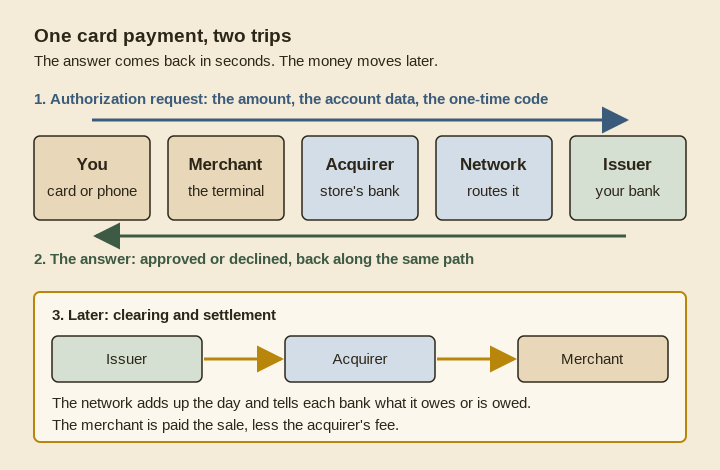 The answer comes back in seconds, and the money follows on a second trip.
The second trip is the money. The Board describes two steps. In clearing, the issuer posts the charge to your account. On some debit systems it works from the authorization message itself, and on others from a second message that follows. In settlement, the network takes all the clearing messages from one day and tells each issuer and acquirer its net position, a single figure for what it owes or is owed. The banks settle that figure between themselves, and the acquirer credits the merchant.
This is why a purchase can sit on your statement as pending. The authorization happened at the counter. Where clearing is a separate message, it arrives afterward.
The merchant does not receive the full price. The acquirer keeps a merchant discount, which the Board defines as the difference between the face value of the sale and what the merchant is paid. Part of it is the interchange fee, set by the network and passed to the issuer.
For debit cards from large issuers, federal rules cap that fee. As printed on ecfr.gov today, Regulation II allows no more than 21 cents plus 5 basis points of the sale (a basis point is one hundredth of one percent), plus 1 cent if the issuer meets the rule's fraud-prevention standards. Here is the arithmetic for three purchases.
| Debit purchase | 21 cents | 5 basis points | Fraud adjustment | Most the issuer can receive |
|---|---|---|---|---|
| $8.00 | 21 | 0.4 | 1 | 22.4 cents |
| $50.00 | 21 | 2.5 | 1 | 24.5 cents |
| $200.00 | 21 | 10 | 1 | 32 cents |
Small issuers are exempt, credit cards are not covered by this rule, and the Board's page notes that it has asked for comment on lowering the cap. The table shows the shape of the fee, mostly flat with a small slice of the sale, and nothing more. I did not check whether any court ruling or pending change affects these figures, so read the Board's page for the current ones.
What does the chip do that the stripe could not?
A magnetic stripe is a recording. PCI's glossary calls its contents track data. A stripe cannot compute anything, so it gives up the same data on every read, and whatever reads it once holds everything the stripe held.
The chip is a small computer. EMVCo, the body that writes the chip specifications, says the chip "generates a one-time use security code for every transaction", which it also calls a cryptogram, and that this code "is unique to each transaction and cannot be reused". The code, EMVCo says, lets the issuer and the terminal confirm that the card is real. A recording of yesterday's payment is no use today, because today's payment needs a new code.
EMVCo says chips built to its specifications are in more than 15.6 billion credit and debit cards.
What changes when you tap?
Very little about the security, and one thing about the physics. Tapping uses near field communication, or NFC. The NFC Forum, which maintains that standard, describes it as radio at a base frequency of 13.56 megahertz "with a typical range of up to 2cm", and notes that one side can send power to the other. That is how a card with no battery wakes up: the reader powers the chip through the air for the moment it takes to talk.
The conversation is the chip conversation. EMVCo's page on contactless payment says "a one-time use security code is generated for every transaction", the same as when the card is inserted.
Tip
Look at your own card. A card that can tap carries the contactless indicator, a small symbol of curved lines like a radio wave, and a card with a chip shows the metal contact pad on its face. If either is missing, the reader has to fall back on an older method.
What is different about a phone or a watch?
A phone wallet adds one more layer, called tokenization. EMVCo's description is direct: it removes "the most valuable data to a fraudster, the primary account number", and replaces it with "a unique alternative value", the payment token. The primary account number is the long number on the card.
The token is restricted. EMVCo says a token "is constrained in how it can be used", for example to a specific merchant or device. So the store's terminal receives a stand-in number that works from that phone, together with the one-time code. Further along the chain, the token is matched back to your real account.
EMVCo points to a practical result. If a token is exposed, it can be replaced without replacing the card, "often without any interaction from the cardholder".
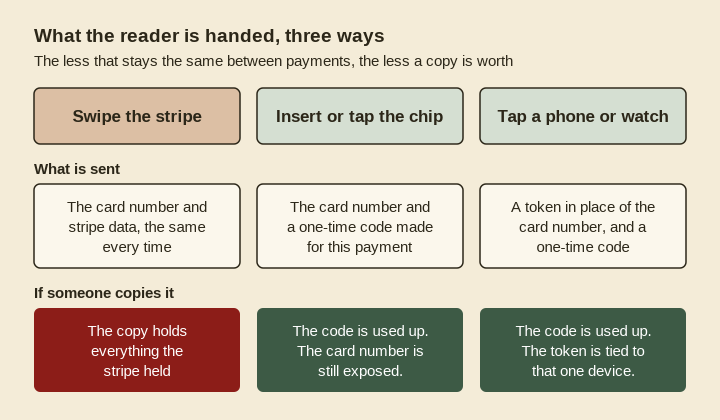 The less that stays the same between payments, the less a copy is worth.
What can a skimmer get, and what can it not?
PCI's glossary defines a card skimmer as "a physical device, often attached to a legitimate card-reading device, designed to illegitimately capture and/or store the information from a payment card." Its guidance for merchants says most skimming captures data from magnetic stripes, and it adds a caution: chip cards "are not immune", and many chip cards still carry a stripe.
Put that beside what EMVCo says and the picture is this. A device that copies a stripe has the stripe. A device that listens to a chip payment may see the card number, but the one-time code it saw is spent. A device near a phone payment sees a token and a spent code.
There are things no chip protects. PCI's guidance describes hidden cameras and keypad overlays used to capture a PIN, which is typed, not transmitted by the card. And the chip takes no part when a card number is typed into a website.
What you can check on your own card is short: whether it has a chip, whether it can tap, and whether your issuer offers alerts for each purchase. "Parking Lots, ATMs and Gas Pumps: Everyday Risk Points" covers how to look over a reader before you use it.
What do the federal rules say about misuse?
This section reports what the Consumer Financial Protection Bureau and the regulations say. It is not legal advice, and your card agreement may be more generous.
| Situation | Credit card (Regulation Z, 12 CFR 1026.12) | Debit card (Regulation E, 12 CFR 1005.6) |
|---|---|---|
| Card lost or stolen, reported promptly | Nothing if reported before it is used; otherwise at most $50 | At most $50, or the amount taken if that is less, when reported within two business days of learning of the loss |
| Card lost or stolen, reported late | Still at most $50 | Up to $500 when reported after two business days |
| Number used, card still in hand | The CFPB says you "generally have no liability" | Report within 60 days after the statement that shows it is sent |
Those are the CFPB's summaries. On debit cards it adds a sharper point. If you wait more than 60 days after the statement was sent, "you could also have to pay the full amount" of transfers made after those 60 days and before you report.
Watch out
The two kinds of card are not treated alike. The Regulation Z limit for a credit card is at most $50. A debit card's limits under Regulation E grow with delay, and the money in question has already left your own account. The CFPB's pages give the timelines in full.
What do people get wrong?
"Approved means paid." Approved means the issuer promised. The money moves at settlement.
"Tapping is the weak option." By EMVCo's account, a tap produces the same kind of one-time code as inserting the chip.
"Someone can read my card from across the room." The NFC Forum gives the typical range as up to 2 centimeters.
"The chip ended card fraud." EMVCo credits chips with reducing fraud where the card is present. It publishes a separate specification, EMV 3-D Secure, aimed at fraud in purchases where the card is not present.
"The store gets my card number when I pay by phone." By EMVCo's description, the store's terminal gets a token.
What to remember
- A card payment is two trips: an authorization that takes seconds and a settlement that moves the money later.
- Four parties take part: you, your issuer, the merchant and the merchant's acquirer, with a network between the banks.
- A stripe hands over the same data every time. A chip adds a code that works once.
- A tap is the chip conversation by radio, at a typical range of up to 2 centimeters.
- A phone wallet sends a token in place of the card number.
- Credit and debit cards fall under different federal rules, and the debit rules turn on how soon you report.
The next time a terminal offers you a choice, you will know what each option hands over. If you want to see the second trip for yourself, watch one purchase on your banking app and note the day it changes from pending to posted.
Sources (15)
- Board of Governors of the Federal Reserve System, "National Payment Volumes, Top-Line Data (CY 2015-24)"
- Board of Governors of the Federal Reserve System, "Debit Card Interchange Fees and Routing", final rule, Federal Register, July 20, 2011
- Board of Governors of the Federal Reserve System, "Regulation II (Debit Card Interchange Fees and Routing)"
- Electronic Code of Federal Regulations, 12 CFR 235.3, "Reasonable and proportional interchange transaction fees"
- Electronic Code of Federal Regulations, 12 CFR 235.4, "Fraud-prevention adjustment"
- EMVCo, "EMV Contact Chip"
- EMVCo, "EMV Contactless Chip"
- EMVCo, "EMV Payment Tokenisation"
- NFC Forum, "NFC Technology"
- PCI Security Standards Council, "Glossary"
- PCI Security Standards Council, "Skimming Prevention: Best Practices for Merchants", September 2014
- Consumer Financial Protection Bureau, "Am I responsible for unauthorized charges if my credit cards are lost or stolen?"
- Consumer Financial Protection Bureau, "How do I get my money back after I discover an unauthorized transaction or money missing from my bank account?"
- Electronic Code of Federal Regulations, 12 CFR 1026.12, "Special credit card provisions"
- Electronic Code of Federal Regulations, 12 CFR 1005.6, "Liability of consumer for unauthorized transfers"