Articles & BlogBy Trapper W. Brown11 min read
You are a passenger in a car at highway speed, talking on the phone. Over twenty minutes you cover twenty miles and the call never drops. In that time your phone has been served by a string of different towers, and you did not hear a single click. Then you get home, see four bars, and a video refuses to load.
Both of those moments come from the same design. A cell phone network is not one big radio station. It is a great many small ones, laid out so they can reuse the same slices of radio spectrum again and again, and joined by a system that passes each phone from one to the next. This article explains the cells, the handoff, the frequency bands, what the generations from 1G to 5G changed, and why the bars at the top of your screen are a poor guide to how your phone will perform.
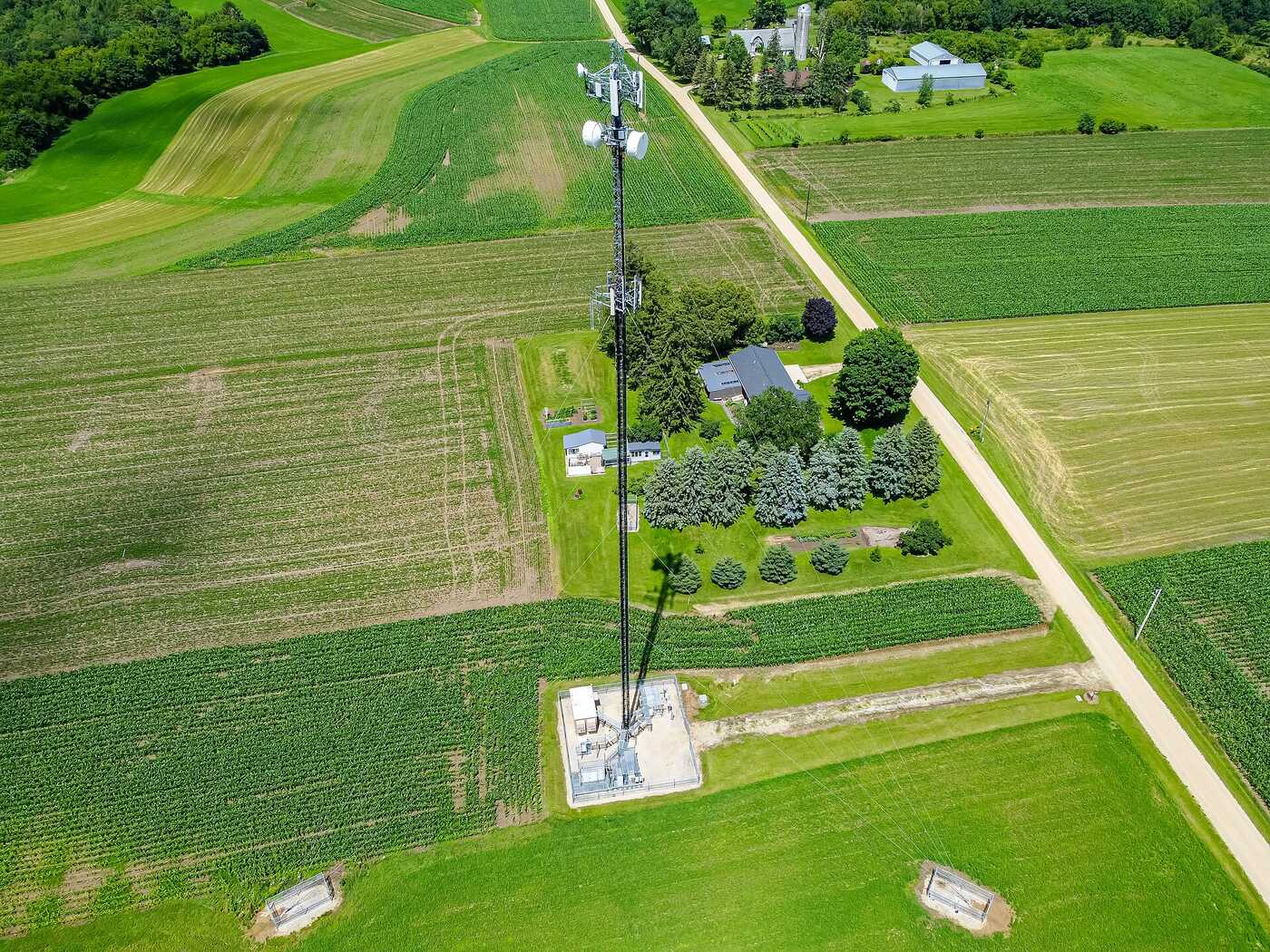 A cell site in farm country: panel antennas and round dishes on the tower, and an equipment yard at the base. Photo by Wikideas1, CC0, via Wikimedia Commons.
Why is it called a "cell" phone?
Radio spectrum is limited. If one powerful transmitter served a whole city, only as many people could talk at once as there were channels, and no one else in range could use those channels for anything.
The cellular idea is to do the opposite: use many low-power transmitters, each covering a small area, and reuse the same channels a short distance away. The federal rules for the original U.S. cellular service still define it this way. In Title 47 of the Code of Federal Regulations, a cell is "the service area of an individual transmitter location," and a cellular system is a high-capacity system of base stations that uses automatic hand-off between them "to enable channels to be re-used at relatively short distances."
Reuse is where the capacity comes from. That original service is allocated two channel blocks, A and B, between 824 and 894 MHz. Split the country into thousands of cells, and the same slice is used thousands of times over. When an area needs more capacity, one answer is more, smaller cells.
What is at the tower, and what is behind it?
The National Institute of Standards and Technology (NIST) describes the layout in its guide to 4G networks, and the same shape holds for other generations. There are three parts.
- Your phone. Inside it is a SIM, which the standards call a UICC: a small smart card holding the subscriber identity and secret keys that prove to the network who you are. That is why a thief who gets your number moved to a SIM he controls becomes you, as far as the network can tell. "SIM Swapping and How to Lock Your Phone Number" covers that attack and its fixes.
- The base station. This is the radio equipment at the cell site. It turns data into radio signals and back, and talks to every phone in its cell. A base station does not have to be a tall tower. NIST notes that small cells transmit at lower power, cover less ground and are used to add capacity.
- The core network. Base stations connect back to the carrier's core over a link called the backhaul, which NIST says can be fiber, microwave or satellite. NIST calls the core the routing and computing brain of the network. It controls authentication, pages your phone when a call comes in, hands out internet addresses, and connects you to the internet and to other phone networks.
The round dishes on the tower in the photograph are the kind of antenna used for point-to-point microwave links, and the flat panels are the kind that serve phones. The radio part of your call ends at the cell site. After that, your voice travels over the backhaul like any other data. "Fiber Optic Internet: Light in Glass, Explained" covers what those cables are.
How does a call survive a moving car?
NIST puts it simply: cellular networks are designed to pass a connection from one base station to the next as the phone changes location. The engineering name is handover, or handoff.
The 5G standard, written by the standards group 3GPP, calls this "network controlled mobility" and lays out the order of events.
- The phone measures. While it is connected, the phone keeps measuring the signal from its own cell and from neighboring cells, and reports those measurements to the base station serving it.
- The network decides. The serving base station makes the handover decision and sends a request to the target base station.
- The target makes room. The target checks whether it has capacity, a step called admission control, and acknowledges.
- The phone switches. The serving station tells the phone to move. The phone detaches from the old cell and synchronizes to the new one, and the old station forwards any data it was still holding.
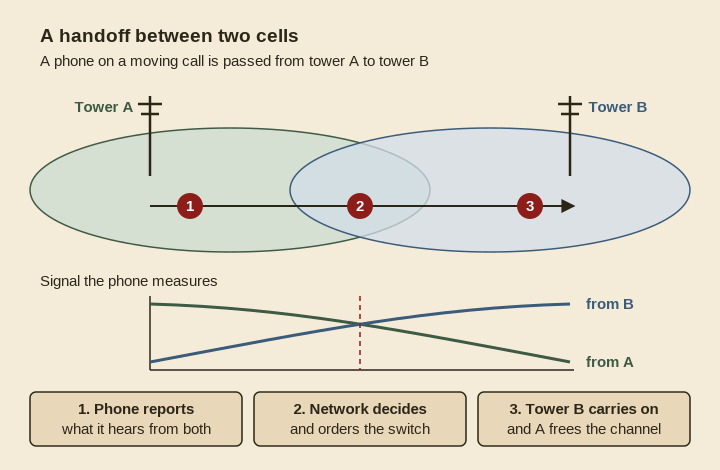 The phone does the measuring, the network does the deciding, and the switch happens in the overlap between two cells.
Here is the highway example with numbers. At 60 miles per hour you cover one mile per minute. A federal briefing on 5G describes mid-band cells as covering several square miles and high-band cells as reaching less than a mile. So in a stretch served by small cells, your phone can be handed off every minute or so, each time without you noticing. Step 3 is also where a moving call can fail: if the next cell has no room, or there is no next cell, there is nowhere to hand the call.
What do the frequency bands mean?
Every radio signal has a frequency, counted in hertz, and a wavelength, the length of one wave. The two are tied together by the speed of light: wavelength equals the speed of light divided by the frequency. Using NIST's value of 299,792,458 meters per second:
- at 700 MHz, one wave is about 43 centimeters long
- at 3.5 GHz, about 8.6 centimeters
- at 28 GHz, about 1.1 centimeters
Carriers and regulators sort the bands into three groups. A Federal Communications Commission (FCC) fact sheet calls low-band spectrum "useful for wider coverage" and says mid-band has "balanced coverage and capacity characteristics." A briefing from the Cybersecurity and Infrastructure Security Agency (CISA) fills in the picture.
| Band | Frequencies | Reach, per CISA | Trade-off |
|---|---|---|---|
| Low | Under 1 GHz | Hundreds of square miles | Widest coverage, suited to rural areas |
| Mid | 1 to 6 GHz | Several square miles | A balance of coverage and capacity |
| High (millimeter wave) | 24 to 47 GHz | Less than a mile | Gigabit speeds, but does not travel well through walls or windows |
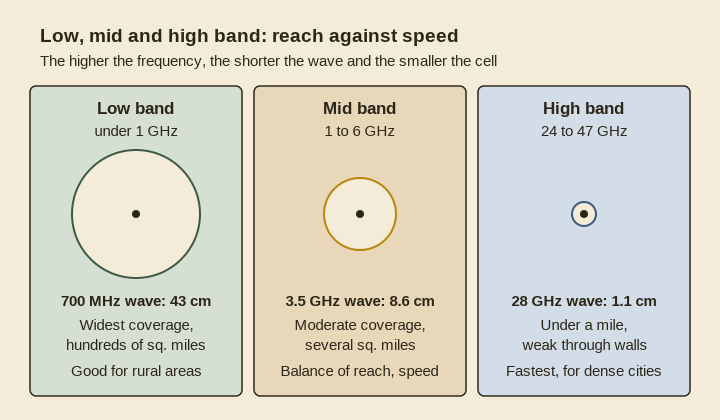 Lower frequencies reach farther, and higher frequencies carry more over a shorter distance.
The 5G standard itself defines two ranges: Frequency Range 1 from 410 MHz to 7,125 MHz, and Frequency Range 2 starting at 24,250 MHz and now reaching 71,000 MHz. As a rule of thumb, the lower the band, the farther each cell reaches. The higher the band, the more data it can carry, the worse it does with walls, and the more cells it takes to cover the same ground.
What did each generation change?
A "G" is a generation of standards, not a single invention. CISA's briefing sums up the first four in a few words each, and NIST and 3GPP supply the detail on the later ones.
| Generation | What it brought |
|---|---|
| 1G | Analog voice |
| 2G | Digital voice |
| 3G | Mobile data |
| 4G LTE | Mobile broadband, with everything carried as internet-style packets |
| 5G | A new radio and a new core, built to connect far more devices as well as phones |
The change from 3G to 4G is the one that reshaped the network. NIST explains that earlier networks used a hybrid: circuit-switched technology for voice, where a path is held open for the length of the call, and packet-switched technology for data. LTE uses only packet-switched, internet-style technology, and a voice call rides over the data connection. LTE arrived in 3GPP's Release 8, which NIST says was frozen, meaning finalized, on December 11, 2008.
5G begins with 3GPP's Release 15, which the group calls the first full set of 5G standards. It comes in two forms. In the early form, called non-standalone, a 5G radio is attached to an existing 4G core, and 3GPP says plainly that in this setup only the 4G services are supported. The full form, standalone, connects the new radio to a new 5G core, and 3GPP says only that form supports the full set of 5G services. One feature 3GPP describes for the 5G system is network slicing, where one physical network is run as several separate ones tuned for different jobs.
Why are bars a poor measure?
The bars are a summary, not a measurement. The developer documentation for Android, one of the two major phone systems, describes the value behind them as an abstract level for overall signal quality: a whole number from 0 to 4. Nothing on that page ties the five steps to fixed signal readings. The mapping is left to software, so two phones side by side can show different bars for the same signal.
The real number is on a steep scale. What the phone measures on 4G and 5G is called reference signal received power, or RSRP. The 5G standard defines it as the average power of specific reference signals the base station sends. It is reported in dBm, which the telecom industry's glossary defines as decibels relative to one milliwatt. Decibels are logarithmic: every 10 dB is a factor of ten in power.
A worked example shows how steep that is. A reading of minus 90 dBm is one billionth of a milliwatt, which is one trillionth of a watt. Compare a strong reading of minus 80 dBm with a weak one of minus 110 dBm. The gap is 30 dB, so the strong signal carries 1,000 times the power. FCC rules have carriers map signal levels from minus 50 dBm down to minus 120 dBm, a range of ten million to one. Five bars cannot say much about a range that wide.
Signal strength is not speed. The bars describe how loudly you hear the tower. They say nothing about how many other people it is serving. A cell's capacity is shared, so a strong signal at a packed stadium can crawl while a weak one on an empty road works fine.
Tip
If your phone or an app shows a signal reading in dBm, remember how the scale runs. The numbers are negative, closer to zero is stronger, and every 10 is a factor of ten. Minus 85 is ten times the power of minus 95.
What do people get wrong?
"A 5G icon means I am getting everything 5G promises." On a non-standalone network the phone is using a 5G radio with a 4G core. And 5G on low band reaches far but does not have the capacity of 5G on high band.
"The coverage map says I am covered, so it should work here." Coverage maps are models. The FCC's rules tell carriers how to build the ones they file: a 4G area is one where a user should expect at least 5 megabits per second down and 1 up at the cell edge, with a 90% probability of coverage and the cell assumed to be half loaded. The maps are drawn at a resolution of 100 meters. That leaves plenty of room for a dead spot in your kitchen.
Watch out
Do not judge a carrier by the bars in the store. Check the places that matter to you, at the times you use them, and look at what the phone can do there: load a page, make a call. A busy cell with a strong signal will show full bars and still disappoint you.
What to remember
- A network is built from many small cells so the same radio channels can be reused over and over. Capacity comes from reuse.
- In a handoff, the phone measures and reports, and the network decides and orders the switch.
- Low bands reach far and get indoors. High bands carry much more over much shorter distances. Mid bands sit between.
- 4G made everything packets, including voice. 5G added a new radio and, in its standalone form, a new core.
- Bars are a rough summary of signal strength on a five-step scale. They do not measure how busy the cell is, and that is often what decides your speed.
GPS.gov notes that major communications networks depend heavily on GPS for precise timing. "How GPS Works: Satellites, Clocks and the Blue Dot on Your Map" explains where that time signal comes from. And when there is no tower at all, "Meshtastic and Open Source Mesh Networks: Texting Without a Cell Tower" shows one way people fill the gap.
Sources (16)
- eCFR, 47 CFR 22.99, "Definitions" (cell, cellular system)
- eCFR, 47 CFR 22.905, "Channels for cellular service"
- eCFR, 47 CFR 1.7004, "Scope, content, and frequency of Broadband Data Collection filings"
- NIST, Special Publication 800-187, "Guide to LTE Security", December 2017
- 3GPP, "5G System Overview", August 8, 2022
- 3GPP, "Release 15"
- ETSI, TS 138 300 V18.4.0 (3GPP TS 38.300), "NR and NG-RAN Overall description; Stage-2", January 2025
- ETSI, TS 138 104 V18.5.0 (3GPP TS 38.104), "NR; Base Station (BS) radio transmission and reception", May 2024
- ETSI, TS 138 215 V18.4.0 (3GPP TS 38.215), "NR; Physical layer measurements", January 2025
- FCC, "The FCC's 5G FAST Plan" fact sheet
- CISA, "NECP Webinar: Technology 5G" slide presentation, December 9, 2020
- Android Developers, "CellSignalStrength" API reference
- ATIS Telecom Glossary, "dBm"
- ATIS Telecom Glossary, "dB"
- NIST, "CODATA Value: speed of light in vacuum"
- GPS.gov, "What Is GPS?"