Articles & BlogBy Trapper W. Brown7 min read
For anyone who has ever looked like a visitor, which is everyone, somewhere.
Why do experienced travelers still get taken? Because a good scam does not look like a crime while it is happening. It looks like a friendly stranger, a small mishap, or an official doing a job.
The details change with the city. One place has a bracelet, another a petition, another a spilled drink. Underneath there are only a few patterns, and once you know the pattern you can recognize it under any disguise. That is what this article is for. It describes how these things feel from the visitor's side, so you can notice one early and walk away.
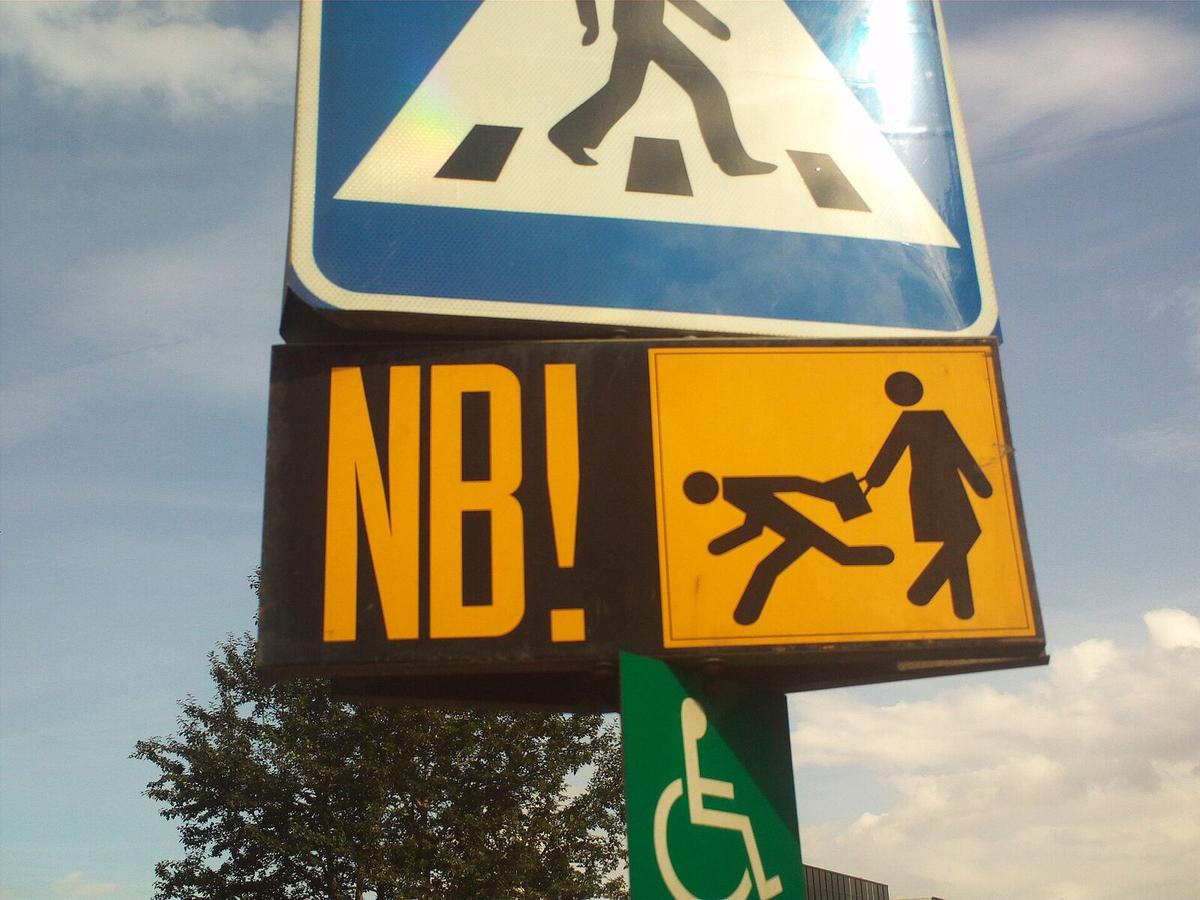 A street sign in Tallinn reminds people to keep hold of their bags, a warning that would fit any busy city. Photo by Ypsilon, CC0 public domain dedication, via Wikimedia Commons.
I wrote this for US travelers going abroad, and the fraud figures further down are US reports. The patterns themselves are the same everywhere, including in your home town.
Why the same tricks keep working
Every scam here leans on something decent in you: politeness, helpfulness, respect for authority, the wish not to make a fuss. Security people call this social engineering, which means getting past a person and not a lock. It works on clever people every day, so being caught by one says nothing about your intelligence.
Three signals turn up again and again. Someone you did not approach starts the conversation. There is pressure to act right now. And you are asked to hand something over: your wallet, your phone, your card, your attention. Any one of these is worth a pause. All three together are a reason to leave.
| Pattern | What it looks like to you | The warning sign | Your response |
|---|---|---|---|
| Distraction | A spill, a bump, a dropped item, a clipboard pushed under your nose | Sudden commotion very close to your body or your bag | Hand on your things, step back, keep moving |
| The helpful stranger | Unrequested help with a ticket machine, a cash machine, your bags, directions | Help you did not ask for, then a fee or a detour | "No, thank you", and find staff yourself |
| The fake official | Someone in a uniform or with a badge wants your passport, your wallet or a fine paid in cash | A demand for money on the spot, away from any office | Offer to go to the police station or your hotel desk |
| The inflated bill | No prices shown, extras you did not order, a total far above what you expected | No menu, no meter, no price until the end | Ask the price first. Check the bill line by line |
| The too-good exchange rate | A rate well above the banks, offered on the street | A hurry, a count done fast, a quiet corner | Use a bank or a cash machine attached to one |
| The imposter call or message | Your "bank", "airline", "hotel" or "embassy" contacts you about an urgent problem | They contacted you, and they want payment or a code now | Hang up. Call the real number yourself |
Distraction
The oldest pattern needs two things to happen at once. Something grabs your attention, and your attention is the thing that was protecting your pocket.
A stranger points out a stain on your jacket. A group crowds you at a train door. Someone pushes a map or a petition toward your chest. The common thread is sudden closeness that you did not invite.
Your response is physical and brief. Put a hand on your bag or your pocket, take a step back, and keep walking.
The helpful stranger and the fake official
Most strangers who offer help are simply kind, and travel would be poorer without them. So how do you tell the difference? Look at who started it and where it ends. Kindness answers a question you asked and then goes on its way. The scam version arrives uninvited, takes over, and finishes with a fee, a "gift" you are told to pay for, or a walk to a shop or an exchange counter owned by a friend.
The fake official works the same way, with a uniform added. A person with a badge says there is a problem with your documents or your money and that it can be settled now, in cash. Real fines come with paperwork and can be paid at an office. Stay polite, keep hold of your wallet, and offer to walk with them to the nearest police station or back to your hotel so the desk can help translate. A real officer can accept that.
Watch out
Do not hand your passport, your unlocked phone or your whole wallet to someone who approached you, whatever they are wearing. Show a document while you hold it. If they insist, insist on going to the station.
The bill and the exchange rate
The inflated bill grows wherever a price is not stated in advance: a taxi with no meter, a bar with no menu, a friendly local who suggests a place and orders for the table. Ask what it costs before you say yes, and read the bill before you pay. If the total is wrong, say so calmly and ask for it to be itemized. If the mood turns ugly, pay, leave, keep the receipt, and dispute the charge with your card company afterward. Your safety is worth more than the difference.
The street exchange pattern promises a rate no bank would give. If a rate looks too good, the loss is hiding somewhere else: in a fast count, in old or false notes, or in a fold of paper where bills should be. Change money at a bank or take it from a cash machine.
On cash machines and card readers, the FBI's advice on skimming is worth carrying with you. The FBI says skimming "costs financial institutions and consumers more than $1 billion each year". Its guidance: inspect the reader before you use it, pull at the edges of the keypad, cover your PIN, prefer tap or chip over swiping, and use credit over debit.
Tip
Tell your bank your travel dates and turn on a text or app alert for every charge. You will know about a bad charge within minutes, while you can still act on it.
The imposter call or message
This one can reach you anywhere, including your hotel bed. Someone contacts you claiming to be a business or an agency you trust, and there is an urgent problem that only an immediate payment or a code can fix.
It is the most reported kind of fraud at home. The Federal Trade Commission says that in 2025 people in the United States filed about 3 million fraud reports with losses of $15.9 billion. Imposter scams drew more than 1 million of those reports and more than $3.5 billion in losses. Business impersonators accounted for nearly $1 billion and government impersonators about $920 million. These are US reports, and they count only what people told the FTC.
| All fraud | $15.9B |
|---|---|
| Imposter scams | $3.5B |
| Government impersonators | $0.92B |
Source: Federal Trade Commission, fraud reports for 2025 (imposter figure is a minimum)
Travel gives the imposter a better story.
| The message says | What to do instead |
|---|---|
| Your flight is cancelled, rebook through this link | Open the airline's own app or website and look up the booking |
| Your card was declined at the hotel, confirm the number | Walk to the front desk and ask |
| Your bank has seen fraud, read us the code we just sent | Hang up and call the number on the back of your card |
| The embassy has found a problem with your visa, pay a fee now | Look up the embassy's number yourself and call it |
The answer is the same every time. End the conversation, then contact the organization yourself, using the number on the back of your card, in the airline's own app, or on the official website. Never use a number or link the caller gave you. No real bank, airline or embassy asks you to read out a one-time code or to pay in gift cards.
If it happens to you
It happens to careful people. Act quickly and without blaming yourself:
- Call your bank or card company and block or dispute the charge
- Change the password on any account you gave details for
- Report it to the local police and ask for a copy of the report
- Report scams and bad business practices at reportfraud.ftc.gov, and online fraud to the FBI's Internet Crime Complaint Center at ic3.gov
- If your passport is gone, contact the nearest US embassy or consulate
What to remember
- There are a few patterns and many costumes. Learn the patterns.
- Three signals: they approached you, there is a hurry, and you are asked to hand something over.
- Ask the price first and read the bill.
- Show documents while holding them. Offer to go to the station.
- If they called you, hang up and call the real number yourself.
- Report it, starting with your bank.
Do not let this list sour you on strangers. Most people you meet abroad want nothing from you but a pleasant exchange, and a traveler who suspects everyone has a worse trip than one who loses a little money. Knowing the patterns is what lets you relax, because you know when to walk away.