Articles & BlogBy Trapper W. Brown7 min readOpinion
Opinion. America cannot build enough housing mainly because local rules make homes slow, costly or illegal to build where people most want to live, and because some places are overpopulated for the homes they allow, even though the country as a whole is not.
Ask me why America cannot build housing and my short answer has been two words: overregulation and overpopulation. I think the first is right. Before writing this I checked both against the Census Bureau's numbers, and the second one holds only in a narrower form: some places are overpopulated for the homes they allow, and the country as a whole is not.
The country is not overfull. Its population grew 0.5% last year, half the pace of the year before. What has grown is the number of households, and they want to live in the same few places. Those places are the ones that have made building hardest. That is my argument, and I will show the numbers.
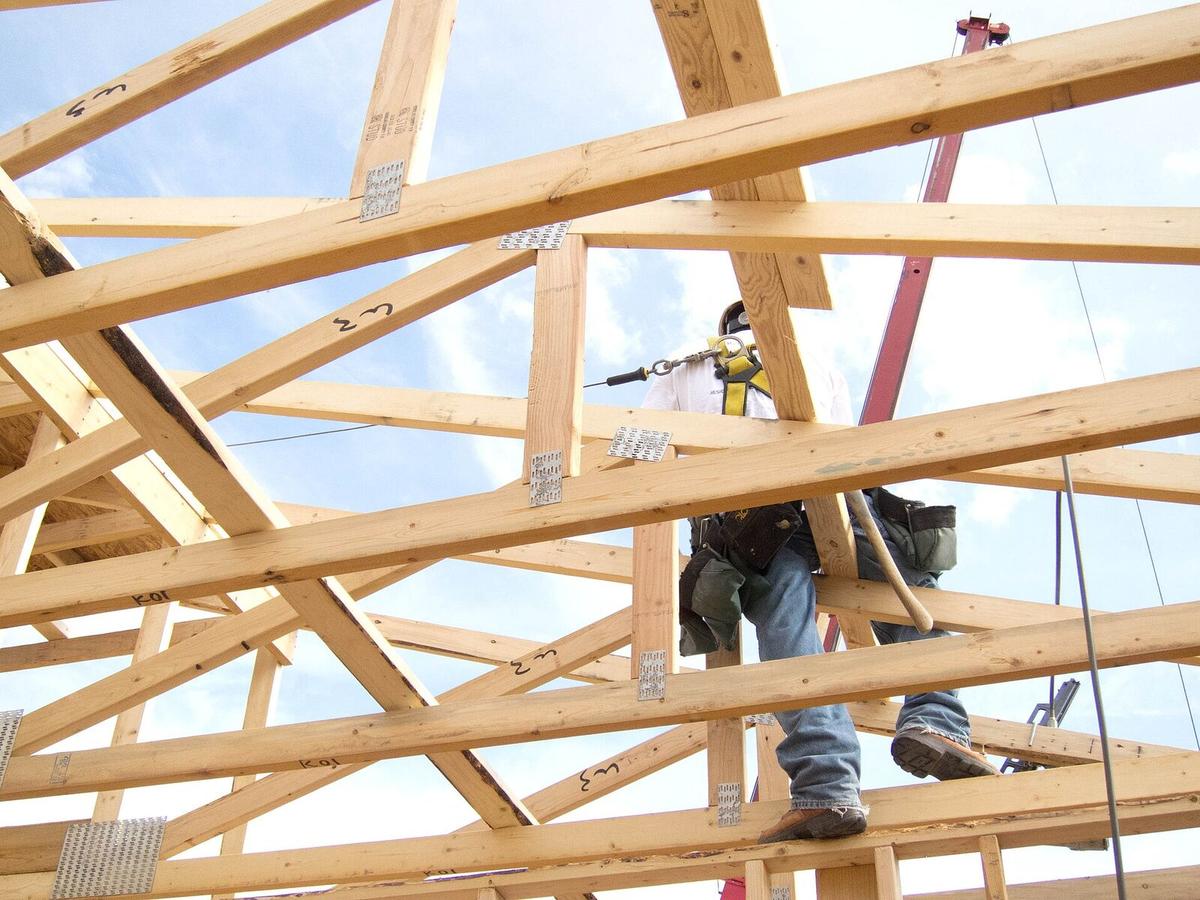 A framer on a new house, tied off against a fall. Photo by the National Institute for Occupational Safety and Health, public domain, via Wikimedia Commons.
Are we building less than we used to?
Yes, by a lot. The Census Bureau's count of housing units started peaked in 1972 at about 2.36 million. In 2025 it was about 1.36 million. In between, the population went from 209.9 million to 341.8 million.
Put those together. In 1972 the country started 11 homes for every 1,000 residents. In 2025 it started 4.
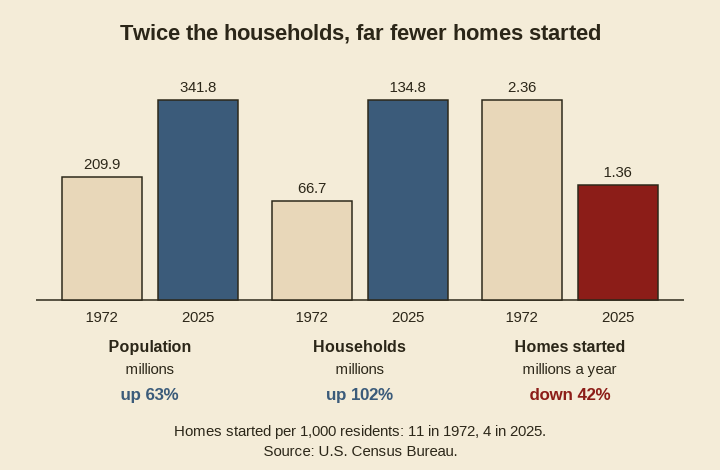 The number of households doubled while the number of homes started each year fell by more than two fifths.
Freddie Mac estimated in November 2024 that the country was short 3.7 million homes. It noted that almost four years of building had barely dented the gap, because 5.8 million homes were added while 6.3 million households formed.
Is it overpopulation?
Not nationally. The Census Bureau reported in January 2026 that the population grew 0.5% in the year to July 2025, the slowest since 2021. Births outnumbered deaths by only about 519,000. Five states lost people, California among them.
So where does the pressure come from? Households. In 1972 the average household held 3.06 people. In 2025 it held 2.50. One-person households went from 12 million to nearly 40 million. By my arithmetic, if Americans still lived 3.06 to a home, today's population would need about 110 million homes. The actual count of households is close to 135 million. That is roughly 25 million extra front doors with no extra people behind them.
The second half is where those households want to be. Jobs and family pull people toward a short list of metro areas. Those are the places I mean when I say overpopulated, and the word needs care even there, because it measures people against homes and not against land. Los Angeles County lost almost 54,000 residents in the year to July 2025, the largest drop of any county, and nobody would call it cheap. A place can lose people and stay short of homes when it builds as little as the chart below shows.
What do the rules do?
Compare metro areas, using the Census Bureau's 2025 permit counts and population estimates.
| Austin | 10.4 |
|---|---|
| Houston | 8.2 |
| Dallas-Fort Worth | 7.8 |
| Phoenix | 7.6 |
| San Jose | 2.8 |
| New York | 2.2 |
| Los Angeles | 2.1 |
| Boston | 2 |
| San Francisco | 1.7 |
Greater Houston permitted about 65,000 homes in 2025. Greater Los Angeles, with 5 million more people, permitted about 27,000. I do not think lumber, wages and interest rates differ enough between Texas and California to explain that. What differs most is what you are allowed to build, where, and how long it takes to get a yes.
Zoning is the local law that says what may be built on each lot. In much of the country it permits one detached house per lot and nothing else, with a minimum lot size and a required number of parking spaces. The economists Edward Glaeser and Joseph Gyourko, writing in the Journal of Economic Perspectives in 2018, treated the gap between what a home sells for and what it costs to build as a "regulatory tax." They wrote that the evidence suggests, without proving, that this tax is often higher than any reasonable harm new building does to the neighbors.
There is a test case. Minneapolis ended parking minimums, allowed backyard units and shrank minimum lot sizes. The Pew Charitable Trusts found that from 2017 to 2022 the city grew its housing stock by 12% while rents rose 1%. The rest of Minnesota added 4% and saw rents rise 14%.
For example, take a family that wants to add a small cottage behind the house for a grandparent, and a builder who wants to put 200 apartments next to a train station. In many towns both need a hearing, a variance and a year. The family gives up. The builder adds the delay to the rent.
What the other side gets right
The strongest objection is that I am blaming rules for what money and history did. It has a point. Housing starts fell to 554,000 in 2009 after the financial crisis and stayed under a million through 2013. An industry that shrinks that far does not regrow overnight, and no zoning reform changes that. Interest rates matter too.
The second objection is that rules exist for reasons. That is also right. Fire codes, flood maps and sewer capacity are not red tape. And a neighborhood has a fair interest in what goes up next door.
My answer is that those are two different kinds of rule. One kind keeps a building from burning or flooding. The other keeps a building from existing: the lot minimum, the parking mandate, the height cap, the hearing where one objection is enough. The home builders' own trade association estimates that regulation of all kinds makes up 26.4% of the price of a new house. That is an interested party's number, and I would not lean on it alone. It still tells you which rules deserve a second look.
Who should change what?
Cities and counties hold most of the power here, and states can override them. I would ask for three things.
- Allow more than one home on a residential lot by right, meaning without a hearing, the way Minneapolis did.
- Drop parking minimums and let the builder decide.
- Put a deadline on permit decisions, with approval as the default when the deadline passes.
In my trade, accepting a risk is a deliberate choice that someone signs for. Saying no to housing is a risk decision too. It has a cost in rent, in commutes and in adult children who cannot move out. Right now nobody signs for it.
Where I land
- The country starts about 4 homes per 1,000 residents a year. In 1972 it started 11.
- The country is not overpopulated. Some metro areas are, measured against the homes they allow: twice as many households as in 1972, smaller ones, want the same few places.
- Greater Houston permits about four times as many homes per resident as greater Los Angeles. I think rules explain most of that gap.
- Keep the rules that make buildings safe. Cut the ones that only make them scarce.
I started with two words and I am keeping both, one of them narrowed. Overregulation, yes. Overpopulation, yes in the places people most want to live and no for the country, and in those places it is what a shortage of homes feels like from the inside.
Sources (12)
- U.S. Census Bureau, New Residential Construction, "Housing Units Started", annual table
- U.S. Census Bureau, historical national population estimates, 1900 to 1980
- U.S. Census Bureau, "U.S. Population Growth Slows Due to Historic Decline in Net International Migration", 27 January 2026
- Freddie Mac, "Housing Supply: Still Undersupplied by Millions of Units", 26 November 2024
- U.S. Census Bureau, historical households table HH-6
- U.S. Census Bureau, historical households table HH-4
- U.S. Census Bureau, "Slow Growth Impacts Nation's Largest Counties Hardest", 26 March 2026
- U.S. Census Bureau, Building Permits Survey, annual 2025 by metropolitan area
- U.S. Census Bureau, metropolitan area population estimates, 2020 to 2025, data file
- Glaeser and Gyourko, "The Economic Implications of Housing Supply", Journal of Economic Perspectives, Winter 2018
- The Pew Charitable Trusts, "Minneapolis Land Use Reforms Offer a Blueprint for Housing Affordability", 4 January 2024
- National Association of Home Builders, press release on regulatory costs, 9 June 2026