Articles & BlogBy Trapper W. Brown6 min readOpinion
Opinion. AI is taking over healthcare paperwork from both sides at once, and unless a named clinician stays answerable for every denial, the result is a faster arms race that costs more and helps no patient.
The first part of healthcare that AI takes over is not the exam room. It is the back office: coding, billing, prior authorization and appeals. Insurers are buying tools to review requests. Hospitals and practices are buying tools to write them. Soon one machine will be arguing with another about whether you get the scan.
I think that goes badly unless one thing stays human. A machine may speed up a yes. A no that delays care needs a clinician's name on it and a reason a person can read. Without that, we will have built a faster argument that costs more and treats nobody.
 Inpatient records at a naval medical center in 2010. Paper made every request cost something to write, to file and to find. U.S. Navy photo by Mass Communication Specialist 3rd Class Amanda L. Kilpatrick, public domain, via Wikimedia Commons.
How heavy is the paperwork now?
Heavy enough that the case for automating it makes itself. The American Medical Association surveys 1,000 practicing physicians each year about prior authorization, the step where a plan must approve a treatment before it will pay. In the 2025 survey, practices reported completing an average of 40 prior authorizations per physician every week. Physicians and their staff spent 13 hours a week on them, and 40% of physicians had staff who did nothing else. The AMA speaks for physicians, so weigh that accordingly. Even so, few people on either side of the desk argue that the load is light.
Now the other side of the desk. KFF, analyzing federal data in January 2026, counted nearly 53 million prior authorization requests sent to Medicare Advantage insurers in 2024. Insurers denied 4.1 million of them in full or in part, or 7.7%. Only 11.5% of those denials were appealed. Of the ones that were, 80.7% were overturned in full or in part.
Read the last two figures together. Most denials that get challenged do not survive, and most are never challenged. KFF is fair about why: an overturned denial may mean the first request was missing paperwork, not that the denial was wrong. Either way the patient waited. In the AMA survey, 52% of physicians said that when they do not appeal, a reason is that they lack the staff or the time.
What happens when writing costs nothing?
Today an appeal costs a human being an hour. That cost is unfair, and it is also the only thing limiting the volume. AI removes it, for both sides at the same moment.
When writing an appeal costs nothing and writing a denial costs nothing, you do not get less paperwork. You get far more of it, moving faster, with nobody reading it. Cheap ammunition makes for a longer war.
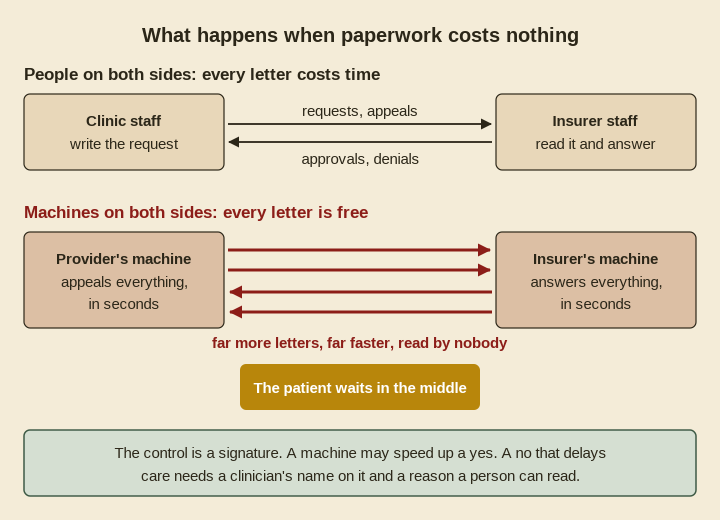 Take the cost out of both ends of an argument and the argument grows.
Nobody in that picture has to behave badly. The provider's tool appeals every denial because appealing usually works. The insurer's tool answers every appeal because it can. Each side is responding sensibly to the other.
Then ask who can afford the tooling. An 800 bed hospital system has a revenue department and a budget for software. A 12 person clinic has one biller. She will be answering machine-speed denials at human speed. Her patients wait longer, or the clinic sells itself to a larger group that owns the software. Arms races are won by whoever can pay for the arms.
The other side: is automation not the cure?
A good part of it is, and I want to say so plainly. The burden is real: 94% of physicians in the AMA survey said prior authorization adds to burnout. Thirteen hours a week handed back to nurses and physicians is care somebody receives. In Medicare Advantage more than nine requests in ten were approved in 2024, and a machine that says yes in seconds does the patient a real good.
Regulators are pushing the same way. A federal rule finalized in January 2024, known as CMS-0057-F, requires most of the plans it covers to answer urgent requests within 72 hours and standard ones within seven calendar days, generally starting in 2026, and to offer an electronic prior authorization interface by January 1, 2027. I am glad of all of it. My objection is narrow. It is to the automated no.
Who signs the no?
The rules already lean this way. The same CMS rule says that beginning in 2026 a plan must give a specific reason when it denies a request (the rule does not reach prescription drugs). In a February 2024 memo to Medicare Advantage plans, CMS said an algorithm may assist with coverage decisions but the plan remains responsible for them. A decision has to rest on the individual patient's circumstances, and a tool that decides from a larger data set in place of the patient's own history and the physician's notes would not comply. An adverse medical necessity decision must be reviewed by a physician or other appropriate professional before it goes out.
That is the right principle. It needs to be applied to everyone and it needs teeth.
- Payers should put a named clinician and a plain reason on every denial that delays care, and should count how many denials each reviewer signs in a day. If the number is 400, nobody reviewed anything.
- Providers should hold themselves to the same standard. Someone with a name answers for every appeal the practice sends. Do not fire off letters nobody has read.
- Regulators should measure time to care and not time to letter, and should treat a high share of overturned denials as a finding to investigate.
Where I come from, accepting a risk is a deliberate act and a named person signs for it. A denial is a decision to accept a risk on a patient's behalf. A machine cannot sign for that.
Where I land
- AI is arriving in the back office first, and on both sides of the same transaction.
- Free paperwork means more paperwork. The smallest practices will lose that race first.
- Automation that speeds up a yes is a plain good, and regulators are right to demand it.
- Every no that delays care should carry a clinician's name and a reason a patient can read.
If you run a practice, ask any vendor selling an appeals or authorization tool two questions: who reads what it writes, and whose name goes on it. If you are a patient holding a denial, ask the plan for the specific reason and for the reviewer's credentials, and appeal. In Medicare Advantage, at least, most appeals succeed.