Articles & BlogBy Trapper W. Brown6 min readOpinion
Opinion. We should try to cure aging, as long as whatever works is open to everyone, with no gate on the technology or the medicine.
Should we try to cure aging? My answer is a question back: why not? Aging is a major risk factor for many chronic diseases, and nearly everyone who lives long enough meets it. If we can make those years better for everyone, I think we should try.
The answer comes with one condition, and it matters as much as the yes. Whatever works has to be accessible to all. No gatekeeping of the technology or the medicine. A treatment for aging that only some people can get is a different project, and I would not sign for that one.
 More good years is the goal, and the question is who gets them. Photo by Rhoda Baer, National Cancer Institute, public domain, via Wikimedia Commons.
What does "curing aging" mean right now?
Mostly it means mice. In 2009 a paper in Nature by Harrison and colleagues reported that mice fed a drug called rapamycin late in life lived longer: 14 percent longer for females and 9 percent for males, measured at the age when 90 percent of the animals had died. The result showed up at three separate test sites. That is a real finding in an animal. It is not a finding in people.
In people, nothing has cleared the bar. In May 2026 the Reagan-Udall Foundation for the FDA, a nonprofit that Congress created to support the agency, held a public meeting on this exact subject. Its summary, published in July, says there is no FDA-approved indication for aging itself and no validated biological marker of aging that regulators accept. An indication is the specific condition a drug is approved to treat. The summary reports that the FDA's chief scientist said the same thing in the room.
So let me be plain. Nothing in this column is a reason to take anything. No pill, supplement or clinic has been shown to slow aging in humans, and anyone thinking about trying one should talk to their own clinician first. This is an argument about research and rules. Your medicine cabinet should stay as it is.
Why try at all?
Because of the numbers. The World Health Organization says that by 2030, 1 in 6 people in the world will be 60 or older, and that by 2050 there will be 2.1 billion of them. The number aged 80 or older is expected to triple between 2020 and 2050, to 426 million. Today we treat the illnesses of age one at a time: a heart, then a hip, then a memory. Slowing what sits underneath them would be a different kind of medicine.
Economists have tried to price it. A 2021 paper in Nature Aging by Scott, Ellison and Sinclair estimated that slowing aging enough to add one year of life expectancy would be worth $38 trillion. Two of the three authors disclose ties to longevity businesses, so read that figure with one eyebrow up. The more useful finding in the same paper is that making the years we have healthier is worth more than adding years at the end. The FDA's chief scientist framed the goal the same way at the 2026 meeting: "healthspan, not lifespan."
That is the version I am arguing for. More good years: the grandmother who still drives at 85, and fewer years in a nursing home bed.
What is the strongest case against?
I do not think it is the claim that aging is natural. Infection is natural too. The strongest objection is about who gets the cure.
We already ration long life by income. A 2016 study in JAMA by Chetty and colleagues used 1.4 billion tax records and found that the richest 1 percent of American men lived 14.6 years longer than the poorest 1 percent. For women the gap was 10.1 years. It was also growing. Between 2001 and 2014, men in the top 5 percent of income gained 2.34 years of life expectancy. Men in the bottom 5 percent gained 0.32.
All of that happened with no aging drug at all. Now imagine one arrives with a high price. For example, a family that can pay cash gets twenty more healthy years, and a family that cannot pay watches through the glass. A gap in money becomes a gap in time, and time compounds: more working years, more savings, more say in how things are run.
The critics are right about this. I think it is the most likely way the project goes wrong, and "the price will come down eventually" is a weak answer when the thing being rationed is years of life. Where I part with them is the conclusion. What they have found is a flaw in the gate, and gates are designed by people. An unfair way of handing out a medicine is a reason to fix the handing out.
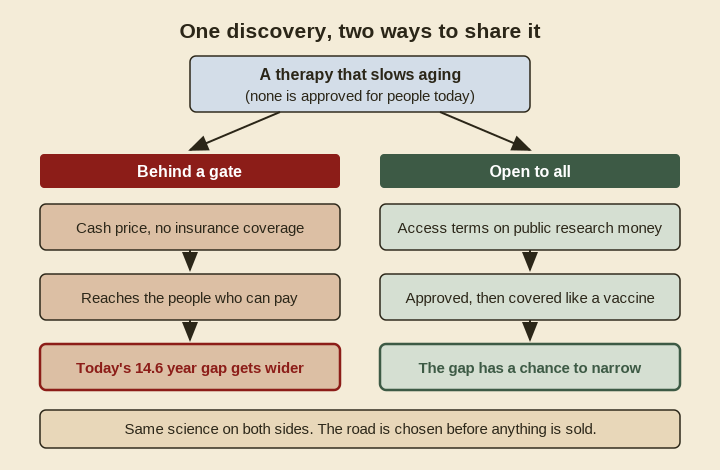 The same discovery can widen the life expectancy gap or narrow it, depending on rules written in advance.
What does "accessible for all" have to mean?
It has to be decided before there is anything to sell. Afterward is too late, because by then someone owns the gate.
A good deal of this research is public money already. The meeting summary describes a new $144 million federal program at ARPA-H, a government health research agency, to build the measuring tools and early tests this field needs. As a rule of thumb, what the public pays to discover, the public should be able to afford. Three groups can make that true:
- Funders. Agencies that pay for the research should attach access terms to the grant: fair pricing and broad licensing, written in at the start.
- Regulators. The FDA should settle what a trial has to prove. Without an approved indication there is nothing for insurers or public programs to cover, and whatever works stays a cash product.
- Payers. Public and private insurers should treat a proven therapy the way they treat a vaccine: something everybody gets because everybody benefits.
Each of those is a choice someone has to sign. Leaving it to the market is a choice too, and someone signs that one as well.
Where I land
- Yes, try. Aging raises the risk of many chronic diseases, and the population over 60 is headed for 2.1 billion.
- Be honest about where the science is: mice, and no approved treatment in people.
- The real danger is a gate. Life expectancy in the United States already tracks income by more than a decade.
- Write the access rules now, while there is nothing to sell and nobody to dislodge.
I do not know whether aging can be cured, and neither does anyone else. I do know the order in which I would want the questions answered. Who gets it comes first, and the only answer I would accept is everyone.
Sources (5)
- Harrison and others, "Rapamycin fed late in life extends lifespan in genetically heterogeneous mice", Nature, 16 July 2009
- Reagan-Udall Foundation for the FDA, "Affecting the Aging Trajectory", public meeting summary, July 2026
- World Health Organization, "Ageing and health" fact sheet, 1 October 2025
- Scott, Ellison and Sinclair, "The economic value of targeting aging", Nature Aging, July 2021
- Chetty and others, "The Association Between Income and Life Expectancy in the United States, 2001-2014", JAMA, 26 April 2016