Articles & BlogBy Trapper W. Brown7 min readCurrent to 12 November 2026Opinion
Opinion. No. A company that has been hacked should not be allowed to break into someone else's computer in return, because we are not like the people who did it.
Should a company that has been hacked be allowed to hack back? No. Someone broke in, took what was not theirs, and is sitting somewhere out of reach. Wanting to reach back through the wire is a human reaction. It should stay a reaction and not become a policy.
"We are not like them" can sound like a slogan. I mean it as an operating rule. The other side breaks into machines it has no right to touch, on its own say-so, and answers to nobody. If we do the same, the only thing left separating us is whose logo is on the building.
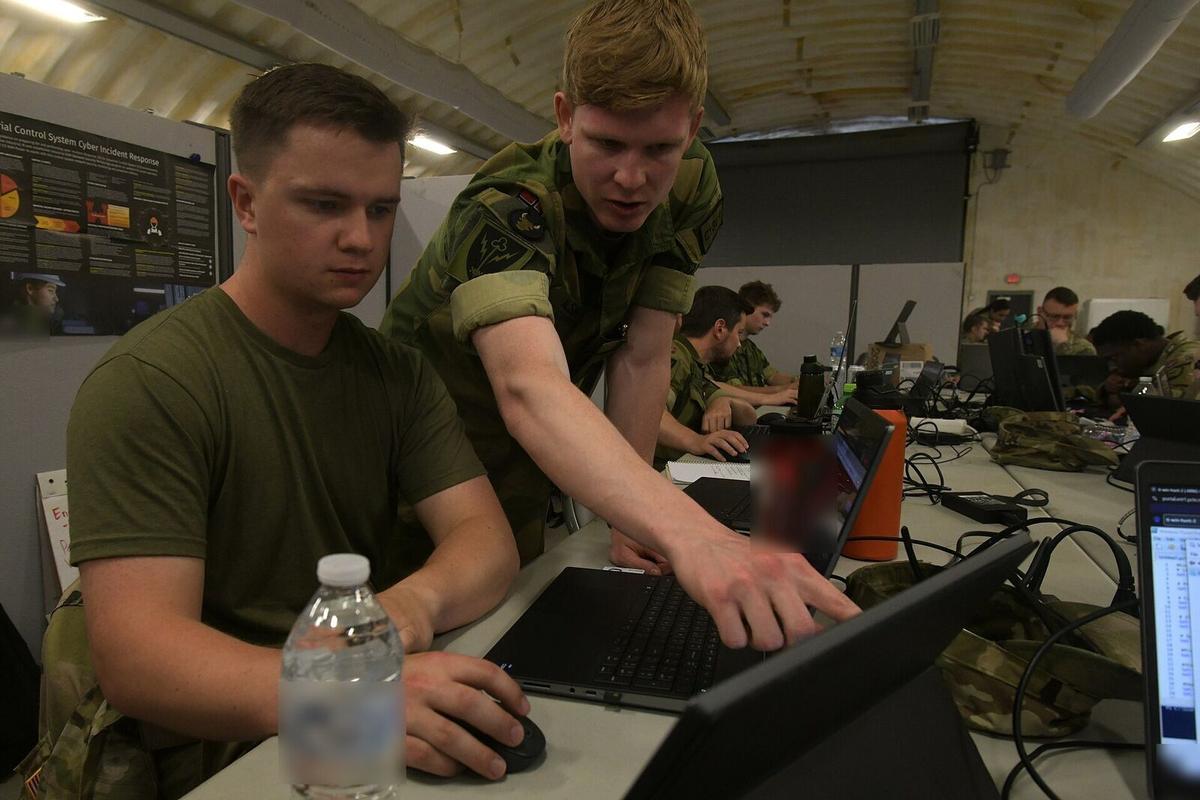 Defense is work done on your own network: U.S. and Norwegian troops practice it at exercise Cyber Shield in Virginia in 2025. Photo by Sgt. 1st Class Jon Soucy, U.S. Army, public domain, via Wikimedia Commons.
What does hacking back mean?
Hacking back means a victim reaches out of its own network and into someone else's computer: to look around, to delete stolen files, or to knock the machine offline. It does not mean defending your own systems. Blocking, tracing, setting traps inside your own walls and handing the results to investigators are all fair.
The line is in federal law. The Computer Fraud and Abuse Act, 18 U.S.C. 1030, makes it a crime when someone "intentionally accesses a computer without authorization." It carves out "lawfully authorized" activity by law enforcement agencies. It has no carve-out for a victim who is angry and good with a keyboard. The Justice Department's guide for victims, "Best Practices for Victim Response and Reporting of Cyber Incidents" (September 2018), says a victim "should not unilaterally respond to a cyber incident by accessing, modifying, or damaging a computer it does not own or operate, even if the computer appears to have been involved in an attack or intrusion."
Who is actually at the address in your logs?
Usually another victim.
The same Justice Department guide explains why: "Many intrusions and attacks are launched from systems a perpetrator has compromised and used as an intermediary." For a concrete case, read the joint advisory that CISA, the NSA and the FBI published on 7 February 2024 about a Chinese state-sponsored group. It says the group routes its traffic through chains of rented servers and "small office/home office (SOHO) routers," including end-of-life routers that had been infected with malware for the purpose.
So picture it. An 800 bed hospital system is hit. Its logs show the attack coming from one address. The security team, furious and capable, strikes that address. It belongs to the router in the back room of a 12 person clinic two states away. The clinic's phones and scheduling go down on a Tuesday morning. The attacker, three hops further back, notices nothing except that one of many relays went quiet.
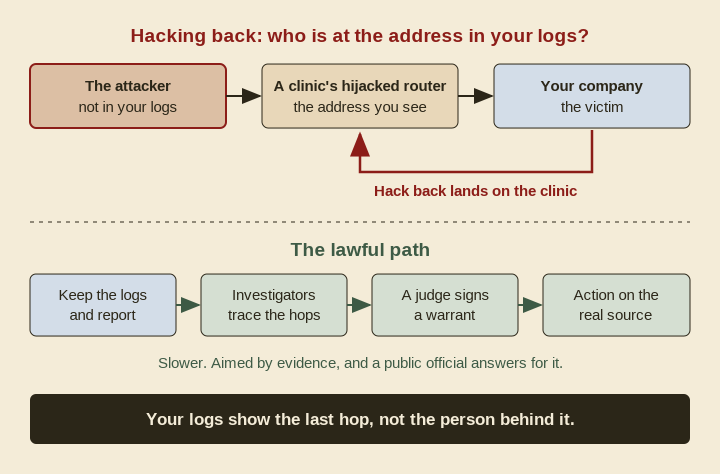 The address that attacked you is usually a machine the attacker borrowed.
The guide lists two more ways it goes wrong. A private strike can interfere with an investigation that was already tracking the intruder. And "a perpetrator who detects a hack back attempt may choose to retaliate, causing further damage to the victim."
What the other side gets right
Victims are right that the lawful path is slow and often ends in nothing. The FBI's Internet Crime Complaint Center took 1,008,597 complaints in 2025, with reported losses of $20.877 billion, up 26 percent on the year before. No police force clears a caseload like that. It is fair to ask why skilled people in the private sector should sit on their hands.
Lawmakers have tried to answer. The Active Cyber Defense Certainty Act, H.R. 3270 in the 116th Congress, was introduced on 13 June 2019 and went no further than a subcommittee. H.R. 4988, the Scam Farms Marque and Reprisal Authorization Act of 2025, was introduced on 15 August 2025 and referred to the House Committee on Foreign Affairs. As of 12 November 2026 that is still its latest recorded action.
The executive branch has gone further. A presidential memorandum of 12 August 2026, "Expanding Capabilities to Combat Transnational Cyber-Enabled Crime," sets up a program in which vetted "Participating Companies" may carry out operations against foreign criminal groups "under the control and oversight of the Federal Government." Read the conditions, though. Every operation needs written approval from program directors at the Justice and Homeland Security departments "before action may be taken." The memorandum says the program must comply with section 1030, and a company that finds it has touched a system in the United States must stop and report at once.
That program is not hacking back as I have defined it. A victim is not deciding for itself. It is the government hiring help, and the memorandum keeps the decision, and the answering for it, with public officials. I read that as the other side conceding the main point: even the most permissive policy on the books does not let a company pull the trigger on its own judgment.
Why "not like them" is a practical rule
Think about how we handle the physical version. A shop owner who is burgled does not get to kick in the door of the house where he believes his stock went. He calls the police, a judge signs a warrant, and officers who can be sued, fired or prosecuted go through the door. Sometimes that is too slow and the stock is gone. We keep the rule anyway, because the alternative is every aggrieved person deciding who is guilty.
Online it is harder. For example, a court wants evidence that survives questions from the other side. A response team at three in the morning has a hunch and an address.
There is a fairness problem too. As a rule of thumb, only the largest firms could afford an offensive team. The clinic could not. A right that only the biggest players can use, and that the smallest are most likely to be hit by, is a poor right.
What should change, and who should change it
- Congress should fund investigators and prosecutors to the scale of the complaints, and leave section 1030 without a private self-help exception.
- The Justice Department should make reporting worth a victim's time: fast intake, and word back on what happened.
- The agencies running the August 2026 program should publish what they can about how often operations are approved and how often one touched the wrong machine.
- Companies should put the money a strike team would cost into logging, backups and practice.
Where I land
- The address that attacked you is usually another victim's machine.
- Federal law has no self-defense exception for breaking into a computer, and I think that is correct.
- The lawful path is too slow. Fix its speed, and keep the judge.
- Even the government's own 2026 program keeps the decision with public officials. So should we.
None of this makes being robbed feel better. I would still rather be the slow party with a warrant than the fast one who took down a clinic's phones. That is most of what "we are not like them" means to me.
Sources (7)
- 18 U.S.C. 1030, Computer Fraud and Abuse Act
- U.S. Department of Justice, Cybersecurity Unit, "Best Practices for Victim Response and Reporting of Cyber Incidents", Version 2.0, September 2018
- CISA, NSA, FBI and partners, Cybersecurity Advisory AA24-038A, "PRC State-Sponsored Actors Compromise and Maintain Persistent Access to U.S. Critical Infrastructure", 7 February 2024
- FBI Internet Crime Complaint Center, "2025 Internet Crime Report", April 2026
- H.R. 3270, 116th Congress, "Active Cyber Defense Certainty Act"
- H.R. 4988, 119th Congress, "Scam Farms Marque and Reprisal Authorization Act of 2025"
- The White House, presidential memorandum, "Expanding Capabilities to Combat Transnational Cyber-Enabled Crime", 12 August 2026