Articles & BlogBy Trapper W. Brown9 min readFacts only
On 12 November 2026, Nvidia announced that Jensen Huang has resigned as president, chief executive officer (CEO) and member of the board, effective immediately. He co-founded the company in 1993 and had run it ever since. The company's finance chief is now interim CEO, and the board has named a chair for the first time.
Nvidia designs the chips that most of the artificial intelligence (AI) industry runs on, so a change at the top matters well beyond its own offices. This article is a plain account of what the company published, as of the evening of 12 November 2026. The story is hours old. Details may change, and anything below that comes from a press report and not from the company is marked as such.
 Every computer chip, including the kind Nvidia designs, begins as one small rectangle in a grid on a silicon wafer like this one. Photo by Syced, CC0, via Wikimedia Commons.
What did the company announce?
Two documents carry the news. The first is a press release dated 12 November 2026 from Santa Clara, California. The second is a Form 8-K, the report a public company files with the US Securities and Exchange Commission (SEC) when something significant happens. Nvidia's 8-K attaches the press release as an exhibit.
Read together, they say four things.
- The board accepted Huang's resignation as president, CEO and director on 11 November 2026, the day before the public announcement. The filing uses his formal name, Jen-Hsun Huang.
- Colette Kress, the executive vice president and chief financial officer (CFO), is interim CEO. She keeps the CFO job while she holds the interim one.
- The board appointed Harvey C. Jones as its chair on 11 November. The release calls him the board's "first-ever Chair."
- The board is starting a search for a permanent CEO.
The release thanks Huang. It refers to "the extraordinary foundation Jensen created over the last 33 years." It contains no statement from Huang himself.
Who is in charge now?
Two people, in two different roles.
Colette Kress runs the company day to day as interim CEO. The 8-K gives her age as 59 and says she has been executive vice president and CFO since 2013. A CFO is the executive responsible for the company's money: its accounts, its forecasts and what it tells investors about both. The filing lists no new pay arrangement for the interim role.
Harvey C. Jones leads the board as chair. The filing gives his age as 73 and says he has been an Nvidia director since 1993, the year the company was founded. It describes him as managing partner of Square Wave Ventures, a private family office, since 2004. The press release adds that he was once chief executive and executive chairman of another technology company, Synopsys. In the release he says: "The Board has full confidence in Colette and the leadership team."
The difference between the two jobs is worth a sentence. The CEO manages the business. The chair runs the board, which is the group that hires, oversees and can remove the CEO. Until this week Nvidia had no board chair at all.
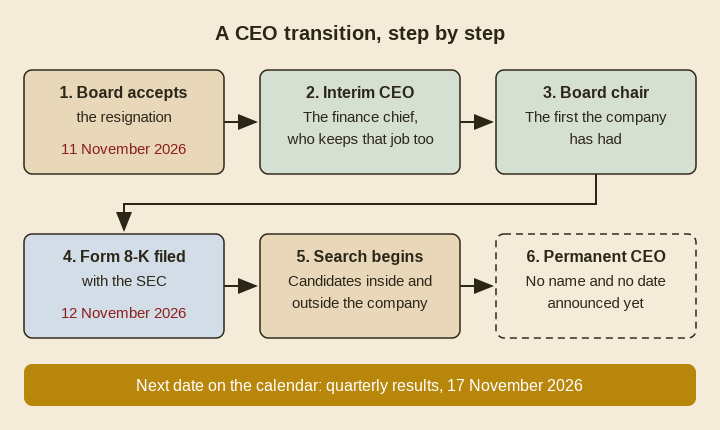 The steps Nvidia's filing and press release describe, in order. The last one has no date.
What did the company say about the reason?
Nothing. Neither the press release nor the 8-K gives a reason for the resignation. Neither mentions an investigation, a review, a health matter or a disagreement. That is what the two documents say, and it is all they say on the point.
Press reports are a separate matter, and this paragraph is the only place they appear. CNBC, and the Australian Associated Press in a story that drew on Reuters, reported that the resignation followed press reports earlier in November about Huang's personal conduct, and CNBC reported that the board had hired an outside law firm to look into them. Those are reports by news outlets. The company's announcement does not confirm them, and nothing here should be read as a statement of fact about his conduct.
On the share price, CNBC reported in a live page last updated at 5:38 p.m. Eastern time on 12 November that Nvidia stock opened more than 13% lower that morning and closed the day down 4.3%. It gave the previous day's closing price as $173.73. Those figures are CNBC's, read at that time, and later reports may differ.
What happens next?
The release names three things.
First, the search. The board says it "is initiating a search for a permanent Chief Executive Officer" and will consider candidates from inside and outside the company. It names no search firm and gives no deadline.
Second, the business. The board says it expects operations, customer commitments and the product plan to continue without interruption. That is a statement of intent by the board, not a measured result.
Third, a date. Nvidia says it will report results for the third quarter of its fiscal year 2027 on Tuesday, 17 November, with a conference call at 2 p.m. Pacific time, as already scheduled. The release contains no financial forecast.
If the board names a permanent CEO, or changes anyone's pay because of this, another 8-K will follow. That is where to look, before any headline.
What does Nvidia make, and why do its chips matter?
Nvidia designs graphics processing units, or GPUs. A GPU is a chip built to do a huge number of simple calculations at the same time. That talent was first used to draw video game pictures. It turned out to be exactly what training and running AI models needs, because that work is also millions of small sums done side by side.
The company's annual report says it was incorporated in California in April 1993. It describes itself today as "a data center scale AI infrastructure company." At the end of its last fiscal year it had about 42,000 employees in 38 countries.
The numbers show how far the business has moved from games. In the fiscal year that ended on 25 January 2026, Nvidia reported revenue of $215.9 billion, up 65% in a year. Sales to data centers, the warehouses of computers where AI runs, were $193.7 billion of that. Gaming was $16.0 billion.
| Data center | $193.7B |
|---|---|
| Gaming | $16B |
| All other | $6.2B |
Source: NVIDIA press release, 25 February 2026; all other is total minus the two named lines
Put another way, about nine of every ten dollars came from data centers. For example, of every $100 the company took in, roughly $90 came from data center customers and about $7 from gaming. That is why who runs Nvidia is a question that reaches well past the people who buy graphics cards for their own computers. A companion piece in this set, How to Find a Good GPU, covers the consumer side.
Huang led the company for all of that history. The annual report says he co-founded Nvidia in 1993 and served as president, CEO and director "since inception." He was 63 as of February 2026. Because one person held the job for 33 years, Nvidia has never before had to replace its chief executive.
How does a CEO change work at a public company?
A paired example helps.
Picture a family hardware store. The owner decides to step back. She tells her daughter over dinner, the daughter takes the keys on Monday, and the customers find out when they see a new face at the register. Nobody outside the family is owed an explanation.
A public company is different because strangers own it. Anyone with a brokerage account can hold Nvidia shares, and the law says those owners must be told about major events quickly and all at once. So the steps are formal.
| Step | Who does it | What the rules require |
|---|---|---|
| Accept the resignation | The board of directors | A board decision, recorded |
| Name someone to run the company | The board | An interim CEO can serve while a search runs |
| Tell the public | The company | A Form 8-K, generally within four business days |
| Find a permanent CEO | The board, often with a committee | No fixed deadline |
The board of directors is elected by shareholders to oversee management. Hiring the CEO, and removing one when it has to, is among its central jobs. An interim CEO is a caretaker with full authority and no promise of keeping the post. Boards often pick a senior insider, because that person already knows the business and the investors.
The Form 8-K is the piece most readers never see. The SEC's instructions say a company must generally file it within four business days of the event. Departures and appointments of top officers go under Item 5.02.
What are shareholders told, and what are they not?
Less than you might think, and this is the part that surprises people.
For a CEO who resigns, Item 5.02 of the form asks the company to "disclose the fact that the event has occurred and the date of the event." That is the whole requirement. It does not ask for a reason.
There is a stricter rule for one case. If a director leaves the board because of a disagreement with the company over its operations, policies or practices, the company must briefly describe that disagreement and give the director a chance to respond in writing. Nvidia's filing describes no disagreement.
For a new top officer, the form asks for more: the name, the position, the date, a short business background, and any material pay arrangement made because of the appointment. That is why the filing gives ages and career histories for Kress and Jones and almost nothing about Huang.
As a rule of thumb, an 8-K tells you what happened and when. It rarely tells you why. Silence about a reason is normal in these filings and proves nothing in either direction.
Tip
You can read any US public company's filings free on the SEC's EDGAR site. Search the company name, open the list of filings, and look for "8-K". The filing is short. The press release is usually attached as Exhibit 99.1.
What to remember
- Nvidia announced on 12 November 2026 that Jensen Huang resigned as president, CEO and director. The board accepted the resignation on 11 November.
- Colette Kress, the CFO, is interim CEO and keeps the CFO role. Harvey C. Jones is the board's first chair.
- The company gave no reason. Press reports about the background are reports, not company statements.
- The board is searching inside and outside the company and has set no deadline.
- Nvidia says its quarterly results will still be reported on 17 November 2026.
- A Form 8-K must state that a CEO left and when. It does not have to say why.
This account is current to the evening of 12 November 2026. For anything newer, read the company's own filings on the SEC's EDGAR site and the news page on Nvidia's investor relations site before relying on a headline.