Articles & BlogBy Trapper W. Brown6 min readOpinion
Opinion. The United States should not bring back compulsory national service, because the volunteer military does not need it, the bill would be enormous, and taking a year of a free person's life requires a better reason than anyone has offered.
Every few years someone proposes that all young Americans should owe the country a year: in uniform, in a conservation crew, in a classroom or a hospital. The idea is sincere. My answer is still no.
I have three reasons, and all of them come from the public record. The military is not short of volunteers. The cost of a universal program is large, and most of it would be paid by 18-year-olds, not taxpayers. And compelling a citizen's labor in peacetime is a serious thing that should need a serious cause.
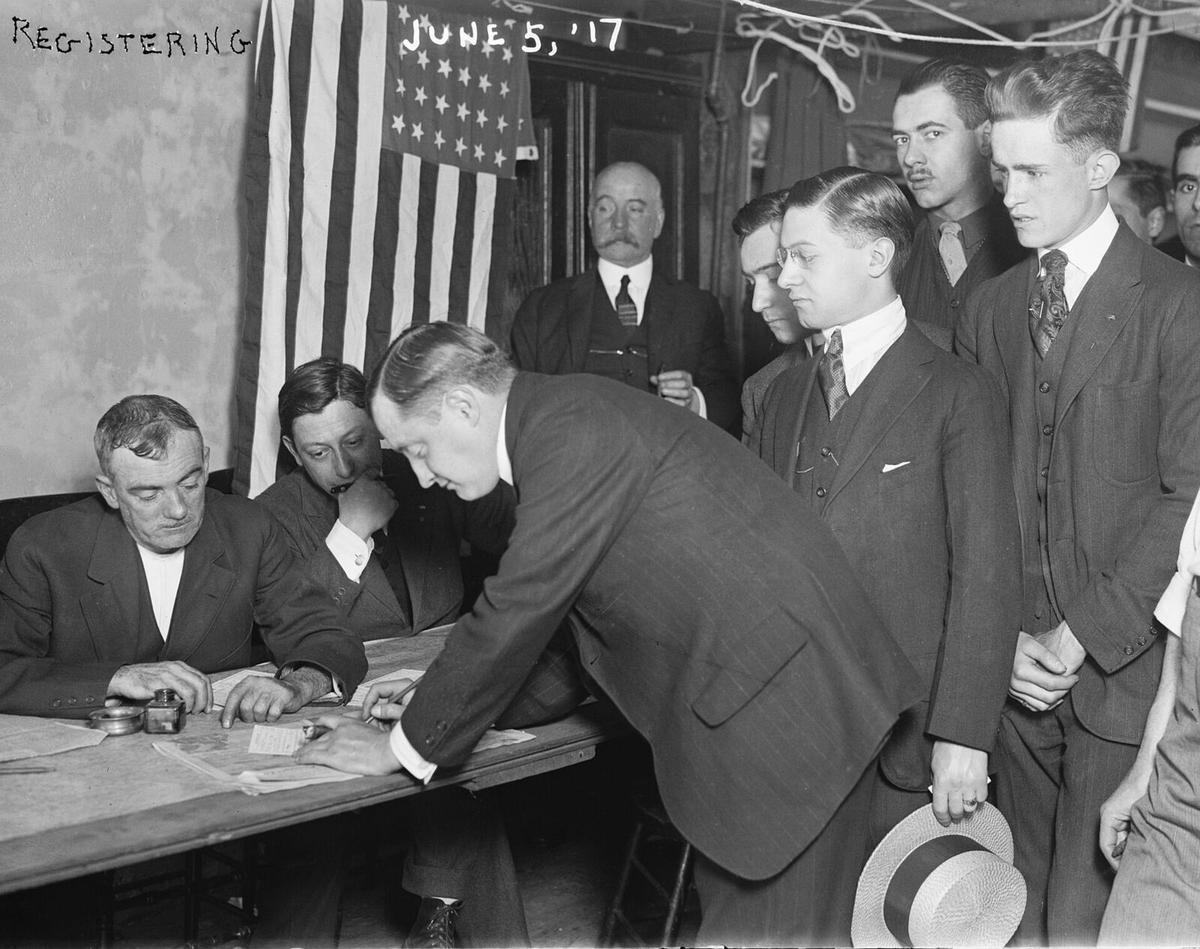 Young men register for military conscription in New York City on 5 June 1917. Photo published by Bain News Service, public domain, via Wikimedia Commons.
Does the military need it?
No, and its own studies say so.
The United States ended the draft in 1973. The plan came from a commission chaired by former Defense Secretary Thomas Gates, which wrote to the president in February 1970: "We unanimously believe that the nation's interests will be better served by an all-volunteer force, supported by an effective stand-by draft, than by a mixed force of volunteers and conscripts."
In July 2007 the Congressional Budget Office looked at how that had worked out. The office made no recommendation, which is its job. But its numbers are telling. In 1967, two-thirds of active enlisted personnel were in their first term. By the time of the study, roughly 46 percent had fewer than four years of service. Volunteers stay longer, and the same study says research "has consistently linked" time in service to better performance.
The force is also filling up. On 23 May 2026 the Army announced it had met its active duty recruiting goal for the fiscal year, with more than 61,500 contracts signed, four months early.
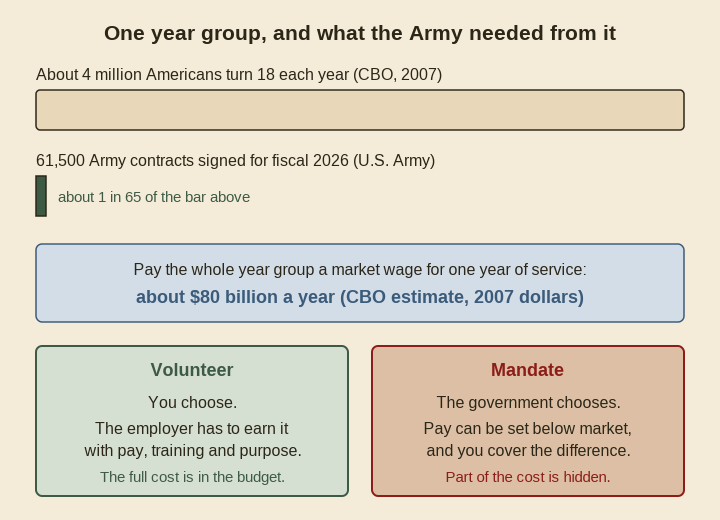 The Army's whole intake for the year is a sliver of one year's 18-year-olds.
Set that beside the size of a year group. The CBO put it at roughly 4 million 18-year-olds. The Army's 61,500 is about one in 65 of them. A mandate would not solve a shortage. It would create millions of extra placements a year and then have to invent work for them.
What would it cost?
The same CBO study did the arithmetic in a footnote. If roughly 4 million 18-year-olds were required to serve one year, in the military or in public service, and were paid what young full-time workers earn, the cost would be "approximately $80 billion a year." That was in 2007 dollars, and it was almost three-quarters of what the Pentagon spent from its military personnel accounts in 2006.
The usual reply is to pay them less. That does not make the cost go away. It moves it. The CBO describes the old draft as "an in-kind tax on inductees," because they were paid less than they could have earned and less than it would have taken to get them to sign up. For example, take an 18-year-old who could earn $30,000 in a year and is paid a $15,000 service stipend. The budget shows $15,000. The other $15,000 is a tax collected from one teenager.
There is a fairness point on the other side of the ledger, and the CBO records it: the budget cost of personnel has been higher under the volunteer force than under the Vietnam-era draft. I accept that. An honest price is the point.
What about liberty?
The Thirteenth Amendment says that "Neither slavery nor involuntary servitude, except as a punishment for crime," shall exist in the United States. In January 1918 the Supreme Court held that the wartime military draft did not violate it. The justices called military service a citizen's "supreme and noble duty" in "a war declared by the great representative body of the people."
I will not guess how a court would treat a peacetime civilian requirement. That case did not decide it. My point is simpler. The country already has the emergency tool. Men must still register with Selective Service at 18, and the agency says registration will become automatic by December 2026 under a law signed on 18 December 2025. The stand-by draft the Gates commission asked for exists. A year of everyone's life, on an ordinary Tuesday with no emergency, is a different request.
The strongest case for it
Is anything lost by leaving service voluntary? Yes, and the people who want a mandate have named it accurately.
Congress created the National Commission on Military, National, and Public Service to study this very question. Its March 2020 report gives the argument fairly: a required program "would help unify Americans through a common service experience, contribute to personal and professional growth, and aid in solving the Nation's problems." The CBO adds the concern "that not all segments of U.S. society are fully participating in the fighting." A country where a small share serves and the rest say thank you at airports has a real problem.
But the commission, after weighing that, concluded that policymakers "should make every effort to promote voluntary approaches to service, reserving mandatory service as a last resort only in response to national emergencies and to ensure the common defense." It also found something that undercuts the need for compulsion: "demand for national service that far outstrips the supply of funded opportunities." People are already asking to serve and being turned away.
What should change, and who should change it
Congress should fund the places before anyone talks about filling them by force. The commission's goal was one million federally supported national service opportunities a year by 2031. As a rule of thumb, you do not conscript for a job that has a waiting list.
A family and a country can read this the same way. A parent who wants a teenager to serve can point to a recruiter or a service program today. A country that wants more service can pay for more openings, and tell employers and colleges to give the year some weight.
Where I land
- The volunteer force is more experienced than the drafted one was, and the Army met its 2026 goal four months early.
- A universal year would cost about $80 billion in 2007 dollars at market wages, or the same amount hidden as a tax on 18-year-olds.
- The stand-by draft for a real emergency already exists.
- The commission Congress asked to study a mandate chose voluntary service, and found more willing people than funded places.
If those facts change, my answer could change with them. A war that volunteers cannot fill is what the registration system is for. Until then I would spend the money on openings for the people already asking.
Sources (8)
- Report of the President's Commission on an All-Volunteer Armed Force (Gates Commission), 6 February 1970
- Congressional Budget Office, "The All-Volunteer Military: Issues and Performance", July 2007
- U.S. Army, "U.S. Army meets FY26 recruiting goals", 23 May 2026
- National Archives, Thirteenth Amendment to the U.S. Constitution, ratified 6 December 1865
- Supreme Court of the United States, Selective Draft Law Cases, 245 U.S. 366, 7 January 1918
- Selective Service System, home page
- Selective Service System, "FY 2027 Congressional Budget Justification"
- National Commission on Military, National, and Public Service, "Inspired to Serve", March 2020