Articles & BlogBy Trapper W. Brown6 min readOpinion
Opinion. A child who can tell you anything is safer than a child who is secretly watched, so set the limits together and loosen them as the child grows.
If I could give a family one thing to keep a child safe online, it would not be an app. It would be a child who walks into the kitchen and says "someone sent me something weird" without first working out what saying so will cost.
Secret monitoring works against that. A hidden app that reads a child's messages teaches one lesson on the day it is found: the adults here are not to be told things. Limits that are chosen together, explained, and taken away with age teach the opposite. That is my position, and the rest of this column is the argument for it.
 The aim is a child who looks out at the world with you, not one who is watched from behind a screen. Photo by Andre Hunter, CC0, via Wikimedia Commons.
What does a hidden app actually buy you?
It buys a view of one device. It does not cover the friend's tablet, the school laptop, the console at a cousin's house or a second account you have never heard of. A child who wants to keep something from you only has to move to a screen you do not control.
The price is higher than it looks. The FTC's guide for parents, Kids and Video Games (January 2025), says parental controls and ratings are strong tools, "but they're no substitute for talking with your child about your rules and expectations." I would go one step past the FTC. Secret tools spend the trust that the talking depends on.
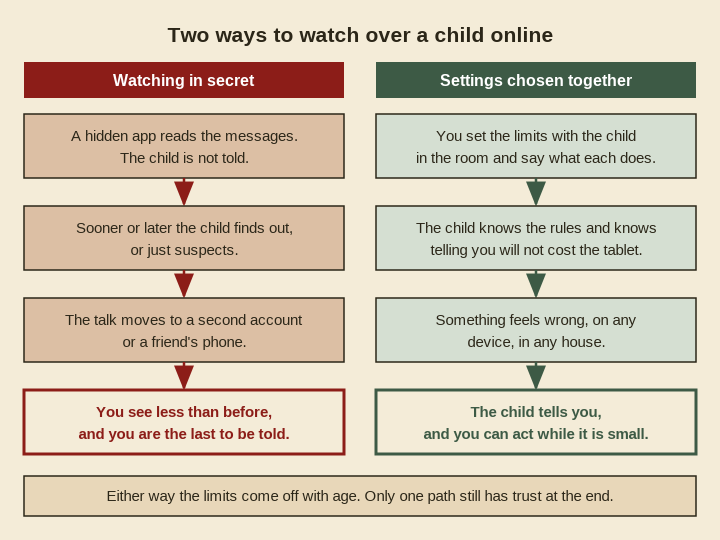 Where each choice tends to lead.
Think of it as a risk decision, since that is my trade. You gain coverage of one device. You put at risk the one reporting channel that covers every device your child will ever touch. At work I would never approve a control that makes staff stop reporting problems. A family is no different. The best sensor in the house is the child.
The case for looking
The other side has two strong points, and both deserve a straight answer.
First, young children need hard limits. A seven-year-old cannot judge a chat with a stranger and should not be asked to. I agree completely. The same FTC guide lists what the controls can do: limit harmful content, keep people a child does not know from contacting them, and cap time and money. For a young child, use all of them. The ESRB, which rates games, keeps a parental controls page with a setup link for each of the major consoles.
Second, some parents have found something serious only because they looked. That is true, and I will not pretend otherwise. If you have a real sign that your child is in danger, look, and act on what you find.
Here is my answer. Both points are arguments for limits and oversight. Neither is an argument for secrecy. A limit can be completely open: chat is friends only, purchases need my password, and I can see which apps you use. An FTC consumer alert on family screen time (June 2026) puts the family talk first and the tools second. It names the free ones built into most devices, Apple's Family Sharing, Google's Family Link and Microsoft Family Safety, and says they can be used to set time limits, restrict apps and content, and show a parent a child's website and app activity.
A child who knows you can see the app list is supervised. A child who learns you have been reading private messages for a year has been deceived. The information may be the same. What differs is what the child does next.
Even the emergency look can be honest if you say it in advance: "If I am ever seriously worried about your safety, I will look at your phone, and I will tell you that I did." A rule stated up front is not covert.
How fast should the limits come off?
Controls are scaffolding. They hold things up while the building is not ready to stand, and then they come down. As a rule of thumb, every birthday should remove at least one limit. The ages below are mine, not a standard, and your child may be ahead of them or behind.
| Rough age | Limits | What the child is told |
|---|---|---|
| Under 9 | Tight: ratings, time, no open chat, purchases off | These are the house rules |
| 9 to 12 | Friends-only chat, apps approved, activity summary on | Exactly what you can see, and why |
| 13 to 15 | Fewer blocks, time limits agreed together | What changed, and what would bring a limit back |
| 16 and up | Mostly conversation | You are nearly on your own, and you can still ask |
A company does the same with a new hire. For example, a new employee starts with narrow access, is told what is logged, and earns more with time. Nobody calls that distrust. Reading that employee's private messages in secret would be a different thing, and everyone in the building would know it.
What should change, and who should change it?
Parents first. Swap the question "how do I see everything?" for "what would make my child tell me?" Set the controls with the child in the room. Say what each one does. And never punish the telling, because a child who loses the tablet for reporting something will not report the next thing.
The makers of family tools come second. Openness should be the default. A supervised device should show plainly that supervision is on and what it covers, and stepping the limits down by age should be as easy as turning them on.
Third, the people parents ask for advice: schools, doctors, the relative who is good with computers. Lead with the conversation, and know where to send a family when something is wrong. If an adult is pressuring a child online, the place to report is the CyberTipline run by the National Center for Missing & Exploited Children, at report.cybertip.org or 1-800-843-5678 at any hour. If anyone is in immediate danger, call 911. Our article Kids Online: Settings and Conversations That Work has the full steps.
Where I land
- Hard limits for young children, yes. Hidden ones, no.
- A monitoring app covers one device. A child who tells you covers all of them.
- Say what you can see. Take a limit away every year.
- If you are truly worried, look, and say that you did.
None of this is as tidy as installing something. It takes repeating the same short conversation for years and staying calm when you hear things you would prefer not to. Tonight's version can be small: ask who they play with, and listen to the whole answer.