Articles & BlogBy Trapper W. Brown7 min readOpinion
Opinion. By 2046 intelligence will be cheap and everywhere, and what will be in short supply is proof, accountability and human attention, so those are what we should start building and protecting now.
Here is my forecast for 2046. Intelligence, the kind that answers questions, drafts documents and makes routine decisions, will be cheap and everywhere, like electricity. The things in short supply will be proof that something really happened, a person with time for you, and a name that answers for a decision.
I could be wrong about the details, and I will say how. But I think the shape is right, and the scarce things take years to build. That is why this is worth arguing about now.
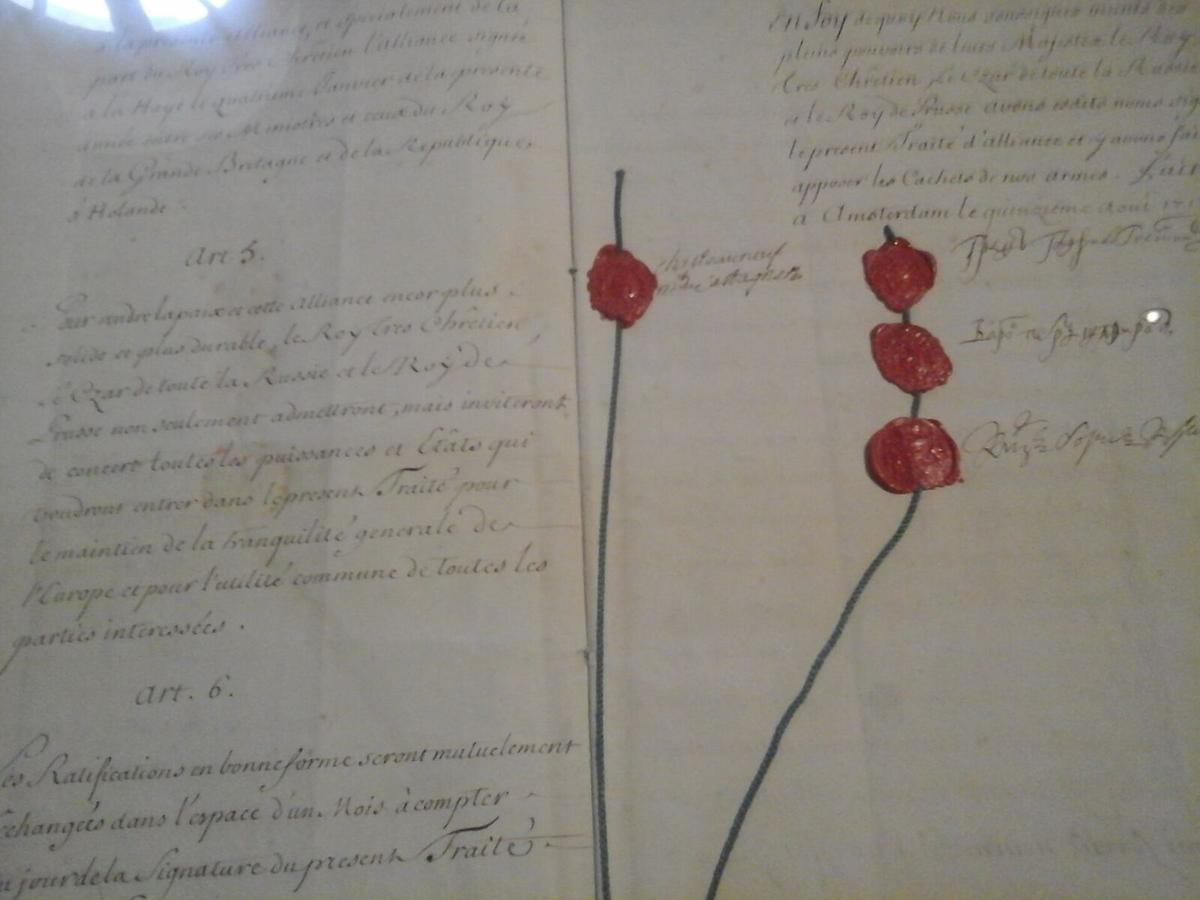 Before the camera, this is how a thing was proved: seals, signatures, and people who could be asked. Photo from the Archives du ministère des Affaires étrangères, Paris, public domain, via Wikimedia Commons.
Why forecast by scarcity and not by gadget?
Start with a date check. Twenty years before today is 2006. Amazon's own announcement of S3, its rented storage for the internet, is dated March 13, 2006. Apple's press release introducing the iPhone is dated January 9, 2007. So someone forecasting 2026 from 2006 was standing a few months before both, and almost nobody called the gadgets.
What a careful person could have called was simpler. Storage and computing were about to become very cheap, and a connected screen was about to be in every pocket. When something becomes cheap, the thing next to it becomes valuable. Cheap publishing made attention scarce. Cheap storage made privacy scarce. Our article Privacy Is Not for People With Something to Hide is about that second one.
So I will not guess at products. I will ask what gets cheap by 2046, and look beside it.
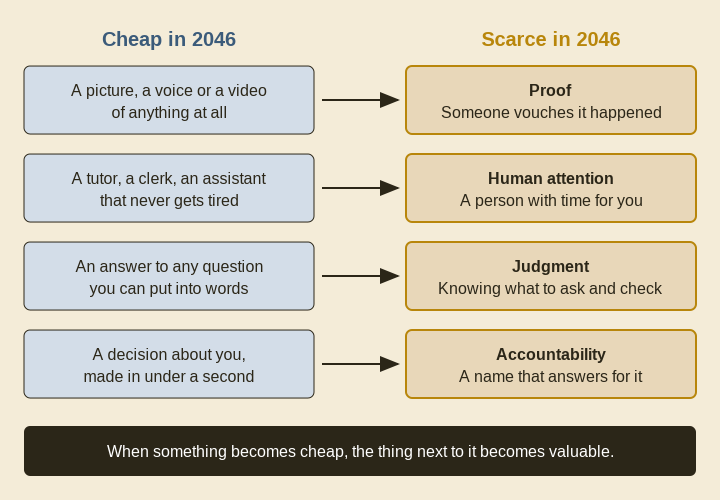 Four things that get cheap, and the four things beside them that do not.
What happens to proof?
For most of the time since the camera was invented, a photograph or a recording counted as evidence because faking one was hard. That period is ending. When a convincing picture, voice or video of anything costs nothing to make, a recording proves very little by itself.
We do not end up with no truth. We go back to the older rule, the one in the photo above: a thing is true because of who vouches for it and how it was handled. Signatures. Witnesses. Chain of custody, meaning a record of every hand the evidence passed through. I expect "a person was actually there" to become a service somebody is paid for, the way a notary is paid now.
For example, a family settling an estate and a company defending a contract will be asked the same question: where has this file been since the day it was made? The ones who kept originals, dates and a short list of who handled them will have an easy afternoon. The others will be holding a recording that anyone could have produced.
A security person recognizes this at once. It is authentication, the work of proving that something is what it claims to be, applied to everything. We already do it for sign-ins and software updates. By 2046 a family will do it for a phone call from a grandchild.
Who gets a person?
Today the cheap option is often a person and the premium option is the technology. I think that flips. The family with less money gets the machine tutor, the machine assistant at the doctor's office and the machine bank clerk. Those may be very good. The family with more money gets a person as well. Inequality in 2046 may be measured in access to humans.
I do not expect the machine versions to be bad. I expect them to be good enough that paying a person looks like waste on a budget sheet, and that is how a person becomes a luxury. A 12 person clinic will keep its front desk because the owner knows the patients. An 800 bed hospital system will be asked, every budget cycle, to justify each human voice on the phone.
The other half of this is stranger. When a capable assistant will do nearly any task you can describe, everyone has staff. The bottleneck moves to knowing what you want. The valuable skills become describing the task, judging the result and noticing what is missing. Schools mostly train people to produce the answer. They will need to train people to check one. Our article AI Will Not Replace Security Analysts, but It Will Replace the Ones Who Refuse to Use It makes the same case for one trade.
Too few jobs, or too few workers?
There are two fears about work, and they cannot both be the whole story. One says the machines will take the jobs. The other comes from the demographers, and it says there will not be enough workers.
The second fear has numbers behind it. The United Nations' World Population Prospects 2024 says that in 63 countries and areas, holding 28 percent of the world's people, the population has already peaked, and the number of people living in those places is projected to fall by 14 percent over the next thirty years. It also projects that by the mid-2030s there will be 265 million people aged 80 or older, more than the number of infants.
Both curves are real, and they arrive together. Which one a town feels depends on its trade and its age. For example, a town built around an insurance processing center and a town built around a hospital are heading into different decades. Nursing care and plumbing are not the same story as paperwork. A forecast that gives one answer for "jobs" is describing no particular place.
Who answers when the machine decides?
In my own field, attack and defense are both increasingly run by software, and I expect that by 2046 most incidents will be over before a person reads the alert. A faster human does not fix that. What protects you is the limits set in advance, and the person who signed for them. Our article We Are Handing AI Agents the Keys Before We Have Locks argues for those limits today.
The same goes for a loan, a claim or a job application decided in under a second. "The machine did it" must never be allowed to be the end of an explanation. Every automated decision needs an owner with a name. More than once I have sat in an incident review where the honest answer to "who approved this" was a shrug toward a system.
Of everything on my list, accountability is the scarcest, because it cannot be manufactured. You can copy a model a million times. You cannot copy the one person who has to answer for what it did.
What if this forecast is wrong?
It probably is, somewhere. Forecasts like this nearly always are. The technology may stall, and cheap intelligence may turn out to be 2060's story. Or it may go much further than I can picture and make all of this look quaint. Both are fair objections, and I have no evidence to rule out either.
My answer is that I am betting on people, not on tools. People need to be believed, to be heard, and to have someone answerable when things go wrong. Those needs change far more slowly than technology does. If the tools arrive late, the bets are early and still sound.
They are also cheap to act on now. A family can keep its important records in a form someone can vouch for, with dates and originals, and agree on a way to verify a strange call. A company can do the same with its contracts and its logs, and rehearse it. Both should keep at least one skill they can do without the machine. And when a system makes a decision about you, ask whose name is on it.
Where I land
- Forecast by what becomes cheap. The valuable thing is usually standing next to it.
- Proof goes back to who vouches and how it was handled. Learn to verify.
- A person's time becomes the premium product. Notice who gets it.
- Every automated decision needs an owner with a name.
A child born this year will be twenty in 2046. I have no idea what will be in that young adult's pocket. I am fairly sure they will need to prove something, want a person to listen, and ask who is responsible. We could have those three things ready.