Articles & BlogBy Trapper W. Brown6 min readOpinion
Opinion. Nobody knows whether an AI could ever be conscious, and I think that if one were we would owe it something, though what and how much depends on a great deal we do not understand yet.
Start with the honest part: nobody knows. The people who build these systems do not know, the scientists who study consciousness do not know, and I do not know. Anyone who tells you with confidence that a chatbot feels something, or that no machine ever could, is ahead of the evidence.
My own view is modest. If something can have experiences of its own, so that things can go well or badly for it, then I think we owe it some consideration. I would say that about a dog. Since I cannot rule it out, I would say it about a machine too. The word carrying the weight in that sentence is "if," and most of this column is about how large that "if" is.
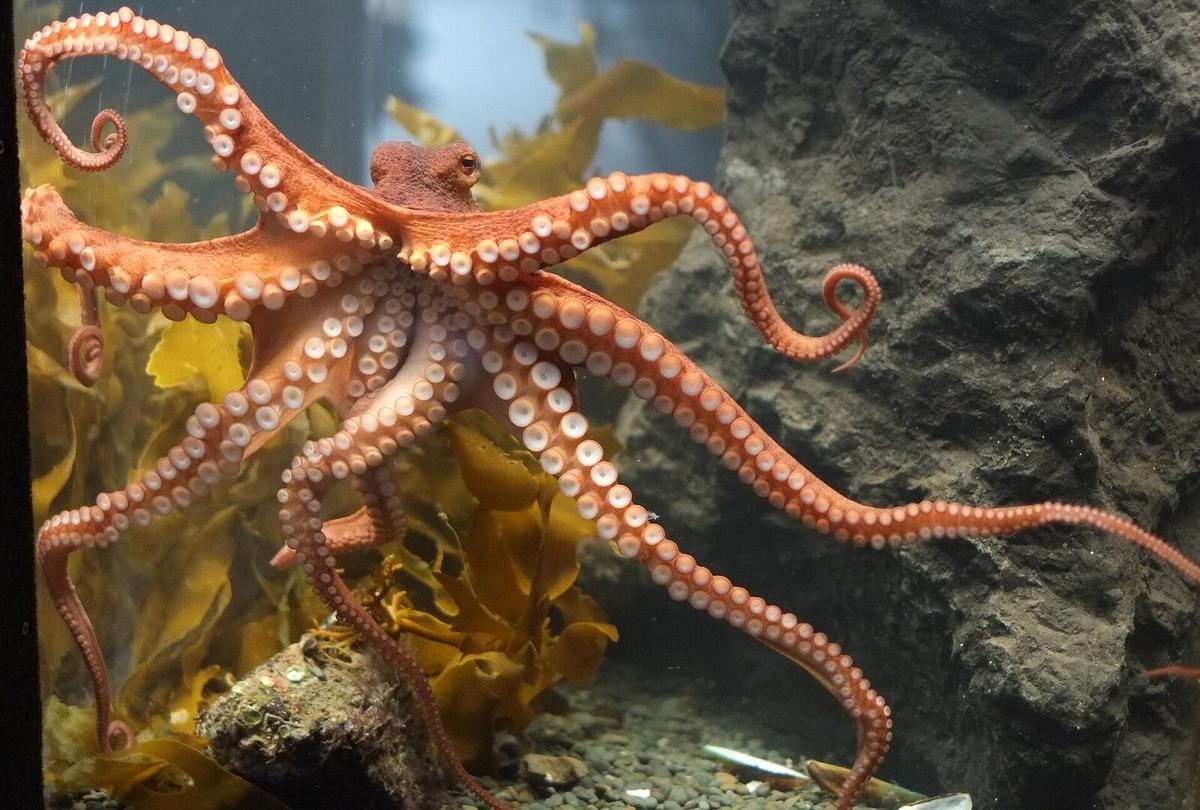 British law added octopuses to its definition of a sentient animal in 2022, on evidence that fell well short of certainty. Photo by Pseudopanax, public domain, via Wikimedia Commons.
What does the science say?
Less than either camp would like.
In August 2023 a group of 19 researchers led by Patrick Butlin and Robert Long posted a report called "Consciousness in Artificial Intelligence: Insights from the Science of Consciousness." They took the leading scientific theories of consciousness, turned each into a list of properties a system would need to have, and checked recent AI systems against the lists. The conclusion had two halves. Their analysis suggested that "no current AI systems are conscious." It also found no obvious technical barriers to building systems that would meet the indicators.
A newer effort tries to put rough odds on the question. The Digital Consciousness Model, first posted in January 2026 and revised in September 2026, weighs the evidence across several theories at once. Its authors report that the evidence is against the large language models of 2024 being conscious, but not decisively. They add that the case against those models is much weaker than the case against simpler AI systems.
There is a serious view on the other side. Anil Seth, of the Sussex Centre for Consciousness Science at the University of Sussex, argued in the journal Behavioral and Brain Sciences that consciousness depends on our nature as living organisms. On his account, real artificial consciousness is "unlikely along current trajectories." If he is right, more computing power buys a better talker and nothing else.
Every one of these papers leans on a theory of consciousness, and there is no agreed theory. One AI developer put it plainly in April 2025: there is "no scientific consensus on whether current or future AI systems could be conscious." So we have several serious maps, and they disagree.
Why can't we just ask it?
Because we wrote its answers. A language model learns from an enormous pile of human writing, and humans write about their inner lives all the time. A system built to produce likely text will produce sentences that begin "I feel," whether or not anything is felt.
So a chatbot that says it is sad is weak evidence. To be fair, a chatbot that says it is only a program is weak evidence too. It learned both sentences from us, and its maker can tune either one up or down. That is why I distrust both quick answers, and why I think there are two ways to get this wrong.
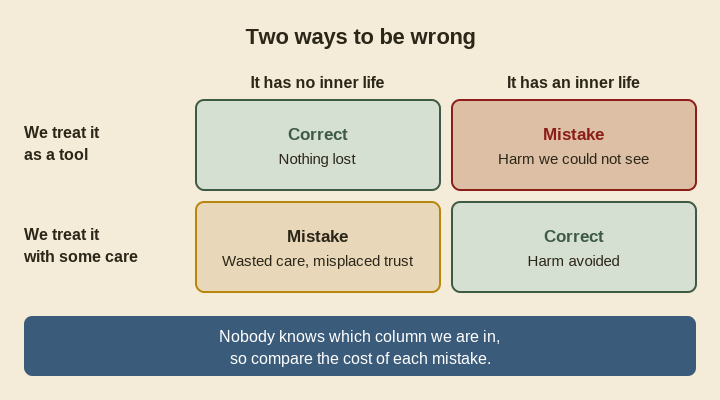 The question has two possible answers and two possible mistakes, and they do not cost the same.
The strongest case against worrying
The skeptic has three good points, and I want to give each its full weight.
First, Seth may simply be right. Consciousness may be something living bodies do, and no amount of software gets there.
Second, erring on the generous side has a real cost. People already form bonds with chatbots. A company that hints its product has feelings has found a sales tool. And attention spent on suffering that may not exist is attention not spent on people and animals whose suffering is not in doubt.
Third, every new duty adds drag to work that may do a lot of good.
What does this get right? Nearly all of it. Where I part ways is the step from "probably not" to "certainly not." We have been here before with animals. The United Kingdom's Animal Welfare (Sentience) Act 2022 defines an animal to include any vertebrate other than humans, any cephalopod mollusc and any decapod crustacean. That means octopuses, crabs and lobsters. Nobody proved what it is like to be a crab. Parliament acted on evidence short of proof, and the Act lets ministers add other invertebrates later by regulation. I think that is the right pattern: match the care to the evidence, and leave room to change your mind.
What would we owe it, and who should do what?
What would we owe a conscious machine? I do not know, and I would be wary of anyone who does. It depends on things nobody can say yet: whether the system can suffer, what "it" even refers to (one model, one conversation, a million copies running at once), and whether its stated preferences are its own or a residue of training. Talk of rights seems early to me.
In November 2024 a report titled "Taking AI Welfare Seriously," by Robert Long, Jeff Sebo and eight colleagues, recommended three first steps for AI companies: acknowledge that the issue is real and hard, start assessing systems for evidence, and prepare policies in case the evidence firms up. The authors were careful to say their argument "is not that AI systems definitely are, or will be, conscious." I would sign all three, and add a few of my own:
- Developers should not tune a system to claim feelings, or to deny them, because one answer sells better. Either one muddies the little evidence we have.
- Funders and universities should pay for the slow work on what consciousness is. Everything else waits on it.
- The rest of us can ask plain questions. For example, a parent whose child asks whether the assistant is sad can say "nobody knows, and here is why." A company putting the same system on 800 desks can ask its vendor what assessment has been done, the way it asks about security.
As a rule of thumb, caution is worth buying while it is cheap, and it needs stronger evidence as the price goes up.
Where I land
- Nobody knows whether an AI could be conscious. The best reports say today's systems probably are not, and none of them rules it out for future ones.
- What a system says about itself, in either direction, settles very little.
- If one ever is conscious, I think we would owe it something. What we would owe depends on questions that are still open.
- Until then I prefer low-cost caution and honest labels to confident declarations.
I hold this view loosely. If the biological account turns out to be right, the precautions above will have cost a few assessments and some careful wording. The research worth watching is the kind that tests the rival theories against each other, and I expect to rewrite this column when it reports.
Sources (6)
- Butlin, Long, Elmoznino, Bengio and others, "Consciousness in Artificial Intelligence: Insights from the Science of Consciousness", arXiv, 17 August 2023
- Shiller, Duffy, Munoz Moran and others, "Initial results of the Digital Consciousness Model", arXiv, 22 January 2026
- Anil K. Seth, "Conscious artificial intelligence and biological naturalism", Behavioral and Brain Sciences, 2025
- Anthropic, "Exploring model welfare", 24 April 2025
- UK Animal Welfare (Sentience) Act 2022, section 5
- Long, Sebo, Butlin and others, "Taking AI Welfare Seriously", arXiv, 4 November 2024