Articles & BlogBy Trapper W. Brown7 min readOpinion
Opinion. AI will not take the security analyst's job, but the analyst who uses it and checks its work will outlast both the one who refuses it and the one who believes everything it says.
Every few months someone tells me that AI is about to empty the security operations center. I do not believe it. I do believe something less comfortable: the job is changing fast enough that an analyst can be left behind while still showing up every day.
Three kinds of analyst are forming. One will not touch the tools. One uses them for sorting alerts, summaries and first drafts, then checks the work. One lets the tool decide and clicks approve. Only the middle one has a long career ahead, and the reasons are practical ones.
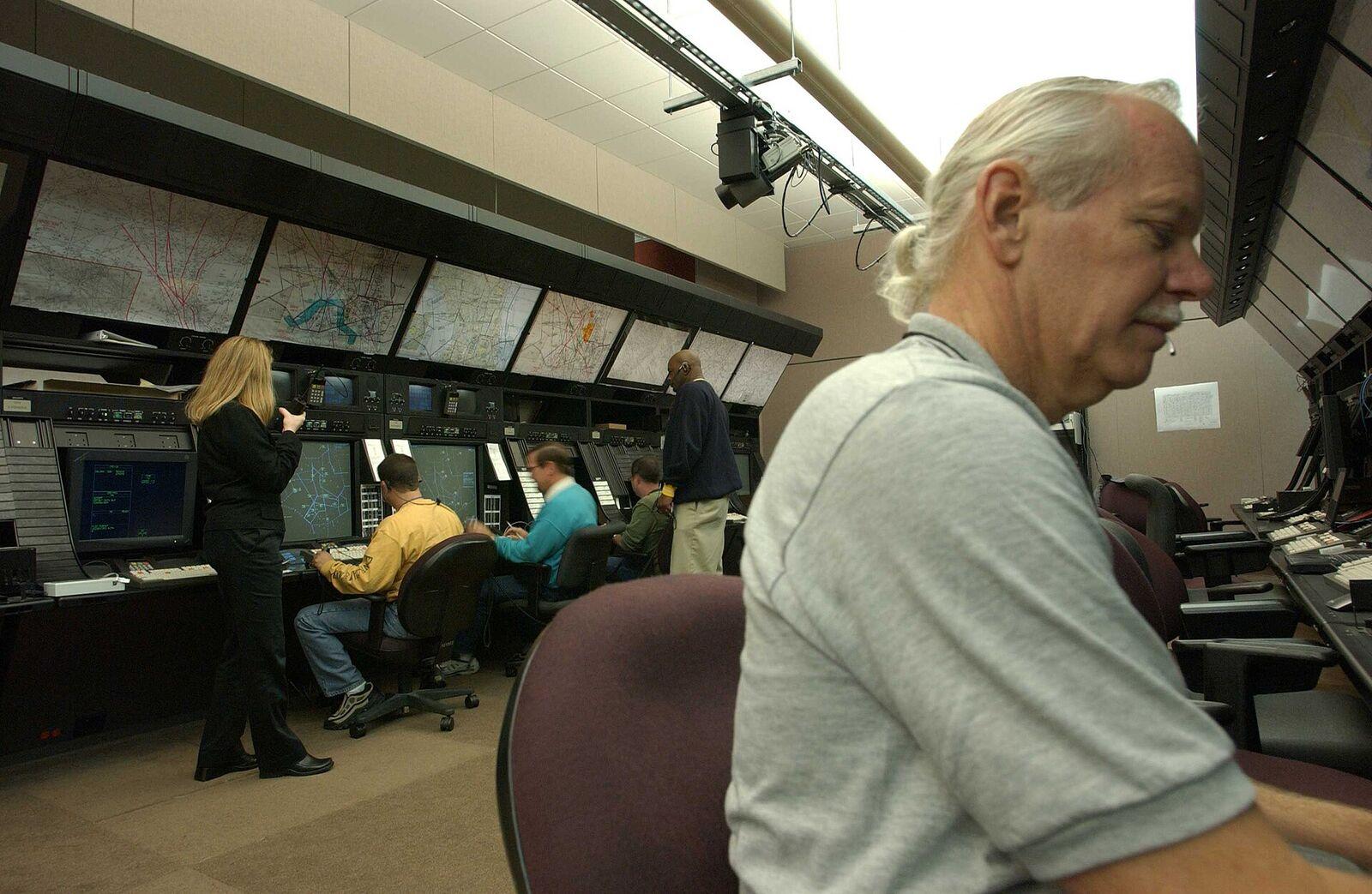
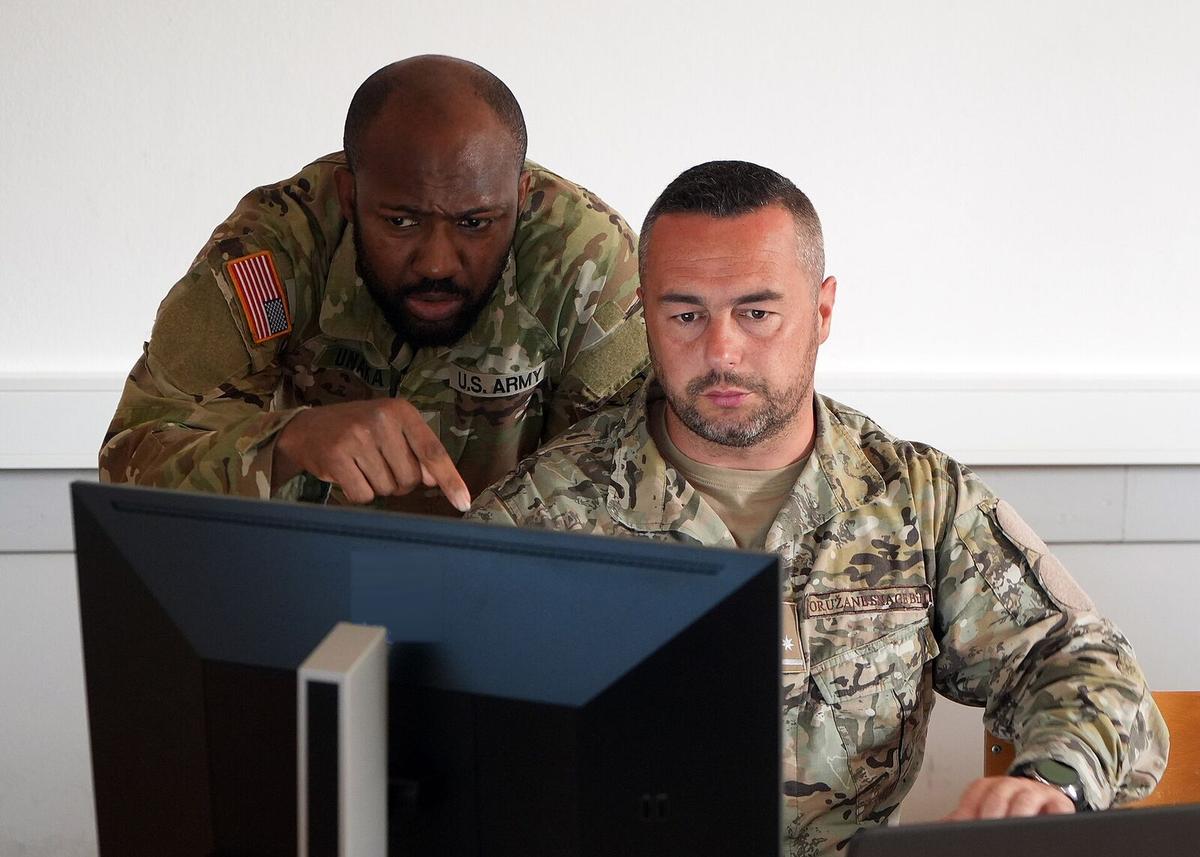 The part of the job that lasts: one person checking what another, or a machine, has concluded. U.S. Air National Guard photo by Maj. Benjamin Hughes, public domain, via Wikimedia Commons.
Is the job going away?
No, and the people doing the work say so. ISC2's 2025 Cybersecurity Workforce Study, published in December 2025 with 16,029 respondents, found that 59% of them reported critical or significant skills needs on their teams, up from 44% in 2024. In the same study 28% had already integrated AI tools into their operations, and with those testing or evaluating them the figure reached 69%. AI was the most pressing skills need, named by 41%. And 73% said AI will create more specialized cybersecurity skills.
Read those together. Teams are short of skill, they are adopting AI, and the skill they most want is the ability to work with it. Nobody in that survey is describing an empty room. They are describing a room where the work has moved.
What moves first is the sorting. A 12 person clinic with one IT generalist and an 800 bed hospital system with a staffed operations center have the same problem at different sizes: more alerts than attention. Sorting alerts, summarizing a long log, drafting the first version of an incident note: a machine does these quickly and tolerably well. More than once I have watched a careful analyst lose a day to a queue that a first-pass sort would have cut in half. I would not call that rigor. I would call it being buried.
The strongest objection: where does anyone start?
Here is the other side at its best. The tasks AI does well are exactly the tasks we used to hand to beginners. Watching the queue, closing the false alarms, writing the routine ticket: that was the apprenticeship. Automate the first rung of the ladder and you may have nobody to promote in five years.
This is a fair worry, and the people inside the field share it. In an ISC2 survey of 436 security professionals published in July 2025, 52% said AI will significantly or somewhat reduce the need for entry-level staff. Only 31% expected it to create new kinds of entry-level and junior roles. In the same survey 44% said their organization's hiring had not yet been affected.
| Will reduce need for entry-level staff | 52% |
|---|---|
| Hiring not yet affected | 44% |
| Will create new entry-level roles | 31% |
Source: ISC2 survey of 436 cybersecurity professionals, July 2025
So what does the objection get right? The old first rung is going. I will not pretend otherwise. A manager who stops hiring juniors because a tool closes tickets is saving money this year by spending the team's future.
Where it goes wrong is in treating the sorting as the point. The queue was only the place where beginners picked up judgment: what normal looks like, and when a quiet alert matters. That can be learned on a different task. Put the junior analyst on reviewing what the tool decided. Why did it close these forty alerts, and was it right about each one? That is harder than clicking through a queue, and it teaches more.
It is also affordable. ISC2's 2025 hiring trends report, a survey of 929 hiring managers, found that 56% said training an entry-level hire to handle tasks independently typically takes four to nine months. That is a short wait for someone who will check the machine's work for the next decade.
Why do the refuser and the believer fail the same way?
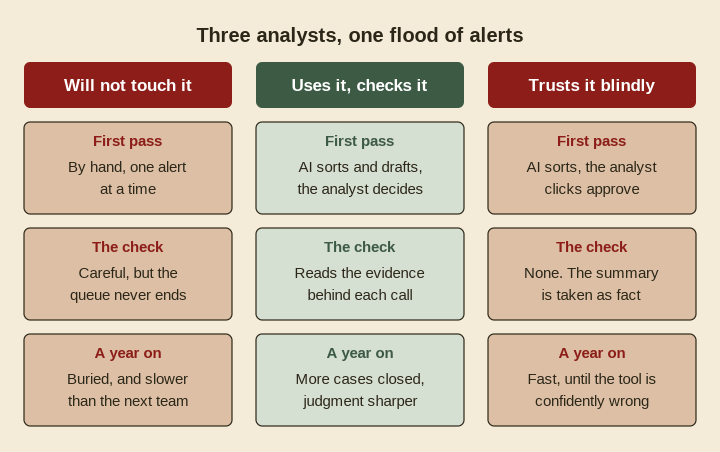 Two ways to fail and one way to last. The difference is in the middle row.
The analyst who refuses the tools and the analyst who trusts them blindly look like opposites. They share one mistake: neither is doing analysis. One spends judgment on work that does not need it. The other has stopped using judgment at all.
The believer is the more dangerous of the two. NIST's profile of the risks of generative AI (NIST AI 600-1, July 2024) has a name for the core problem, confabulation: "the production of confidently stated but erroneous or false content." A summary of an incident reads the same whether the tool found the cause or made one up.
For example, a tool reports "no sign of data leaving the network." It may be describing only the logs it was given, and nobody gave it the firewall logs. An analyst who checks will ask what it looked at. An analyst who does not will paste that sentence into a report for the board.
As a rule of thumb, let the tool go first and never let it go last. It may sort, summarize and draft. A person reads the evidence behind any call that closes a case, touches a patient system or leaves the team. A person also decides what goes into the tool to begin with, which this site covered in AI Assistants at Work: What Not to Paste In.
What should change, and who should change it?
Security leaders first. Keep hiring juniors, and rewrite the job: less queue watching, more review of automated decisions, with a senior analyst signing off. I have sat in the meeting where a team was told to do more with the same headcount, and nobody in the room could say which work would stop. A tool that sorts the queue is an answer to that question. Use it to free people for analysis, and say so in the budget.
Analysts next. Learn the tool your employer approved, and learn where it fails. Keep a short list of the times it was confidently wrong. That list is worth more in an interview than a line on a resume saying you "use AI."
Then the people who train newcomers: schools, certification bodies, whoever writes the lab exercises. Teach checking. Hand students a machine-written incident summary with two errors planted in it and grade them on finding both.
Last, whoever approves the tool should own the risk of using it. Which decisions may it make alone, and which need a person? That is a business decision about acceptable risk, and someone with authority should sign it. It should not be settled by whichever analyst happens to be on shift.
Where I land
- The job is not vanishing. Teams report more skills gaps than they did a year earlier, and the skill most in demand is working with AI.
- The entry-level worry is real. The answer is a new first rung built on reviewing the machine's work, and it only exists if managers keep hiring.
- Refusing the tools and trusting them blindly are the same failure, because in both cases no analysis is happening.
- Let the tool go first, never last.
If you are early in your career, pick one task this week, a log summary or the first draft of a ticket, and do it twice: once with the approved tool and once by hand. Compare the two line by line. Write down where they differ, and bring the list to your next one-on-one.