Articles & BlogBy Trapper W. Brown6 min readOpinion
Opinion. A company that lets AI absorb its entry-level work without replacing the training that work provided is spending its own future senior staff, and should have to account for that as a risk.
AI is taking the bottom rung off the career ladder, and most of the companies removing it believe they are only saving money. They are also closing a school. The entry-level job was where the next decade's senior people were made, and almost nobody has budgeted for making them some other way.
My position is that this is a risk like any other. It belongs on the risk register, with an owner. A firm that automates its junior work and keeps no way of growing experienced people is borrowing against its own future. That may even be a sensible loan. Right now nobody is writing it down.
 A petty officer walks an airman apprentice through a fault on a real part. This is what the first rung looks like when somebody is standing on the second. U.S. Navy photo by Mass Communication Specialist 3rd Class Patrick Heil, public domain, via Wikimedia Commons.
What did a junior job actually produce?
Two things, sold as one. The first was cheap output today: the first draft, the ticket queue, the reconciliation, the log review nobody else wanted. The second was an experienced person five to ten years later, someone who had made small mistakes on small things and learned what wrong looks like. That is how I learned this trade: by doing the dull parts of it, with someone more experienced checking what I found.
Only the first product ever appeared on a report. The second was a byproduct. Nobody was billed for it and no budget line carried it, so nobody notices when it stops being made. AI replaces the first product very well. It does nothing about the second.
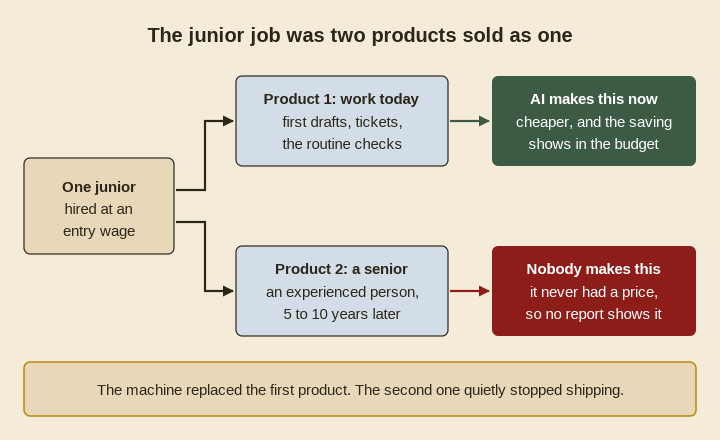 One hire used to deliver both. The saving is visible and the loss is not.
The early numbers fit that picture. Researchers at the Stanford Digital Economy Lab, working from payroll records that cover millions of US workers, reported in a paper revised in August 2026 that employment of 22 to 25 year olds in the occupations most exposed to AI stands 19% below where it would be had it kept pace with their less exposed peers. Experienced workers show no comparable gap. The gap comes mainly from reduced hiring, not from people being let go. The authors are careful. They find no economy-wide job loss, they say the pattern weakens when they control for education, and they call their findings early, descriptive signs and not proof of cause. I read it the same way. Nobody is being marched out. The door is simply not opening.
The Federal Reserve Bank of New York tracks the same door from the other side. In the third quarter of 2026 it put unemployment among recent college graduates at 5.2%. Its data file has all workers at about 4.0%. When that series began, in 1990, the order was reversed: 3.4% for recent graduates and 5.1% for everyone.
Why would sensible firms all make the same mistake?
Because for each of them, alone, it is not a mistake. Training is expensive and trained people leave. So the tidy plan is to stop training and hire seniors that somebody else trained. One firm can do that. If every firm does it, there are no seniors to hire.
In my trade we would call that a supplier with a ten year lead time, and everyone has quietly cancelled the order. Vendor reviews ask where a critical part comes from and what happens if the only source dries up. Nobody asks where the lead engineer of 2036 comes from.
For example, a 12 person clinic has never grown its own specialists. It hires the one biller or the one IT person that a bigger shop trained. An 800 bed hospital system is that bigger shop. Its entry-level analysts and coders go on to staff half the small offices in the region. When the system stops hiring at the bottom, the clinic does not get a vote.
Has anyone solved this?
Medicine has, and in the open. Nobody pretends a first-year resident pays their own way, so residency is funded on purpose. The Congressional Research Service, in an August 2025 overview, estimated that Medicare paid $21.2 billion for graduate medical education in fiscal year 2023, toward costs such as resident stipends and supervising physicians' salaries. It adds that the payments are not meant to cover a hospital's full cost of training.
People argue about whether that formula is right. What I notice is that the argument exists at all. One profession decided that an experienced practitioner is a product, put a price on it and assigned the bill. Most other fields, mine included, got their seniors free, as a side effect of grunt work. The grunt work is leaving.
The other side: is a junior with AI not better off?
This is the strongest objection and a good deal of it is right. The productivity is real. A junior with a good assistant can ask at 2 a.m. the question that once needed a patient senior, and can see more cases in a year than a junior once saw in three. The Stanford paper itself reports that where AI complements the work, employment is flat or rising. Earlier automation scares, from the cash machine to the spreadsheet, did not end bank or bookkeeping careers the way people predicted. And no firm owes anyone a job that a machine does better.
I accept all of that. It tells us what the junior role should become. It does not tell us we can do without one. A junior with AI learns faster only if there is a junior. The earlier technologies changed the tasks on the first rung and left the rung in place. This time the rung itself is what is being automated.
What should change, and who should change it?
Managers should redesign the entry-level job from "produce the draft" to "check the machine's draft and say why it is wrong." That is closer to what seniors do all day, and it teaches judgment faster than typing ever did. Our article AI Will Not Replace Security Analysts, but It Will Replace the Ones Who Refuse to Use It makes the same case for one profession.
Risk owners should put bench depth on the register with a named owner, next to every other supplier risk. For each role the business cannot run without: how many people are in training for it, and how long does it take to grow one?
Boards should ask for two numbers on the same slide: the savings from automation, and the count of people in training. If the second number is zero, the first one is overstated.
Where I land
- The entry-level job made two products, and AI replaces only the one that had a price.
- Each firm is sensible to stop training. All of them doing it at once is how a shortage gets built.
- Medicine funds its trainees on purpose. Other fields will have to choose to, because the free version is ending.
- Running without a bench is a risk someone can accept. It should be accepted by a named person, in writing.
If you run a team, count the people on it with less than three years of experience, then count the people you expect to retire or leave in the next ten. If you are at the start of a career, ask in the interview who will review your work and how often. The answer says a lot about whether the rung is still there.