Articles & BlogBy Trapper W. Brown6 min readOpinion
Opinion. Letting AI take over customer service is acceptable on two conditions: the company is bound by what its machine tells you, and you can always reach a person with the power to fix the problem.
Customer service is the first job AI is truly taking over. I do not mean in a forecast. I mean that when you contact a bank, an airline or a phone company today, the first thing that answers is often software, and more and more often it is the last thing too.
I am fine with that, on two conditions. The company is bound by what its machine tells you. And you can always reach a person who has the power to fix the problem. Meet both and the bot is a faster front desk. Miss either and it is a way of not being home when customers call.
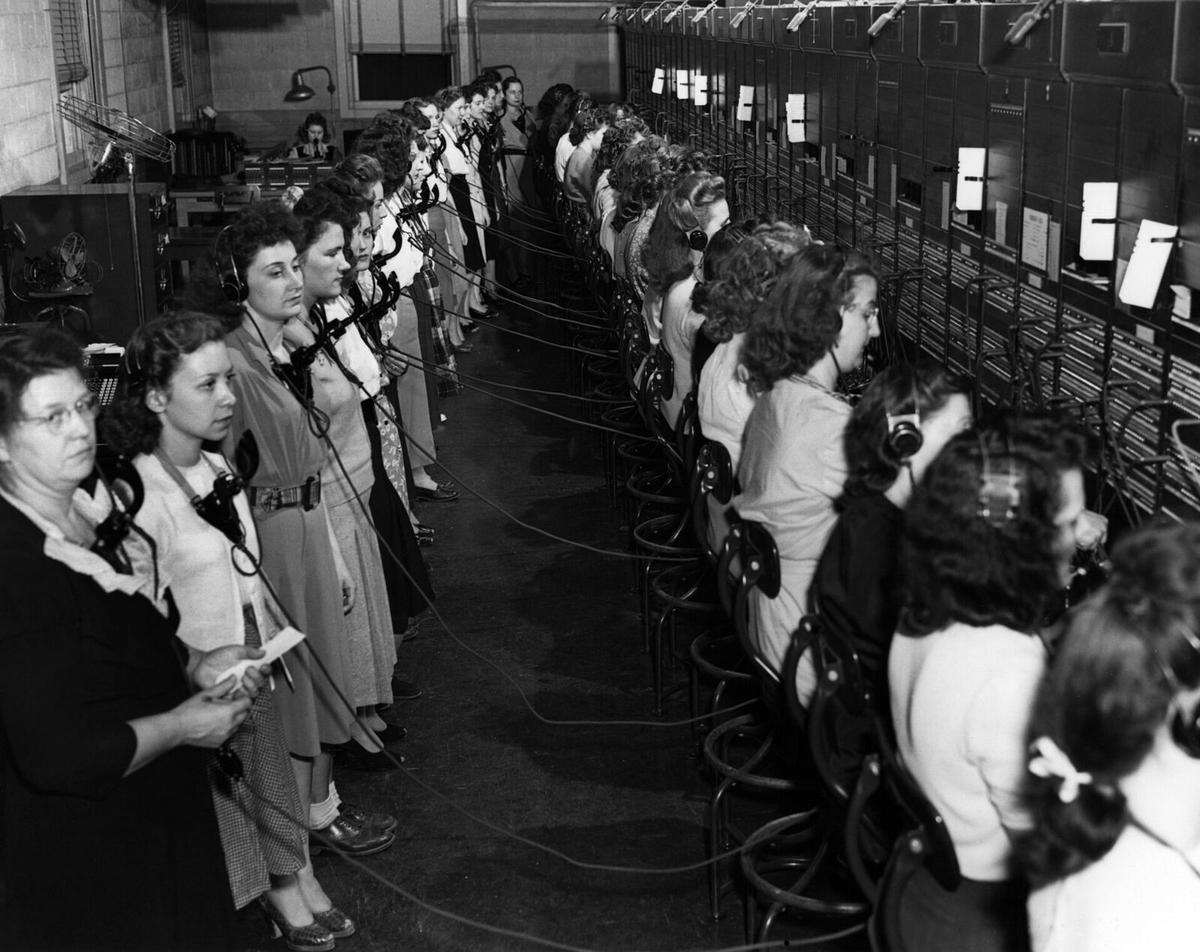 Shift change at the Oak Ridge, Tennessee switchboard in 1946: one person on every line and another standing behind her. Photo by Ed Westcott, U.S. Department of Energy, public domain, via Wikimedia Commons.
What was support really for?
The takeover shows what the job always was. Answers were cheap long before AI. Opening hours, baggage limits and how to reset a password have been on a web page for twenty years.
What a customer needs when something has gone wrong is different. They need someone with the authority to make an exception: waive the fee, reverse the charge, rebook the flight. A bot with no authority is a wall with good grammar.
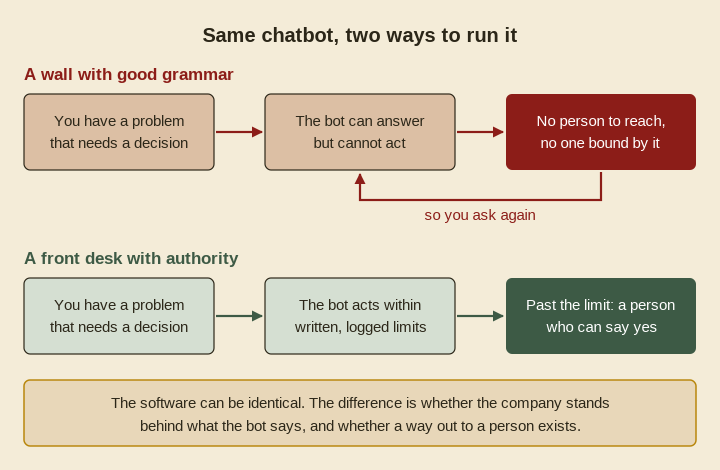 Nothing in the top row is a technology problem. Every box in it is a decision somebody made.
The US Consumer Financial Protection Bureau described the top row of that diagram in a June 2023 report on chatbots in banking. It reported that more than 98 million people used a bank's chatbot in 2022, about 37% of the US population. It also gave the failure a name: "doom loops," where a customer goes around in circles with no exit to a human. And it warned that a chatbot may fail to recognize that a customer is invoking a legal right.
Can a company disown its own bot?
One has tried, and there is an official record of how it went. In February 2024 British Columbia's Civil Resolution Tribunal decided Moffatt v. Air Canada, a small claim. According to the decision, Mr. Moffatt was booking a flight after a death in the family and asked the chatbot on the airline's website about bereavement fares. The chatbot said a reduced rate could be requested after travelling, within 90 days of the ticket being issued. Another page on the same website said the opposite, and the airline did not pay.
The airline argued that it could not be held liable for information its chatbot provided. The tribunal member wrote that this amounted to suggesting the chatbot was a separate legal entity responsible for its own actions, and called it "a remarkable submission." The member found that the airline was responsible for all the information on its website, whether it came from a static page or a chatbot, and that it had not taken reasonable care to make the chatbot accurate. The order was to pay $650.88 in damages, plus interest and fees.
That is one small claims ruling in one Canadian province. It binds nobody else. I cite it because the reasoning is hard to improve on. If a company puts a machine at its front door, what the machine says is what the company said.
Who still gets a person?
The quiet risk is an inversion. Talking to a human becomes a premium feature. The customers who pay the most get a phone number and a name. Everyone else gets the machine.
That should bother us for a practical reason. The customers with the least money are the ones whose problems most often need an exception: the late fee that triggers another fee, the payment applied to the wrong account. They are also the ones who can least afford an afternoon in a loop. And a company that measures how many contacts the bot "contained" cannot tell a solved problem from a customer who gave up.
Customers have noticed. In a Gartner survey of 3,566 customers taken in February and March 2026, 50% said their interactions are easier when a company uses generative AI. In the same survey, 87% said it is essential that the company offer a way to reach a human agent.
The other side: is the bot not simply better?
Often it is, and the half of that survey I just skated past says so. No hold music. An answer at 3 a.m. Most questions really are simple, and a machine answers them the same way every time without getting tired. Call center work is hard, the turnover is high, and I do not think anyone grew up wanting to read a refund policy aloud for the fortieth time in a shift.
All of that is right. None of it conflicts with my two conditions. A bot can handle the simple questions and still hand the hard one to a person. A company can save the money and still stand behind what its software said. The objection only bites if the savings depend on the customer giving up.
What should change, and who should change it?
Three things, and each has an owner.
Whoever runs support should give every customer a visible "get a person" path that is not a maze. One step, stated at the start, with the conversation handed over so nobody repeats themselves.
Whoever runs legal and the business should commit, in writing, to honor what the bot tells a customer. If that promise sounds frightening, the bot is not ready.
And whoever owns security should treat the bot as a new employee. This is the part from my own trade. A support bot that can issue refunds, change an address or reset access is a path to account takeover, and people will try to talk it into things, as our article Prompt Injection: The New Phishing, Aimed at the Machine explains. A bot that can do nothing is useless. So its authority has to be designed: what it may do, up to what amount, after which checks, with every action logged. Then a named person signs for it. More than once I have reviewed a new support tool and found that nobody could show me, in writing, what it was allowed to do.
Where I land
- AI taking the first line of customer service is fine. Taking the last line is the problem.
- What the bot says, the company said. A tribunal has already put that in plain words.
- A human with authority must be reachable by every customer, including the ones who pay least.
- The bot's powers should be written down, limited, logged and signed for, like any employee's.
The next time a chatbot gives you an answer that matters, take a screenshot. Then ask it for a person and count the steps. A company that has done this properly will not mind either one.